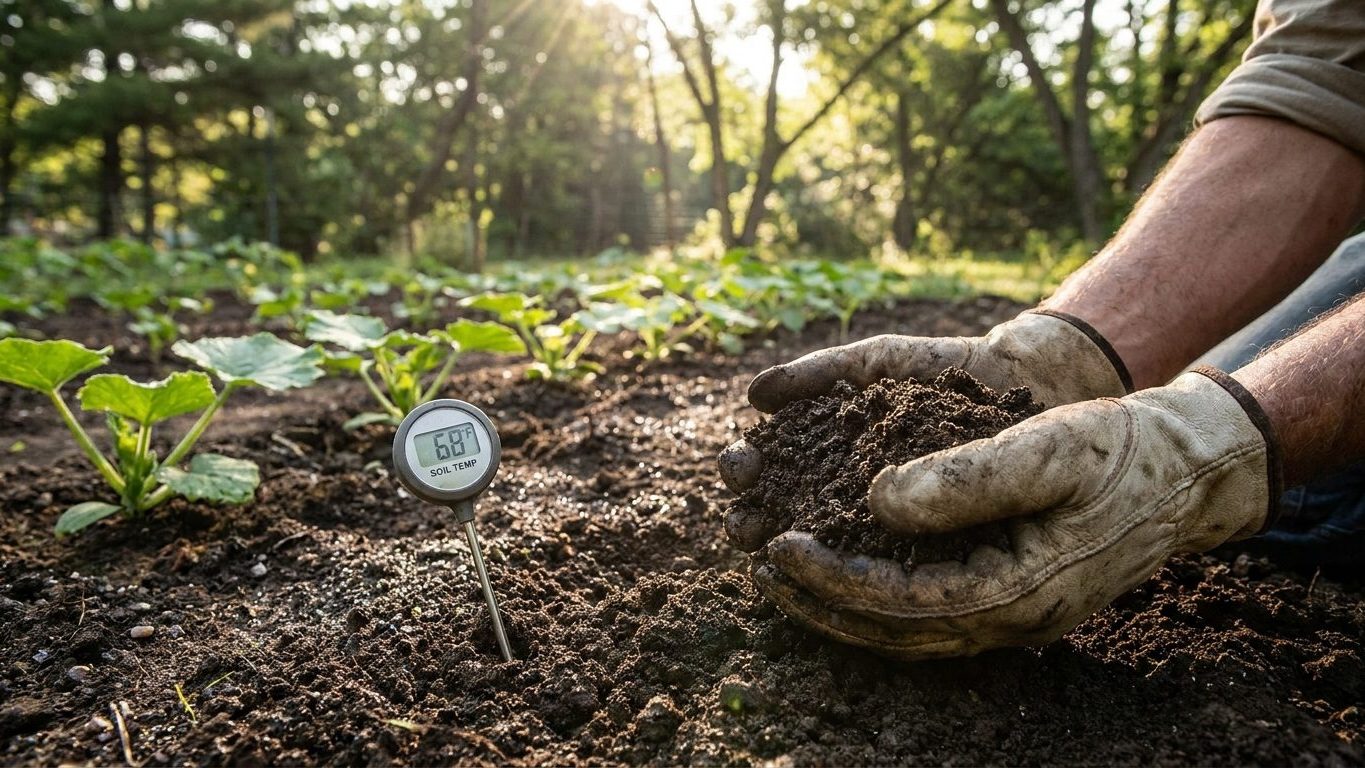

The short answer for Ohio is to get winter squash into the ground after May 15, once soil has lost its early-spring chill, and to have harvest wrapped up before frost returns in early-to-mid October. That’s the calendar version. The real answer depends on which frost dates apply where you garden and which variety you’ve chosen to grow.
The short answer for Ohio
Ohio State University Extension’s Ohio Gardening Calendar puts the last spring frost for zone 6a at May 5 to May 15, and the first fall frost at October 5 to October 15. Those aren’t guarantees. They’re probability dates, the point at which the odds of a damaging frost drop to a level most gardeners are comfortable planting around. Plant on May 5 in a cooler pocket and you’re accepting more risk; wait until May 15 and you’re playing it safer, at the cost of a shorter growing season.
Do the math on that window and you get somewhere between 143 and 163 frost-free days, depending on which end of each range you land on. That’s the budget winter squash has to work with in central Ohio. Most winter squash varieties, from acorn to butternut to the larger hubbard and kabocha types, need somewhere in the range of 80 to 110 days from seeding to harvest. A 143-day season handles even the slower varieties with room to spare, as long as seeding happens promptly once frost risk clears rather than drifting into June.
What this means for sowing dates
Direct-seeding outdoors after May 15 is the straightforward path for most of the state, since squash seed rots in cold, wet soil and gains nothing by going in early. Gardeners who want a head start, particularly for the longer-season winter squash types, can start seed indoors three to four weeks ahead of their expected last frost and transplant out once nights stay reliably above 50°F. That shaves a few weeks off the outdoor clock without exposing tender seedlings to a frost they can’t survive.
The tighter the reader’s actual last-frost date sits toward May 15 rather than May 5, the more that transplant head start matters, especially for anyone growing a variety on the slower end of the maturity range.
What will not work here

Picking a long-season variety and planting it late is the single most common way winter squash fails in Ohio gardens. If a gardener waits until Memorial Day to get seed in the ground and then chooses a variety needing close to 110 days, that fruit is racing an October 5 frost with almost no margin. A cold snap on the early side of that window, or even a stretch of overcast, cool September weather that slows ripening, and the harvest comes in underdeveloped, with thin skins that won’t cure or store.
Heat and dryness cause a different kind of failure. Columbus averages 15.3 days a year at or above 90°F, and that heat load falls right in the middle of the season when squash vines are setting fruit. Summer rainfall averages about 12.7 inches across June, July and August, but it isn’t spread evenly: June brings 4.33 inches, July 4.67, and August drops to just 3.74, the driest of the three months and often the hottest stretch too. A gardener watering once a week on a fixed schedule, the way many vegetable gardens are managed, can find that schedule badly mismatched to an August heat spell. Vines stressed for water during flowering commonly drop blossoms before they ever set fruit, and existing fruit can stall or soften.
Whether that rainfall total is actually enough depends heavily on soil. A sandy garden bed can lose an inch of rain within a day, while heavy clay holds the same inch for a week or more. That means two gardens receiving identical rainfall can need completely different watering routines, and a watering plan built around the regional average without accounting for the reader’s own soil texture is likely to under- or overwater.
Crowding plants in is the third common mistake, and it compounds the moisture problem rather than solving it. Winter squash vines already sprawl, and tight spacing traps humidity around the leaves during Ohio’s wetter June and July stretches, which is exactly the setup powdery mildew needs to take hold. Wide spacing that lets air move through the planting matters more here than in a drier climate, where fungal pressure is lower to begin with.
What changes across Ohio
Ohio sits across USDA hardiness zones 5b through 6b, a two-zone spread built entirely from one measurement: the average coldest temperature a location experiences in a typical winter. That’s a wide enough range that there’s no single “Ohio answer” to when it’s safe to plant. A garden in the coldest 5b pockets, generally the higher, more exposed parts of the state, is working with a meaningfully shorter frost-free window than a garden in the warmest 6b areas, typically found along the Ohio River valley in the south.
The frost dates cited above, May 5 to May 15 for spring and October 5 to October 15 for fall, apply specifically to zone 6a, which sits in the middle of that statewide range. Gardeners in colder 5b zones should expect their own last frost to arrive later than mid-May and their first fall frost to arrive earlier than October 5, squeezing the season from both ends. Gardeners in the warmer 6b areas can generally expect the reverse: an earlier safe planting date and a later fall frost, stretching the window out.
Elevation and proximity to Lake Erie both play into this beyond simple north-south geography. Higher ground tends to run colder regardless of latitude, and low spots where cold air pools, sometimes called frost pockets, can see frost well after surrounding areas have cleared. Areas near Lake Erie get a moderating effect from the lake in fall, often pushing the first frost later than inland locations at the same latitude, while paying for it with a slower spring warm-up.
None of this can be resolved from a state-level page. A reader trying to figure out where their own garden falls within that 5b-to-6b spread needs the USDA Plant Hardiness Zone Map, not a guess based on which part of the state they live in.
Where to check this for your own county
Ohio State University Extension, at extension.osu.edu, is the resource built to close the gap this page can’t. A state-level calendar has to use a reference station, and the frost dates here are built around conditions typical of central Ohio, not the specific ground a reader is actually gardening on. County extension offices adjust for that, working from local weather station data and years of observation in that specific county rather than a statewide average.
Two things are worth looking for once there. First, the local planting calendar for that specific county, which will typically list a narrower and more locally accurate frost-date range than the statewide figures cited here. Second, any list of varieties that county’s extension office has trialed or recommends, since local trial results reflect how a given winter squash variety actually performs in that county’s soil, disease pressure and season length, not just its seed-packet maturity date.
A county recommendation beats a state one every time, for the simple reason that it’s built from data closer to the reader’s actual garden. This page works from statewide and regional figures, useful for understanding the general shape of an Ohio growing season, but not a substitute for what a local extension office can tell a gardener about their own county.
Checking this against your own garden
Every date on this page is an average built from decades of regional weather records. A reader’s actual garden, on actual ground, in an actual year, outranks all of it. Three things to watch for confirm what’s really happening on that specific patch of soil.
Soil warmth by feel is the first and most direct check. Winter squash seed wants soil that’s genuinely warmed through, not just air temperature that’s turned pleasant. Digging down a couple of inches and feeling for real warmth, rather than trusting a calendar date, catches the cold, wet soil that rots seed even after the air has warmed up.
The first flush of male flowers is the second signal. Squash plants typically produce a run of male flowers before the female flowers, the ones with a small swollen bulge behind the petals, start appearing. Seeing male flowers first is normal and doesn’t mean fruit set is imminent; it’s the female flowers that matter for tracking toward harvest, and they usually follow within a couple of weeks.
The appearance of true leaves, the second set that emerges after the rounded seed leaves, marks the point where a young plant has moved past its most vulnerable stage and established real root growth. A garden where true leaves show up quickly after seedlings emerge is running warmer and faster than the regional average suggests; a slow, delayed appearance is a sign that particular spot is running cooler than the county norm, which is worth factoring into decisions about variety choice and timing next season.
Some gardeners also time this by the Moon: when to plant winter squash by the moon, as almanac tradition rather than fact.