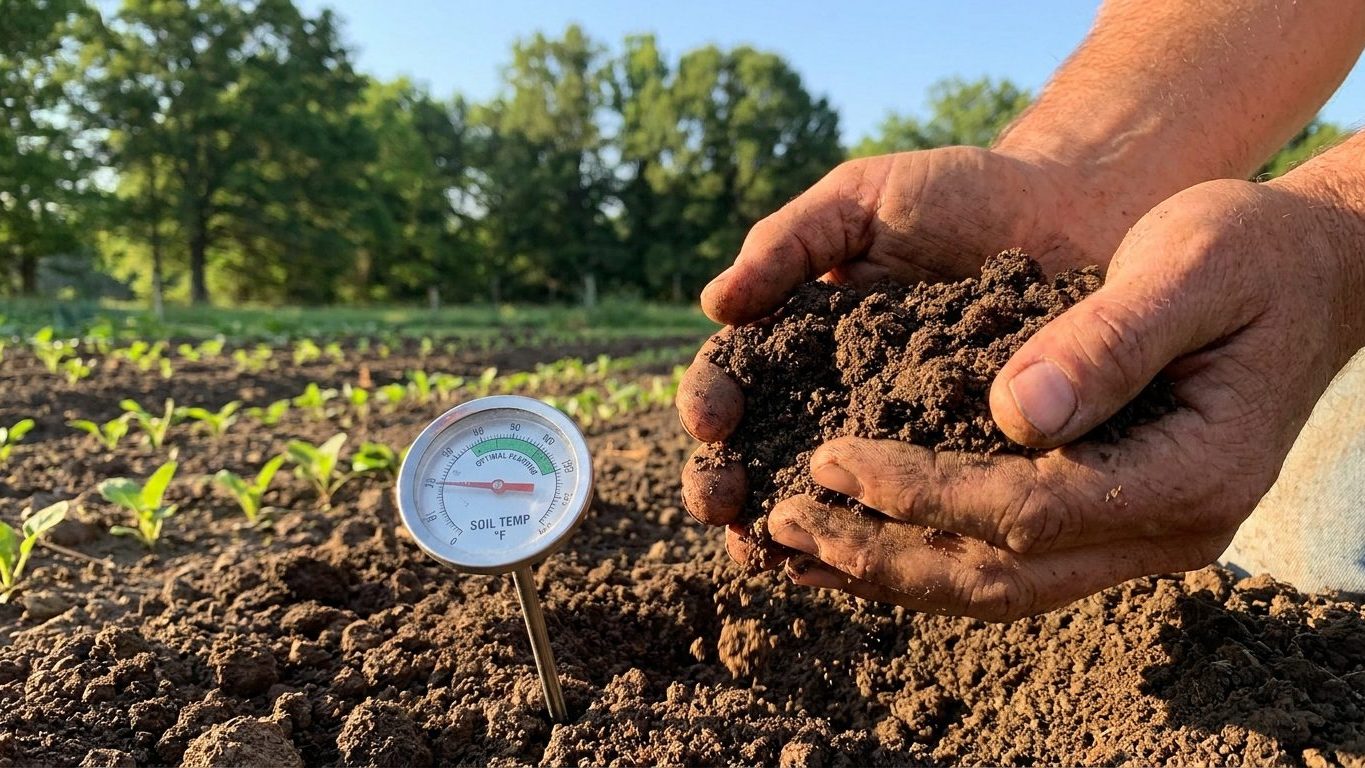

In most of Ohio, winter squash goes in the ground anywhere from mid-May to early June, once the soil itself has warmed rather than the moment the frost risk clears. The growing window runs roughly five months, heat load is moderate, and the bigger challenge is usually humidity rather than drought. Type selection matters more than technique here.
When the soil is warm enough in Ohio

The date every Ohio gardener wants is the last spring frost, and the Ohio State University Extension’s Ohio Gardening Calendar puts it at May 5 to May 15 for the state’s zone 6a areas. That’s a useful anchor. But it’s not the actual signal winter squash responds to, and treating it as one is where a lot of transplants stall out in cold, wet soil for two weeks doing nothing.
Frost dates track air temperature at a set height, on a given night, at a given probability. They don’t measure what’s happening six inches down, where a squash seed or transplant root actually lives. Soil warms more slowly than air, especially after a wet spring, and it can lag the last frost date by a week or two depending on how much sun the bed gets and whether the ground has been mulched or left bare to soak up warmth.
Winter squash is a warm-season crop through and through. Direct-seeded plants germinate poorly, or not at all, in cold soil, and transplants set out too early simply sit there, vulnerable to rot at the stem and to any lingering cool snap that the “last frost” window didn’t fully rule out. Remember that May 5 to May 15 is a probability range, not a guarantee. Some years the real last frost lands after that window; a light frost warning in late May in parts of Ohio is not unheard of.
The practical approach is to treat the frost date as the earliest that planting makes sense, then wait for the soil itself to confirm it. Gardeners without a soil thermometer can use a simpler check: if the ground feels cool and heavy when you dig a few inches down, or if a bare patch still feels cold to the bare hand in the morning, it hasn’t caught up yet. Raised beds and black mulch both speed this along, sometimes by a week or more, which matters in a state where the growing season, while workable, isn’t long enough to waste on soil that isn’t ready.
This is also where local knowledge earns its keep. Microclimates inside Ohio vary by more than the statewide zone 6a range suggests, and a garden in a low, shaded spot will lag one on an open, south-facing slope. Rather than guess at a variety’s cold tolerance, the smarter move is to check with the Ohio State University Extension for guidance specific to the county, since soil warm-up and frost risk both shift meaningfully across the state.
How long the season lasts here
Put the two frost windows together and the frost-free stretch in Ohio’s zone 6a areas runs from as short as 143 days (a late spring frost on May 15 followed by an early fall frost on October 5) to as long as 163 days (an early spring frost on May 5 followed by a late fall frost on October 15), both windows sourced from the Ohio State University Extension’s Ohio Gardening Calendar. That’s roughly 20 to 23 weeks, or a bit under five months to a bit over.
That range matters more than it looks like it should, because it changes what’s actually possible in a given year rather than what’s theoretically possible on paper. A season on the long end, 163 days, gives real breathing room: a squash that needs a long stretch to bulk up and cure fully still has margin left over, and there’s enough runway that a grower who loses an early planting to a cutworm or a cold snap can start over without forfeiting the whole crop.
A season on the short end, 143 days, is a tighter calculation. There isn’t room for a mid-season mistake to be corrected by simply reseeding, because a second attempt might not mature before the October frost risk returns. In that scenario, the first planting is effectively the only planting, and it raises the stakes on getting the timing and the type right the first time.
It also changes whether transplanting is worth the trouble. Winter squash resents root disturbance, and transplants need a few days to recover before they resume real growth. On a 163-day season, that setback is a rounding error. On a 143-day season, it’s a bigger bite out of an already tight window, which is one reason many Ohio gardeners lean toward direct seeding once the soil has genuinely warmed, reserving transplants for getting a head start indoors rather than for convenience.
Gardeners who want to stretch what a short window allows, or who are weighing whether a second, faster crop fits after squash comes out, will find more on timing strategy in the site’s succession sowing guide.
Heat and water in Ohio

Winter squash is unforgiving about one thing above all: the fruit has to finish maturing on the vine before frost. An immature squash doesn’t cure properly in storage and doesn’t keep, no matter how it’s handled afterward. That makes the local heat and rainfall pattern, not just the calendar, part of the real decision.
At the Columbus reference station, NOAA’s 1991-2020 Climate Normals put the average at 15.3 days a year reaching 90°F or higher. That’s a modest heat load, not the kind of sustained, searing summer that pushes squash vines into heat stress or forces the plant to shut down pollination for weeks at a time. Ohio growers generally aren’t fighting the heat itself; they’re managing what comes with a summer that’s warm but rarely brutal.
Rainfall tells a more complicated story. Summer totals average about 12.7 inches across June, July and August, broken down as 4.33 inches in June, 4.67 in July and 3.74 in August, the driest of the three months, against a yearly total of 41.6 inches, all from the same NOAA reference station. That’s a reasonably wet summer by national standards, and it arrives unevenly, often as thunderstorms rather than steady, soaking rain.
What moderate heat and steady rain actually mean for squash
With heat load this modest, the bigger risk in Ohio isn’t drought stress on the fruit; it’s the flip side. Frequent summer rain keeps foliage wet longer, and wet foliage combined with the dense canopy winter squash throws is exactly what powdery mildew and other foliar diseases need to take hold. A cool, damp stretch in a wet year can also slow ripening right when the fruit needs its final weeks of sun and dry weather to cure its skin properly.
None of these normals describe any single backyard. A rain shadow behind a building, a slope that drains fast, or a patch of heavy clay that holds water for a week after a storm will all shift the real picture, and how quickly an inch of rain disappears depends heavily on the soil it lands on. A rain gauge on the actual plot, tracked over a season, is what turns these regional averages into a watering decision that fits one specific garden.
Which winter squash suit Ohio
Given a growing window of 143 to 163 days, a moderate heat load, and summers wet enough to invite mildew, the type of winter squash matters more here than any particular growing trick. Three broad categories are worth weighing against those numbers.
- Earlier-maturing types fit the short end of the window best, and they’re the safer default in any year where planting gets pushed later than planned by a slow-to-warm spring.
- Types bred or selected for disease resistance earn their place given how often Ohio summers deliver wet foliage conditions that favor powdery mildew and vine diseases; airflow from wider spacing and morning watering that lets leaves dry helps regardless of type.
- Longer-season, larger-fruited types are workable in a year that lands on the long end of the frost window, but they leave less margin for a rough spring, and they’re a riskier bet where the season runs short.
None of these categories comes with a name here, and that’s deliberate. Ohio’s zone 6a range, per the USDA Plant Hardiness Zone Map (1991-2020 normals), still covers a fair amount of variation across the state, and the specific varieties that perform well in a trial garden in one county aren’t automatically the ones that will perform in another. This page has the climate facts; it doesn’t have local variety trial data, and guessing at a cultivar name would be worse than saying nothing.
The genuinely useful next step is the Ohio State University Extension, which runs and publishes the actual variety trials for the state’s growing conditions. That’s the source built to answer the “which exact variety” question that a climate-facts page like this one can only frame, not finish.