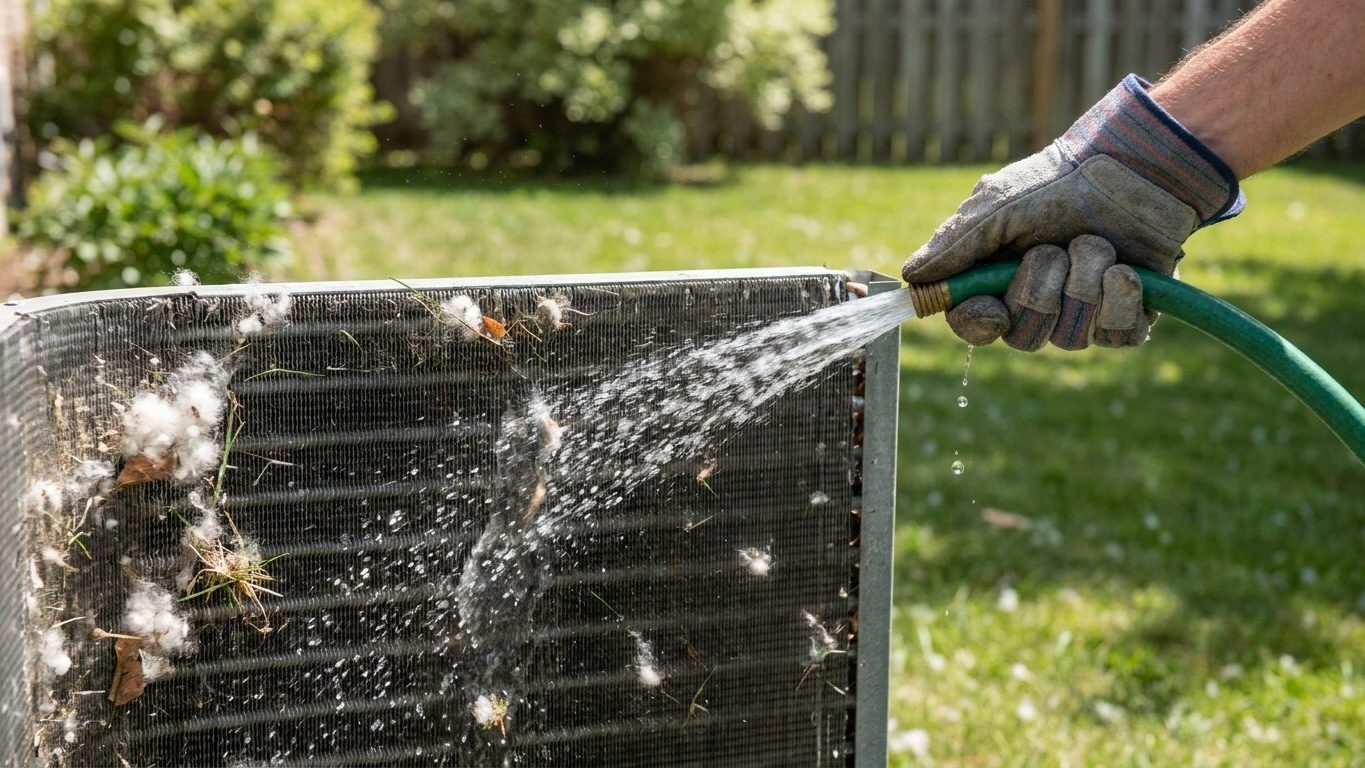

Cleaning a central air condenser comes down to three safe moves: cut the power at the thermostat and the outdoor disconnect, clear debris from the top and sides of the cabinet, then rinse the fins from the inside out with a garden hose. Skip the pressure washer, skip the stiff brush, and never open the electrical compartment. That sequence protects the fins and the coil behind them, which is the part actually doing the work of getting heat out of your house.
What the outdoor unit is actually doing

The outdoor coil has one job: it releases the heat that was pulled out of your house through the ductwork and dumped into the outside air. The fan pulls air across a maze of thin aluminum fins wrapped around copper tubing, and that airflow is what lets the heat escape. Block the airflow, and the heat has nowhere to go, so the compressor runs longer and harder to do the same job.
The U.S. Energy Star program puts a number on that penalty: “Airflow problems can reduce your system’s efficiency by up to 15 percent.” That’s not from a dirty filter inside your house. It’s the coil outside, sitting in the yard, catching everything the wind brings.
Nothing indoors filters what lands on that outdoor coil. Cottonwood fluff in early summer, grass clippings kicked up by a mower pass, plain dust, and pet hair from a dog that likes to nap in the shade next to the unit all settle into the fins. None of it gets stopped by the filter you change every month, because that filter only protects the indoor coil and the blower. The outdoor coil is exposed the entire season, which is exactly why it needs its own occasional attention.
Why a little buildup matters more than it looks
A thin layer of fuzz doesn’t look like much, but fins are packed close together by design, to maximize surface area in a small footprint. That density means even a light coating of debris can bridge the gaps between fins and choke airflow across a large portion of the coil, not just the spot where the debris landed. The system doesn’t fail outright. It just quietly costs more to run and works closer to its limit on the hottest days, which are exactly the days you don’t want it struggling.
Doing it safely
The order of operations matters here as much as the cleaning itself. Rushing the shutdown step, or skipping the confirmation, is where people get hurt or damage equipment they didn’t mean to touch.
- Switch the system off at the thermostat first. Then find the outdoor disconnect, usually a small gray box mounted on the wall near the unit, and pull it, or switch off the dedicated outdoor breaker at your electrical panel. Confirm the unit is dead, fan not spinning, no hum, before you touch anything.
- Clear leaves, twigs, and loose debris from around the cabinet and out of the top grille where the fan sits. A shop vacuum with a brush attachment or just your hands works fine for this part.
- Where you can reach the fins from the inside, brush gently along their length, not across them, working from the inside of the coil outward.
- Rinse with a garden hose at ordinary household pressure, aiming from the inside of the coil outward, pushing debris out the way it came in rather than driving it deeper.
That inside-out direction is the detail that separates cleaning from packing. Fins are angled and layered, and rinsing from the outside forces dirt and fuzz further into the coil, where it compacts against the tubing and becomes harder to remove than it was before you started. Working from the inside pushes everything back out the way it settled in.
No pressure washer, ever. A pressure washer’s stream is concentrated enough to fold the fins flat against each other, and folded fins don’t spring back. Once flattened, they block airflow permanently in that section of the coil, and there’s no gentle way to reverse it. A garden hose, at the pressure that comes straight out of an outdoor spigot, is already enough to lift ordinary debris without bending anything.
Let the unit sit for a few minutes after rinsing before restoring power, just so water isn’t actively dripping through the electrical compartment area when the fan starts back up.
What damages it
Most of the damage done to a condenser happens during a well-meant cleaning attempt, not from neglect. The table below covers the habits that cause the most avoidable harm.
| Action | Why it hurts the unit |
|---|---|
| Pressure washer on the fins | Folds fins flat and can cut through the thin aluminum |
| Stiff brush scrubbed across the fins | Bends and crushes fins instead of clearing debris along their length |
| Chemical coil cleaners used off-label | Some formulas attack aluminum or leave residue that traps future dirt |
| Reaching in and bending the fan blades | Throws the fan out of balance, straining the motor |
| A cover left on through summer | Traps heat and moisture right at the coil, the opposite of what the unit needs to run |
That last one surprises most people. Covers make sense for winter, when the unit sits idle and you’re keeping debris out of a fan that isn’t spinning. Left on in summer, a cover blocks the exact airflow the coil depends on and can trap humidity against the metal, encouraging corrosion instead of preventing it.
The electrical compartment, the panel on the side of the cabinet with the wiring and controls behind it, is not something to open during a cleaning. A run capacitor inside that compartment holds an electrical charge even after the power is switched off at the breaker. That’s a fact, stated once, without a workaround: no tool, no trick, and no reason to open that panel yourself for a cleaning job that only concerns the fins and the coil surface.
The space around it matters as much
A spotless coil surrounded by the wrong landscaping still struggles. The unit has to pull air in through the sides and push it out the top, and anything that interferes with either direction acts as a restriction, even if the fins themselves are perfectly clean.
A shrub that seemed like a reasonable distance away when it was planted three years ago has likely grown into the airflow path by now. A fence panel added last summer for privacy can box the unit in against a wall, cutting off one whole side of intake air. A deck built over or around the unit changes how air moves through the area entirely, sometimes recirculating the unit’s own warm exhaust back into its intake. Even a dryer vent aimed at the condenser introduces warm, lint-laden air right where the unit is trying to draw in cool air.
What to check without a tape measure
This brief won’t hand you a distance in feet, because that number isn’t universal. It depends on the specific model, the cabinet design, and the manufacturer’s own airflow calculations. The label on the unit itself, usually inside the service panel or on a data plate on the cabinet, states the clearance that model needs on each side and above it. That label is the only number that governs your situation, not a rule of thumb from a neighbor or a general home improvement guide. If the label has worn off or was never legible, the manufacturer’s documentation for that model covers it.
What you can judge without any measurement at all is whether air is visibly struggling to move: dense foliage pressed against the cabinet, a fence panel close enough to touch, furniture or storage bins stacked against a side panel. Any of those is worth adjusting regardless of the exact inch count, because the principle holds even without a number: the unit needs open paths in and open paths out.
Common questions
How often should the outdoor condenser be cleaned?
There’s no fixed schedule in this brief to point to, but a visual check each season, especially after heavy pollen, cottonwood, or a mowing season, tells you whether debris has built up enough on the fins to matter.
Can I use a leaf blower instead of a hose?
A leaf blower can clear loose debris off the top grille and surrounding area before you start, but it won’t dislodge material that’s already packed into the fins the way a hose rinse will.
Why does the unit seem low on refrigerant every summer?
Refrigerant is not a consumable that gets used up in normal operation. A system that keeps running low has a leak somewhere in the sealed system, and simply topping it off without finding and fixing that leak means paying for the same refrigerant twice, on top of running with reduced efficiency in the meantime.
Is it safe to clean the condenser while it’s running?
No. The fan and internal components need to be fully stopped, confirmed by cutting power at both the thermostat and the outdoor disconnect or breaker, before any brushing or rinsing begins.