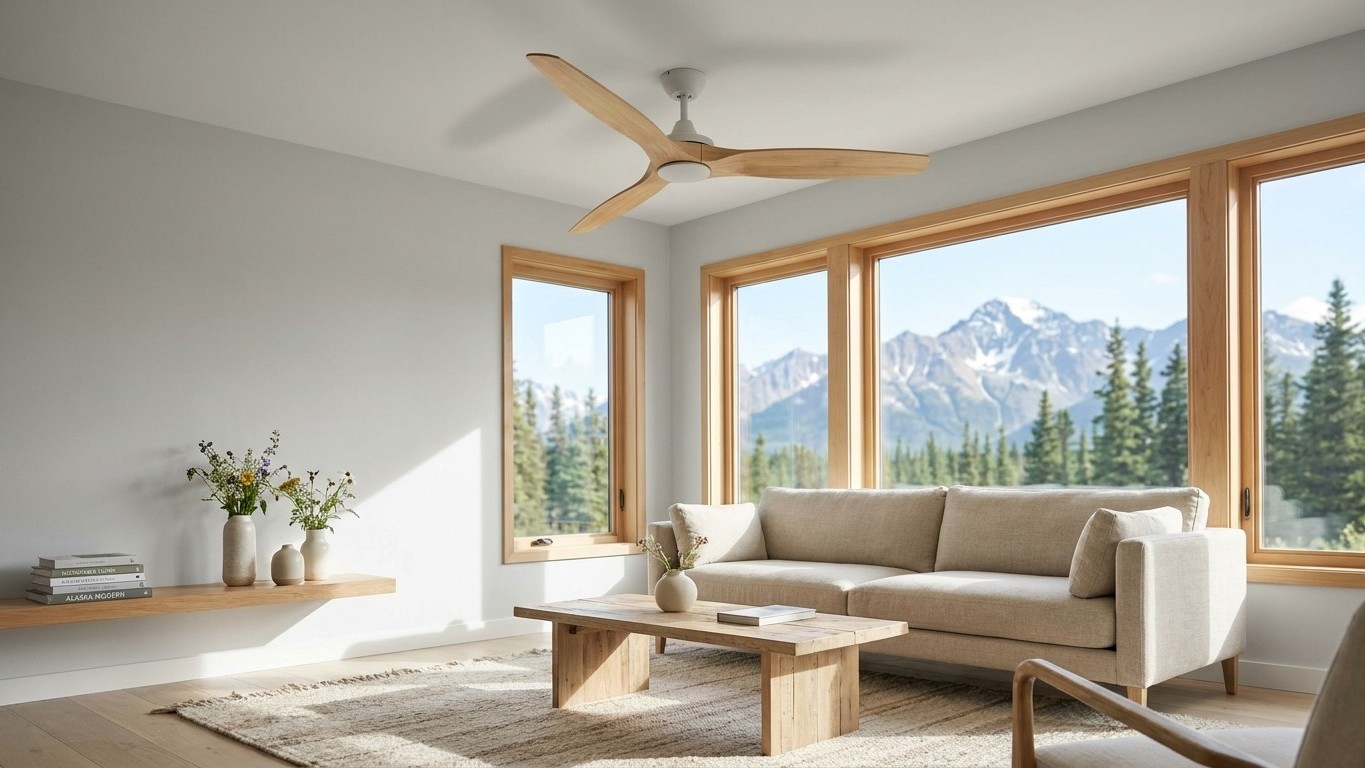

Colorado homes cool with a mix dominated by central air: 57% of households run a central system, another 20% rely on an individual unit like a mini-split or window unit, and 82% use some form of air-conditioning equipment overall. Ceiling fans show up in 72% of homes, often working alongside or instead of mechanical cooling on milder days.
What homes in Colorado actually cool with
Those four numbers, from the U.S. Energy Information Administration’s 2020 Residential Energy Consumption Survey, tell a specific story about the state’s housing stock. Eighteen percent of Colorado homes have no air-conditioning equipment at all, a meaningfully large share compared to hotter, more humid states where going without AC is nearly unheard of. That gap reflects Colorado’s altitude and dry climate: plenty of older homes, especially in the mountains, were built without any cooling system because summer nights cool off fast and daytime heat rarely lingers long enough to make it feel necessary.
The 57% central figure and the 20% individual figure are both published directly in the survey, not derived from subtraction. Central air conditioning tends to show up in newer construction and in homes where forced-air heating already put ductwork in the walls, since adding a cooling coil to an existing furnace system is a far smaller project than running new ducts. Individual units fill in where retrofitting central air would mean tearing into finished walls, or where a single room needs targeted relief without cooling the whole house.
Compare that mix to Connecticut, where air conditioning shows up in 90% of homes but central systems cover only 34% of them, leaving most households on window or wall units because the housing stock there predates central air by decades. Colorado runs the opposite pattern: more central, less individual, which lines up with a building boom that happened well after forced-air heating and central cooling became standard in new construction. Ceiling fans at 72% aren’t a substitute for either kind of AC, but they make a room feel several degrees cooler without running compressor cycles, which matters where afternoon heat spikes hard but evenings cool off fast.
None of these shares are a recommendation for what a given household should install. They’re a snapshot of what was affordable and practical when each home was built, filtered through decades of renovation decisions.
How much cooling the year actually asks for
At the Denver reference station, the mean number of days per year reaching 90 degrees Fahrenheit or higher runs 39.6 days, based on NOAA’s 1991-2020 climate normals. That figure counts individual hot days, not an average summer temperature and not a statewide reading, so it’s best read as a measure of how often a cooling system actually has to work hard rather than a description of how hot the state feels overall.
Thirty-nine and a half days a year sits in a middle zone. It’s nowhere near the triple-digit day counts that push Arizona or interior Texas into near-constant summer cooling demand, but it’s also far more than a state where 90-degree days barely register. That moderate-but-real heat load lines up with what Colorado homes actually run: a majority on central air, a meaningful minority on individual units, and a sizable share skipping mechanical cooling entirely.
This is one of the states where the equipment mix and the heat load roughly agree with each other, rather than pulling in opposite directions. A state with a high day count above 90 but a housing stock still dominated by individual units usually signals older construction that predates central air, forcing homeowners to bolt on window units room by room even though the climate demands more. Colorado doesn’t show that mismatch. Instead, a housing stock built largely during and after the era when central forced-air systems became standard meets a climate that’s warm enough to need cooling on a real but not relentless basis. The 18% of households running no AC at all fits into this picture too: at higher elevations, where the 90-degree days cluster more narrowly into a shorter stretch of summer, some homeowners simply decide the investment isn’t worth it.
The takeaway for anyone weighing a new system isn’t that the state runs hot or mild in some abstract sense. It’s that the demand is concentrated into a real but limited stretch of the year, which changes how a system should be sized and run, a point that matters more once rainfall enters the picture.
Wet heat or dry heat, and what it changes
Summer rainfall at the same reference station averages about 5.7 inches across June, July, and August, with the driest month, August, bringing just 1.58 inches. June runs 1.94 inches and July 2.14 inches. Out of 14.5 inches of precipitation for the entire year, only a bit over a third falls during the three hottest months, putting Colorado firmly on the dry side for summer weather. That figure measures precipitation, not humidity or dew point, so it says nothing directly about how sticky the air feels, only how much rain actually falls.
Here’s why that distinction changes how a cooling system should be run. An air conditioner does two jobs at once: it lowers air temperature, and it pulls moisture out of the air as that air passes over a cold coil. Removing moisture takes run time, because water has to condense out gradually as air cycles through the system again and again. In a genuinely humid summer, a large share of an air conditioner’s workload is moisture removal, and a unit that’s too large for the space will cool the air fast, shut off, and never run long enough to finish that drying job, leaving a room that reads cold on the thermostat but still feels damp.
Colorado’s dry summers flip that equation. With less moisture in the air to begin with, an air conditioner’s job leans almost entirely toward temperature reduction rather than dehumidification. A correctly sized unit here does its main job efficiently without fighting a humidity load that would otherwise eat into runtime. It also means the classic humid-climate warning about oversizing, while still true in principle, matters somewhat less for comfort and more for straightforward energy waste and short-cycling wear on the compressor.
Given that dry-summer pattern, a few adjustments make more sense here than in a humid state:
- Size for temperature control first, since moisture removal is a smaller share of the workload than in humid regions.
- Run the fan on auto rather than continuous, since there’s less benefit to keeping air moving purely to manage humidity.
- Resist oversizing even though humidity isn’t the main concern, since short-cycling still wastes energy and shortens equipment life regardless of climate.
Sizing a room unit, from the published chart
For anyone cooling a single room, whether that’s a supplement to central air or the only cooling equipment involved, ENERGY STAR publishes a straightforward starting chart for room air conditioners:
| Area to be cooled (square feet) | Capacity needed (BTU per hour) |
|---|---|
| 100 up to 150 | 5,000 |
| 150 up to 250 | 6,000 |
| 250 up to 300 | 7,000 |
| 300 up to 350 | 8,000 |
| 350 up to 400 | 9,000 |
| 400 up to 450 | 10,000 |
| 450 up to 550 | 12,000 |
| 550 up to 700 | 14,000 |
| 700 up to 1,000 | 18,000 |
| 1,000 up to 1,200 | 21,000 |
| 1,200 up to 1,400 | 23,000 |
This chart is a starting point for a single room, not a sizing method for a whole house. It doesn’t scale up linearly past its last line, since the relationship between area and required capacity shifts as rooms get larger, insulation and window area come into play, and ceiling height changes. A central system, which cools 57% of Colorado homes, is sized through a full load calculation performed by a technician, not through a table built for a single window or portable unit.
That table matters most for the 20% of Colorado households running individual equipment, plus anyone adding a supplemental unit to a room that central air struggles to reach. Picking a unit rated well above what the room actually needs isn’t a safety margin, it’s a genuine fault. An oversized unit cools the air fast, shuts off before finishing its cycle, and in a state where summer air already runs dry, that just means wasted electricity and a compressor cycling on and off far more than it should, shortening its working life.
What actually needs looking after here
With central air conditioning the dominant setup across 57% of Colorado homes, and with dry summers reducing the moisture-removal workload, the maintenance items that matter most are the basics ENERGY STAR points to for any forced-air system. ENERGY STAR advises: “Inspect, clean, or change air filters once a month in your central air conditioner, furnace, and/or heat pump.” That’s a monthly task, not a seasonal one, and it applies to all three types of equipment together, which matters for anyone who assumes filter care is only a furnace concern.
A dirty filter doesn’t just get ignored quietly. ENERGY STAR notes that “airflow problems can reduce your system’s efficiency by up to 15 percent,” meaning a system in otherwise perfect mechanical condition can still underperform simply because air isn’t moving through it the way it should. That’s a real efficiency loss sitting behind a $10 part that most homeowners can swap themselves in a few minutes.
For the majority of Colorado households running central systems, duct condition is worth checking too. ENERGY STAR states that “in a typical house, however, about 20 to 30 percent of the air that moves through the duct system is lost due to leaks, holes, and poorly connected ducts.” That caution applies specifically to ducted, central systems, not to window units or mini-splits, which move conditioned air directly into a room without any duct run to leak from. For the 20% of Colorado homes on individual equipment, this isn’t a relevant concern at all.
A seasonal pass before the hot stretch of the year sets in covers the essentials without turning into a full remodel project:
- Check or replace the filter, and mark the date so the once-a-month schedule actually sticks through summer.
- Have accessible ductwork inspected for obvious leaks or disconnected sections if the home runs central air.
- Confirm outdoor units and vents are clear of debris built up over the offseason.
- Consult site guides for the specific equipment installed, whether that’s a central system, a mini-split, or a window unit, for deeper seasonal checks beyond the basics covered here.