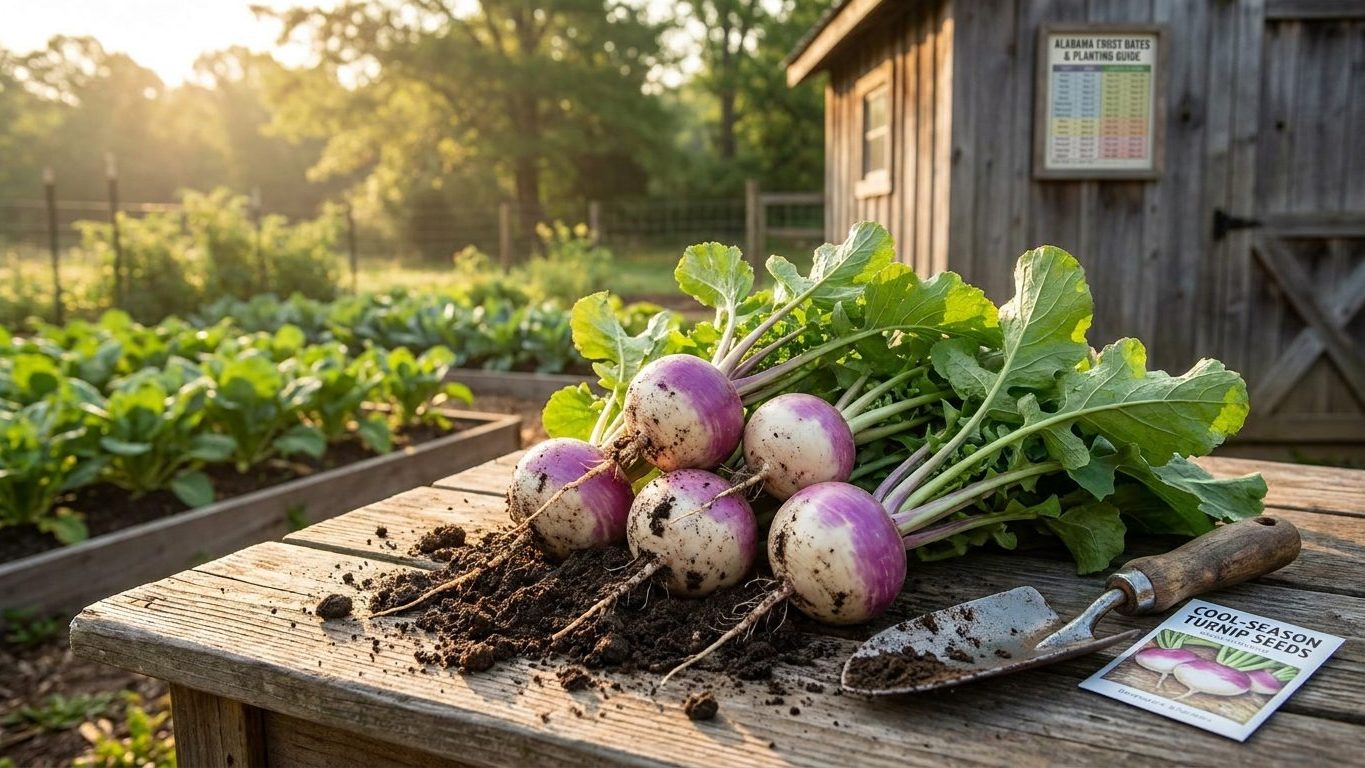

Sow turnips outdoors from mid-March through April for a spring harvest, then again from late July into early September for a fall crop that finishes before frost. Both windows are built around two averaged dates from Environment and Climate Change Canada, and neither one is a guarantee, only a midpoint you adjust once you’ve watched your own soil and sky for a season.
The short answer for British Columbia
The frost dates behind this calendar come from Vancouver International Airport, the reference station Environment and Climate Change Canada uses for the Lower Mainland: a mean last spring frost of March 18 and a mean first fall frost of November 10. That’s a frost-free stretch of roughly 237 days, which is long by Canadian standards and gives turnip growers here more flexibility than almost any other province. A spring sowing can go in as soon as the soil has drained and warmed past the March 18 mark, and a second sowing for fall roots can be timed by counting backward from November 10.
Turnips are quick. Salad types size up in 35 to 45 days, and standard bulbing varieties take closer to 55 to 65 days from seed to a root worth pulling. Counting back from a mean frost of November 10 puts the safe fall sowing window at late July through early September, with the earlier end reserved for slower rutabaga-type turnips and the later end for the fast salad varieties. Push much past early September and you’re racing a frost date that, remember, falls later than average in half of all years and earlier than average in the other half.
That mean-date caveat matters more here than the raw numbers suggest. Environment and Climate Change Canada’s normals are averages built from three decades of records, not a probability band with a safety margin baked in. In one year out of two, the real frost at Vancouver Int’l A arrives after March 18 in spring or before November 10 in fall. Treat both dates as the center of a window you sow around, not a line you sow right up against.
There’s no single fact in this data set for a “best variety” recommendation by type, and this page won’t invent one. What the frost dates and the season length do support is a two-sowing strategy: an early spring crop for salad turnips and a mid-to-late-summer sowing for a fall harvest of either type, timed off the November frost mean rather than the calendar month alone.
What will not work here

The most common mistake in this climate isn’t running out of season, it’s ignoring soil conditions in favor of the calendar. Coastal Lower Mainland soils, especially the heavier clay and silt common around Vancouver and the Fraser Valley, stay saturated well past the March 18 mean frost date. Turnip seed sown into cold, waterlogged ground doesn’t germinate faster because the calendar says spring has arrived, it rots. Waiting for soil that crumbles rather than smears is worth more than any date on this page.
A second failure point sits at the other end of the season. Because the frost-free period here runs long, gardeners sometimes push a “fall” sowing into July while days are still long and the coast is still warm and humid. Turnips read long daylight and warmth as a signal to bolt, sending energy into a flower stalk instead of the root. A sowing timed for late summer, closer to the late July through early September window already outlined, avoids that trigger far more reliably than an early-July planting aimed at “getting ahead.”
Density is the third trap, and it’s specific to a wet coastal climate. Standard turnip spacing guidance assumes a range of humidity levels, but the persistent moisture and mild air typical of coastal British Columbia favor downy mildew and clubroot when rows are sown thick and thinned late. Thinning early, to something closer to 4 to 6 inches between plants, does more here to keep foliage dry and airflow moving than it would in a drier interior climate.
Finally, don’t lean on the region’s mild winter mean to leave a fall crop in the ground indefinitely. The coldest month here averages a minimum of just 0.8°C (33.5°F), which sounds forgiving, and near the coast it often is. But that figure comes from one station, and it will mislead anyone gardening even a short distance inland or upland from it, which is exactly the problem the next section gets into.
What changes across British Columbia
British Columbia is not one growing climate, and the plant hardiness data makes that plain on its own. The reference city behind this page’s zone rating, Vancouver, sits in Canadian hardiness zone 9a, one of the mildest ratings anywhere in the country. That number is built from seven climate variables under the Canadian system, not the single-variable USDA method, so it can’t be lined up against American hardiness maps or against zone numbers quoted on U.S. gardening sites. It also describes Vancouver specifically, not the province as a whole.
Move away from that reference point and the picture changes fast. The BC Interior, the Kootenays, the Cariboo, and northern regions of the province run through a wide spread of colder Canadian zones, with shorter frost-free seasons and colder winter minimums than anything the 0.8°C coastal figure suggests. A garden in the Okanagan or Prince George is not working from the same frost dates as one in Richmond or North Vancouver, even though both are technically “British Columbia.” This page cannot tell you which zone applies to your own yard, only that the spread across the province is wide enough that no single sowing date serves everyone.
Elevation compounds the effect even within a single region. Gardens a few hundred feet higher than a valley floor routinely see their last spring frost run two to three weeks later and their first fall frost arrive that much earlier, shrinking the whole sowing calendar from both ends. Coastal fog belts, by contrast, can moderate temperature swings enough to extend the effective season slightly beyond what the Vancouver station alone would predict.
The practical takeaway is to treat the March 18 and November 10 dates on this page as a coastal Lower Mainland reference, useful for calibration, not as fixed points for every corner of the province. Readers gardening away from the coast should expect their real window to sit somewhere later in spring and earlier in fall than what’s written here, and to check their specific zone before locking in a sowing date.
Where to check this for your own county
For anything more local than a province-wide mean, the right next stop is British Columbia’s own agriculture ministry, not a national average. The BC Ministry of Agriculture and Food publishes region-specific growing information at gov.bc.ca/gov/content/industry/agriculture-seafood, and that’s the source to search for anything tied to a specific district rather than the Vancouver airport station used throughout this page.
Look there for two things in particular. First, any regional planting calendars or frost-date guidance broken out by area, since the ministry and regional extension offices sometimes publish figures calibrated to the Interior, Vancouver Island, or the North that will differ meaningfully from the coastal numbers used above. Second, look for variety trial results or recommendations specific to root vegetables in your growing region. A turnip variety that performs well in the mild, wet Lower Mainland is not necessarily the one that will size up reliably in a shorter, drier Interior season.
A county-level or regional recommendation, when you can find one, beats a provincial average every time. This page works from a single station’s climate normals because that’s the most consistent province-wide figure available, and it’s useful for understanding the general shape of the season and for calibrating expectations. But it is, deliberately, a broad-strokes reference. Anyone gardening outside the immediate coastal zone should treat the ministry’s regional material as the tie-breaker whenever it conflicts with the dates given here, and should check the regional source before finalizing a sowing date rather than defaulting to the provincial mean out of convenience.
Checking this against your own garden
No frost date, however carefully sourced, replaces what your own soil and plants are telling you in a given year. Three simple observations will do more to fine-tune a turnip sowing than any calendar figure on this page.
Start with soil feel rather than soil temperature readings. Turnip seed germinates reliably once the top few inches of soil crumble loosely in your hand instead of packing into a cold, wet ball. If the ground still smears when squeezed, it’s too cold and too saturated regardless of what the calendar says about March 18 having passed.
Watch for the first true leaves after germination, the second set that appears distinct from the rounded seed leaves. Their appearance within about a week of sowing signals that soil temperature and moisture were both in a good range; a long delay suggests the ground was colder than ideal and that your personal sowing date should shift later next season.
Finally, keep an eye on any plant that bolts, sending up a flower stalk before the root has bulked up. A bolting turnip is a direct signal that it hit either a cold snap after germination or a stretch of long, hot days, both of which point toward adjusting your sowing window, earlier in spring to dodge a cold snap, or later in summer to avoid the season’s longest, warmest days, in the years that follow.
Some gardeners also time this by the Moon: when to plant turnips by the moon, as almanac tradition rather than fact.