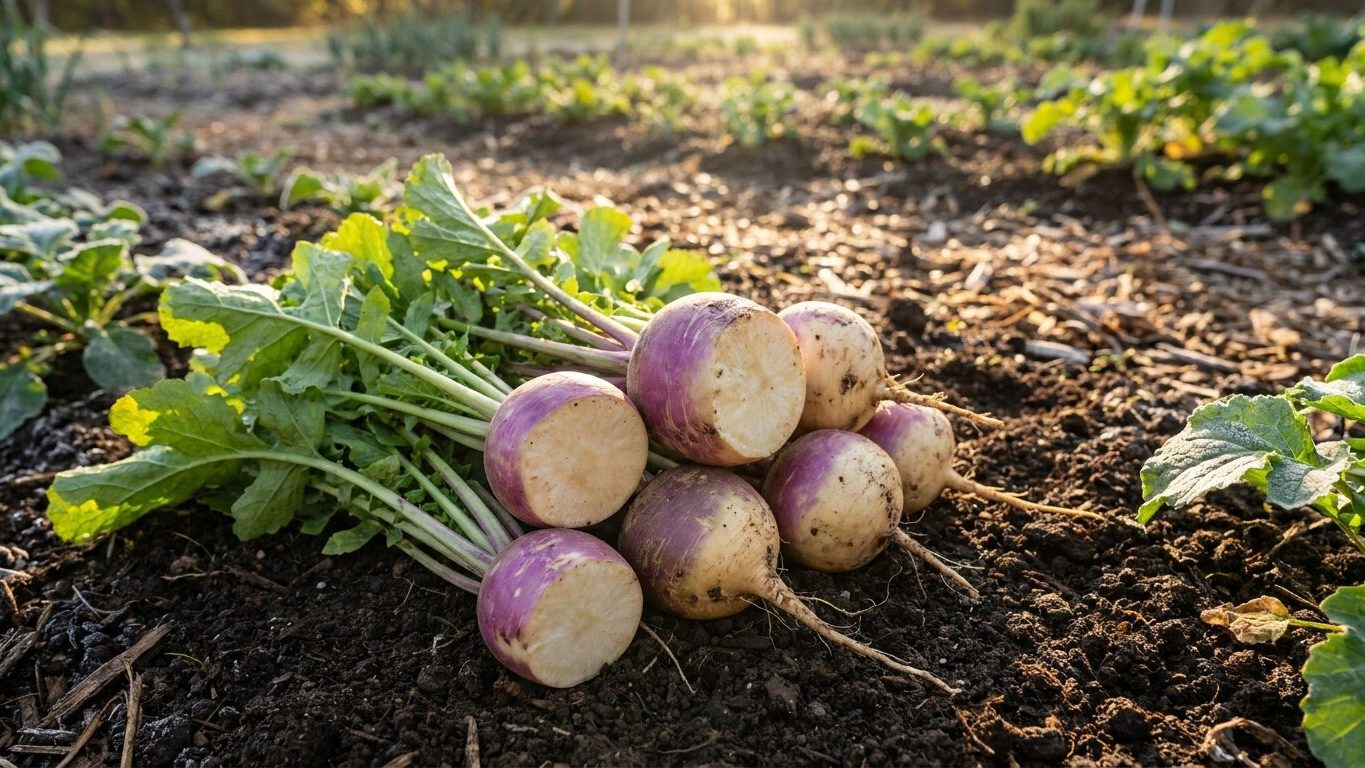

Turnips and rutabaga in British Columbia don’t follow a single calendar rule. The coast runs mild enough (Canadian hardiness zone 9a near Vancouver) for a genuinely long frost-free stretch, but the crop itself prefers cool finishes over hot starts. That combination favors an early spring sowing for quick turnips and a summer sowing timed to mature in the cool, damp fall, when both flavor and storage odds improve.
When the soil is warm enough in British Columbia
The average last spring frost at Vancouver Int’l A runs March 18, according to Environment and Climate Change Canada’s 1981-2010 climate normals. That’s the number most calendars will hand you, but it’s a mean, not a promise. In one year out of two, frost shows up after that date. Treat it as the midpoint of a range, not a green light.
Frost dates are also a stand-in for something more useful: soil temperature. Turnip and rutabaga seed will sit and sulk in cold, wet ground no matter what the calendar says. What actually triggers a good spring sowing is soil that’s dried out enough to crumble in your hand and warmed past the point where germination stalls. That often lags a week or two behind the frost date itself, especially in heavier coastal clay. Raised beds and loosened, amended rows warm faster than flat, compacted ground, which matters more here than the exact frost date does.
British Columbia isn’t one climate. The Vancouver Int’l A station sits in the mild Lower Mainland; move inland or up in elevation and both frost dates shift, sometimes by weeks. Gardeners in the Interior or the Kootenays should treat this page’s dates as a coastal reference point, not a local guarantee.
Choosing types, not names
This page won’t hand you a cultivar name, and that’s deliberate. The varieties that actually perform well in a given BC microclimate are the ones your regional trials have already tested, and the BC Ministry of Agriculture and Food is the place to find that list. What’s useful here is the type: fast salad turnips for an early spring crop, slower maincrop turnips and rutabaga for a fall harvest built around the long, cool finish this region offers.
One thing worth saying plainly: turnips and rutabaga are brassicas. They share pests and diseases with cabbage, kale, and mustard, including root maggot and clubroot, and a rotation that just moves them into last year’s cabbage bed hasn’t rotated anything. Cultural controls, floating row covers for maggot flights, wider spacing for airflow, do more good than any product name would. If you’re storing roots through winter, check them before use: a soft patch, a weeping spot, or a moldy crown ends the question regardless of how sound the rest of the root looks.
How long the season lasts here
Subtract the two Vancouver Int’l A normals and you get a frost-free window of roughly 237 days, running from the March 18 average last spring frost to the November 10 average first fall frost. That’s a long season by Canadian standards, long enough that a single sowing isn’t your only option.
| Metric | Value |
|---|---|
| Average last spring frost | March 18 |
| Average first fall frost | November 10 |
| Approximate frost-free window | 237 days |
A window that long changes the math on succession sowing. Instead of committing every square foot of turnip bed to one spring crop, there’s room for an early quick-maturing sowing in spring, followed by a second, slower sowing timed to finish in the cool of autumn, which is usually when turnip and rutabaga flavor is at its best anyway. If you’re new to staggering plantings, the site’s succession sowing guide walks through spacing those sowings so you’re not harvesting everything the same week.
Contrast that with a territory where the frost-free window runs closer to 90 or 100 days. There, the first sowing is effectively the only sowing, and every week of delay matters, which is where transplanting or row covers start earning their keep just to buy time. British Columbia’s coastal window doesn’t force that tradeoff. Direct seeding twice, spring and midsummer, is a realistic plan here without reaching for season-extension tricks just to fit a crop in.
The caveat stands: this math only holds where both frost dates come from real station data. Move away from the Lower Mainland and the window narrows or shifts, sometimes considerably, so treat these 237 days as a coastal benchmark rather than a province-wide rule.
Heat and water in British Columbia
The verified figures for this station don’t include a days-above-90°F count or a summer rainfall total, so the honest approach is to lean on what’s actually measured: the coldest month’s mean daily minimum, 33.5°F, and the Canadian hardiness zone rating of 9a for the Vancouver reference area. That’s not a gap in the story. It’s the point. Turnips and rutabaga in this territory are fundamentally an autumn and winter crop, and the numbers that govern them are cold numbers, not heat numbers.
A mean coldest-month minimum of 33.5°F sits close to freezing but rarely deep into it. That matters for storage decisions. In many winters, mulched turnip and rutabaga beds can hold roots in the ground well past first frost without the crop suffering, because the ground itself doesn’t freeze hard for long stretches. That’s not a guarantee every single winter behaves the same way, and a hard, sustained freeze can still force an early lift. Watch the first real cold snap rather than a calendar date.
There’s an upside to that cold, too. Frost converts some of the starches in turnip and rutabaga roots into sugars, which is why roots pulled after a light frost often taste sweeter than roots pulled in warm weather. A zone 9a coastal climate, with its mild but real cold spells, gives the crop some of that frost sweetening without the risk of the ground locking up solid before harvest.
What this climate lacks in heat stress, it makes up for in dampness. Coastal British Columbia’s wet, mild fall and winter pattern is well known even without a specific rainfall figure attached to this page, and that dampness brings its own problems: powdery mildew, downy mildew, and roots that ripen slowly in cool, saturated soil rather than roots that bolt or turn woody from heat, which is the more common complaint in hotter territories. Spacing plants for airflow and avoiding overhead watering late in the day matter more here than shade cloth ever would.
Which turnips and rutabaga suit British Columbia
The season length and the climate together point toward a two-track approach rather than one ideal type. Early, quick-maturing turnip types make sense for a spring sowing timed to beat the wetter, cooler stretch of early summer. Slower-maturing maincrop turnips and rutabaga fit the second half of the season, since the roughly 237-day window comfortably covers rutabaga’s longer time to maturity without racing the November frost date.
Given the coastal dampness discussed above, disease resistance, particularly against mildew, deserves to be the first thing you screen for when picking a type, ahead of size or color. That’s a question your regional trials have already answered for the varieties grown in your specific part of the province, whether that’s the wetter Lower Mainland or a drier Interior valley. The BC Ministry of Agriculture and Food is the right place to ask, since a variety that resists mildew on Vancouver Island isn’t automatically the right pick for the Okanagan.
Naming a specific cultivar on this page would mean guessing at trial results this page doesn’t have access to, so the refusal to do that is itself the useful answer: local trial data beats a generic recommendation every time, and that’s especially true for a crop as regionally sensitive to moisture and disease pressure as turnips and rutabaga.
Whatever type you land on, remember the brassica connection before you plan next year’s bed. Turnips and rutabaga share their pest and disease pressures with cabbage, kale, and mustard, so rotating them into a bed that held any of those crops last season isn’t really a rotation. Check the site’s crop rotation guide before laying out next year’s plot, and when it comes time to pull roots for storage, inspect each one rather than trusting appearances. A firm, dry root is fine to store; anything soft, weeping, or showing mold at the crown gets pulled from the batch, no exceptions.