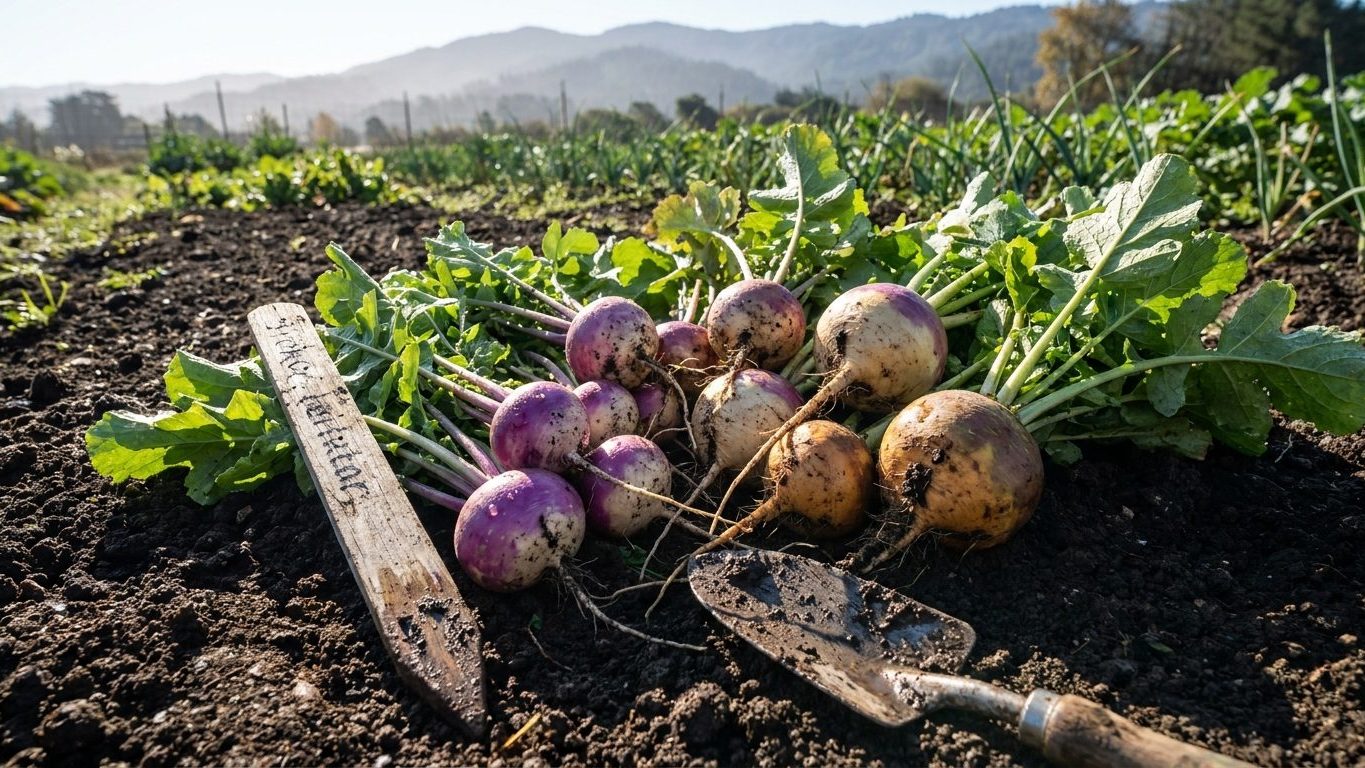

Idaho’s growing season runs short almost everywhere outside the Treasure Valley, and that single fact should drive every turnip and rutabaga choice you make. Quick turnips finish in five to seven weeks and forgive a late spring. Rutabaga needs nearly the whole season and a cool finish, which favors higher, cooler ground more than the valley floor.
The short answer for Idaho
Pick fast turnips for most of the state, and save rutabaga for gardens with a long enough window to let it mature slowly. Around Boise, the reference station shows a last spring freeze arriving somewhere between April 23 and May 7, and the first fall freeze landing between October 7 and October 21. That gives the valley floor a frost-free stretch that can run past 150 days in a good year. Higher ground across Idaho gets nowhere close to that, and the state’s hardiness range of 3b to 7b tells you why: this is not one climate, it’s several stacked on top of each other by elevation.
For turnips, that means leaning on 35 to 55 day varieties almost everywhere. Tokyo Cross and Hakurei-type turnips finish fast enough to dodge a late frost and still get harvested before the ground freezes solid in October. Purple Top White Globe sits a little longer, near 55 days, and still fits comfortably inside the Boise-area window with room to spare for a second planting later in summer.
Rutabaga is the harder call. Laurentian and American Purple Top rutabaga both want 90 to 100 days to size up properly, and they actually taste better after a light frost sweetens the root. In the Treasure Valley, where the season can stretch past five months, that’s workable if you get seed in the ground by early June at the latest. Farther north, at altitude, or anywhere the growing window closes earlier than Boise’s, rutabaga becomes a much tighter fit, and some gardens simply don’t have the season for it most years.
So the practical split looks like this: plant fast turnips (35-55 days) as the default choice statewide, and treat rutabaga as a crop for gardens with a confirmed 90+ day frost-free window. If you don’t know your own frost-free count, that’s the first thing to nail down before choosing rutabaga over turnips.
This isn’t a case where one variety quietly outperforms another by a week or two. It’s a case where the crop itself either fits your season or it doesn’t, and the fix is choosing the right one rather than fighting the calendar.
What will not work here

Long-season storage rutabaga planted late is the most common failure across Idaho gardens, and it’s almost entirely a timing problem rather than a variety problem. A 100-day rutabaga sown in early July, which feels reasonable if you’re thinking in terms of “fall crop,” runs straight into an October freeze before the root has bulked up. In Boise’s own window, that leaves barely 90 days if you count from July 1 to the earliest recorded fall freeze on October 7, and that’s before accounting for the slower germination rutabaga shows in cool soil. Anywhere colder than the valley floor, that math gets worse, not better.
Overwintering turnips or rutabaga in open ground is the second failure pattern, and it comes straight from the coldest-month numbers. At the Boise reference station, the coldest month averages a daily minimum of 25.4°F, which sits well within the range where unprotected roots and shoulders can freeze and turn to mush in storage. That’s the mild end of the state. Areas at higher elevation, which make up most of Idaho’s land area, run colder than that reference figure by a wide margin, and the hardiness range of 3b to 7b spans conditions from merely cold to genuinely brutal. Leaving roots in the ground past hard frost only works reliably in the warmest pockets, not as a statewide strategy.
Spacing and succession mistakes
Tight succession planting, where a new turnip sowing goes in every two weeks all summer, tends to backfire in Idaho’s dry interior heat. Turnips sown into the hottest stretch of July often bolt to flower before the root forms, especially varieties bred for cooler, slower finishes like Purple Top White Globe. The better move is skip the peak-heat window entirely and resume sowing turnips about six to eight weeks before your first fall freeze, so the crop matures into cooling weather instead of rising heat.
Rutabaga crowded at close spacing also underperforms here. The plants need real room, roughly 8 inches between roots, to bulk up before the season closes, and gardeners who spaced them like radishes end up with a bed of small, woody roots that never had the growing room the crop actually needs in a short window.
What changes across Idaho
A hardiness range of 3b to 7b is not a rounding error, it’s nearly the entire cold-hardy end of the USDA scale packed into one state. Zone 3b describes conditions cold enough to challenge perennial shrubs; zone 7b describes conditions mild enough to grow figs outdoors in some years. No single planting date or variety list covers that spread honestly, which is why this page describes a decision framework rather than a fixed calendar.
Elevation drives almost all of that variation. The Boise area sits low in its valley, which is exactly why its frost dates run as favorable as they do, with roughly five months of frost-free growing in a typical year. Areas at higher elevation across Idaho, including much of the central mountains and the higher benches around the Panhandle, lose weeks of season on both ends: a later last frost in spring, an earlier first frost in fall. That compression is what pushes many of those gardens out of rutabaga territory entirely and into a fast-turnip-only strategy.
Latitude matters too, but less than elevation does in a state shaped like Idaho. Northern counties trend cooler overall, but a low-elevation valley in the north can still out-perform a high bench in the south simply because of where cold air settles and how long the growing season actually runs at that specific site.
The practical takeaway is that gardeners at higher elevation should plan on a season measured in weeks fewer than Boise’s, not the same window shifted slightly. Rather than guess where your own garden falls inside that 3b-7b range, check your specific location against the current USDA Plant Hardiness Zone Map, since the range itself only describes the state’s outer bounds, not any single yard.
Where to check this for your own county
Everything above describes Idaho as a whole, anchored to one reference station in Boise. Your county almost certainly differs, sometimes by a little, sometimes by a lot depending on elevation, and a county-level recommendation will always beat a state-level one like this page.
The University of Idaho Extension is the source built for that finer-grained answer. Their office network publishes local planting calendars built around each area’s actual frost data, not a statewide average, and they track which turnip and rutabaga varieties have actually performed well in trials or demonstration gardens near you. That’s information this page can’t replicate, because it depends on soil, elevation, and microclimate details specific to your county.
Start at University of Idaho Extension and look for two things specifically: the county-level planting calendar for your area, and any variety trial results or recommended cultivar lists for root crops. Many county offices also run a master gardener helpline, which is worth using directly if you can’t find your county’s planting dates published online. A five-minute phone call to a local extension office often settles a question that no state-level guide, including this one, can answer with real confidence.
Treat the county-level calendar as the final word, and this page as the starting framework that gets you asking the right question when you call or search their site. If your county’s data differs from what’s written here, go with the county every time. That’s not a hedge, it’s simply how extension recommendations are meant to work: broad guidance at the state level, refined answers at the local one.
Checking this against your own garden
No frost date on this page beats what your own soil and plants are telling you in real time, and three simple observations will confirm or correct everything above for your specific yard.
First, check soil temperature by feel before sowing turnip or rutabaga seed. Push a finger a couple of inches into the bed in spring; if it still feels cold and slightly damp-numb rather than merely cool, germination will be slow and uneven no matter what the calendar says. Turnip and rutabaga seed both germinate reliably once soil has warmed past the raw, just-thawed stage, and waiting an extra week for that shift often outperforms sowing on a fixed date.
Second, watch for the first true leaves, the second set that appears after the initial seed leaves. That’s the point where you can judge whether the crop is growing at a normal pace for the week you’re in. A turnip crop that’s still on seed leaves alone two weeks after sowing is telling you the bed is cooler or slower-draining than the surrounding area, which matters more for timing your next planting than any regional average does.
Third, for rutabaga specifically, watch root shoulders as fall approaches. Once the top of the root pushes noticeably above the soil line and reaches roughly the width of a golf ball, you’re weeks from harvest rather than a full season out, regardless of what the original planting-date math predicted. Check root shoulder size weekly starting in late September and let that visual cue, not the calendar, decide your actual harvest date. A garden that runs warmer or cooler than the county norm will show it here first, before any frost ever arrives.