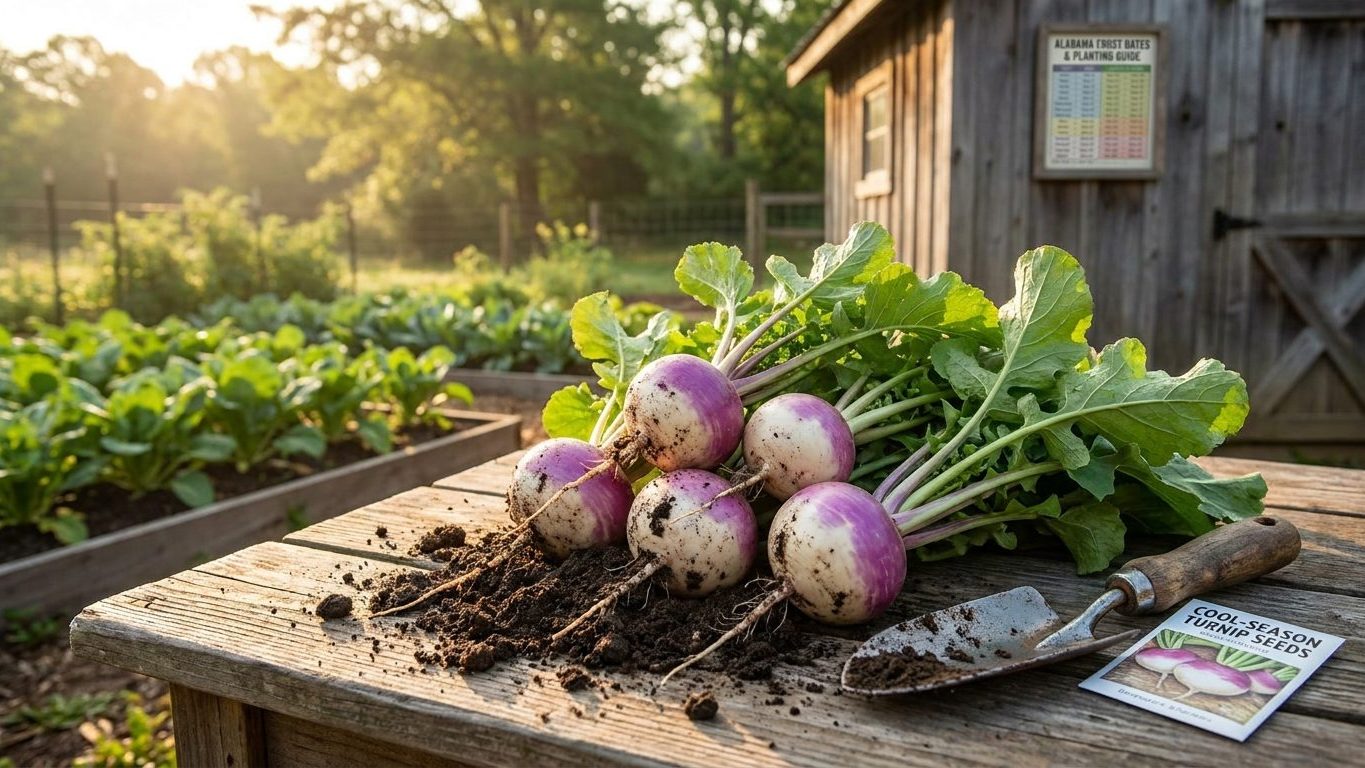

Kansas gardeners get two turnip windows each year: a spring sowing from mid-March through early April, and a fall sowing in early-to-mid August. The state’s frost dates, which run April 4 to April 18 in spring and October 23 to November 2 in fall, set the boundaries for both. Turnips mature in 30 to 60 days, fast enough to slide into either gap before summer heat or a hard freeze shuts the season down.
The short answer for Kansas
Sow turnips for a spring crop about two to four weeks before your last frost, and sow again for a fall crop roughly six to eight weeks before your first fall frost. Those two windows come straight from the frost data for the Wichita reference station: a last spring freeze landing between April 4 and April 18, and a first fall freeze between October 23 and November 2. Working backward from those dates gives a spring sowing target in the second half of March, and a fall sowing target in the first half of August.
The frost dates themselves need a footnote before you write anything down. NOAA’s 30 to 70 percent freeze-probability band means there’s a real chance of frost on either side of those windows, not a hard boundary. A April 4 date is the early edge of that band, meaning frost is still plausible after it in a cold year. That’s why most Kansas seed packets and extension guides push the spring sowing date a week or two later than the bare frost math suggests, to buy a cushion against a late cold snap.
Turnips tolerate a light frost once they’re up, which is part of why the spring window can start close to the frost date rather than well after it. The seedlings shrug off temperatures a few degrees below freezing; it’s the seed and the first tender leaves that are more exposed. Mid-March is the point most Kansas growers use to start spring turnips, giving the crop time to bulb up before the state’s summer heat arrives and turns the roots woody and bitter.
The fall window works on the same backward math but from the other frost date. Count back 30 to 60 days (the typical turnip maturity range) from October 23, the early edge of the fall frost band, and you land in the second half of August for the latest safe sowing, with earlier August dates giving a bigger buffer for slower varieties.
What will not work here

The most common turnip failure in Kansas isn’t frost, it’s the gap between the spring and fall windows. Sowing turnips in June or July, when soil temperatures are climbing past what the crop tolerates, produces plants that bolt to flower or turn fibrous before the root has any size. That’s not a Kansas quirk so much as basic turnip biology colliding with a Kansas summer, but the collision is sharper here because the coldest-month mean minimum of 22.5°F tells you this state doesn’t have a mild, extended shoulder season the way a coastal state might. The heat arrives fast and the cool window closes just as fast.
Rutabaga is the crop that gets caught worst by this squeeze. It needs 90 to 100 days to size up, well beyond a turnip’s 30 to 60, and neither Kansas window is long enough to comfortably fit it. A spring sowing in mid-March runs into summer heat long before day 90; a fall sowing in August runs into the October 23 frost date before day 90 as well, unless the grower pushes sowing into late July and accepts some risk of stunting in the tail end of summer heat. Rutabaga in Kansas is a crop for growers willing to watch the calendar closely, not a plant-and-forget vegetable.
Weekly watering will not carry a Kansas turnip crop through summer either. Once soil surface temperatures climb into the 80s and 90s, as they routinely do between the two sowing windows, turnip roots that dry out and rewet in cycles crack and turn woody, and the flavor turns sharp and bitter rather than sweet. That’s a reason, on top of the temperature problem, that gardeners here treat the June-to-July stretch as a no-sow period rather than trying to push a heat-tolerant variety through it.
Leaving mature turnips in the ground too far into November is the other trap. The 22.5°F average minimum for the coldest month means a hard freeze severe enough to damage stored-in-ground roots isn’t far behind the first fall frost date, so roots left unharvested past early-to-mid November are gambling against a cold snap that Kansas winters deliver reliably.
What changes across Kansas
Kansas sits across USDA hardiness zones 5b to 7a, and that spread means there’s no single sowing date for the whole state. A zone 5b garden in the north or in the higher elevations of the west sits noticeably colder than a zone 7a garden near the Oklahoma line, and the practical effect is a shift of roughly two to three weeks in both the spring and fall windows between the two ends of that range.
A 7a garden can expect an earlier last frost than the Wichita reference dates and a later first fall frost, which stretches both the spring planting start and the fall planting deadline in that grower’s favor. A 5b garden runs the opposite way: the last frost lingers later into spring, shrinking how early a spring sowing can safely go in, and the first fall frost arrives earlier, tightening the fall sowing deadline and putting more pressure on choosing a fast-maturing variety for that second crop.
Elevation compounds this inside a single zone too. Western Kansas sits at meaningfully higher elevation than the eastern third of the state, and gardens at altitude tend to run colder overnight than the flat zone map alone would suggest, which is part of why the zone range itself spans as wide as 5b to 7a rather than sitting in a tight band. A grower on a ridge or in a low-lying frost pocket within the same county as a neighbor can see frost dates that differ by a week or more from that neighbor’s garden.
None of this is something to guess at from a state-level article. The USDA Plant Hardiness Zone Map lets a Kansas gardener enter a ZIP code and see which of the 5b-to-7a range applies to their specific location, which is the starting point for shifting the sowing windows above in either direction.
Where to check this for your own county
Kansas State Research and Extension is the source that turns this state-wide window into a county-specific date. A state page like this one has to average across a 5b-to-7a range and a single reference weather station; a county extension office works from local frost records and from variety trials actually grown in that county’s soil and climate.
Two things are worth pulling up on the K-State site specifically. The first is the county-level vegetable planting calendar, which will list a turnip sowing window built on local frost data rather than the Wichita station used here, closing the gap between the state figure and what actually happens in a given county’s gardens. The second is the variety trial and recommendation list, which names the turnip and rutabaga varieties that have performed well in Kansas conditions rather than leaving that choice to a seed catalog written for a different climate entirely.
A county recommendation beats a state one every time, and it’s worth saying plainly that this page is the state one. The frost dates cited here come from a single airport weather station, and suburban and rural gardens across Kansas routinely see the last spring frost later and the first fall frost earlier than that station records, sometimes by a week or two, more at elevation. A county extension office, or a K-State Research and Extension local office, has usually already adjusted for that gap in the numbers it publishes.
Local Master Gardener programs, run through the same K-State extension network, are another practical resource for a Kansas-specific answer, since many keep informal records of sowing successes and failures for a specific county that never make it into a formal calendar.
Some gardeners also time this by the Moon: when to plant turnips by the moon, as almanac tradition rather than fact.
Checking this against your own garden
Every date on this page is a starting estimate, and a gardener’s own observations should override it once the season is underway. Three signs matter more than any calendar date for turnips specifically.
Soil warmth by feel is the first and most reliable. Turnip seed germinates poorly in cold, wet soil regardless of what the calendar says, so pressing a hand a few inches into the bed and feeling for soil that’s cool but no longer cold, with some give rather than a compacted, damp chill, is a better green light than the date on a seed packet.
Speed of germination is the second signal. Turnip seed sown into properly warmed soil typically shows the first true leaves within a week or so of the seed leaves emerging; a much slower pace suggests the soil is still too cold for that particular spot, even if the calendar date has already passed, and it’s worth noting that for next year’s sowing in the same bed.
A flowering stem appearing early on a spring-sown turnip is the third and most useful warning sign. Turnips bolt to flower under temperature stress, usually a stretch of unseasonable heat or an unusually cold snap right after germination, and a flowering stalk showing up well before the roots have sized up is the plant reporting that this particular spring pushed it past its comfort range. That signal, more than any date on a calendar, tells a Kansas gardener whether next year’s sowing needs to move a week earlier or later in that specific garden.