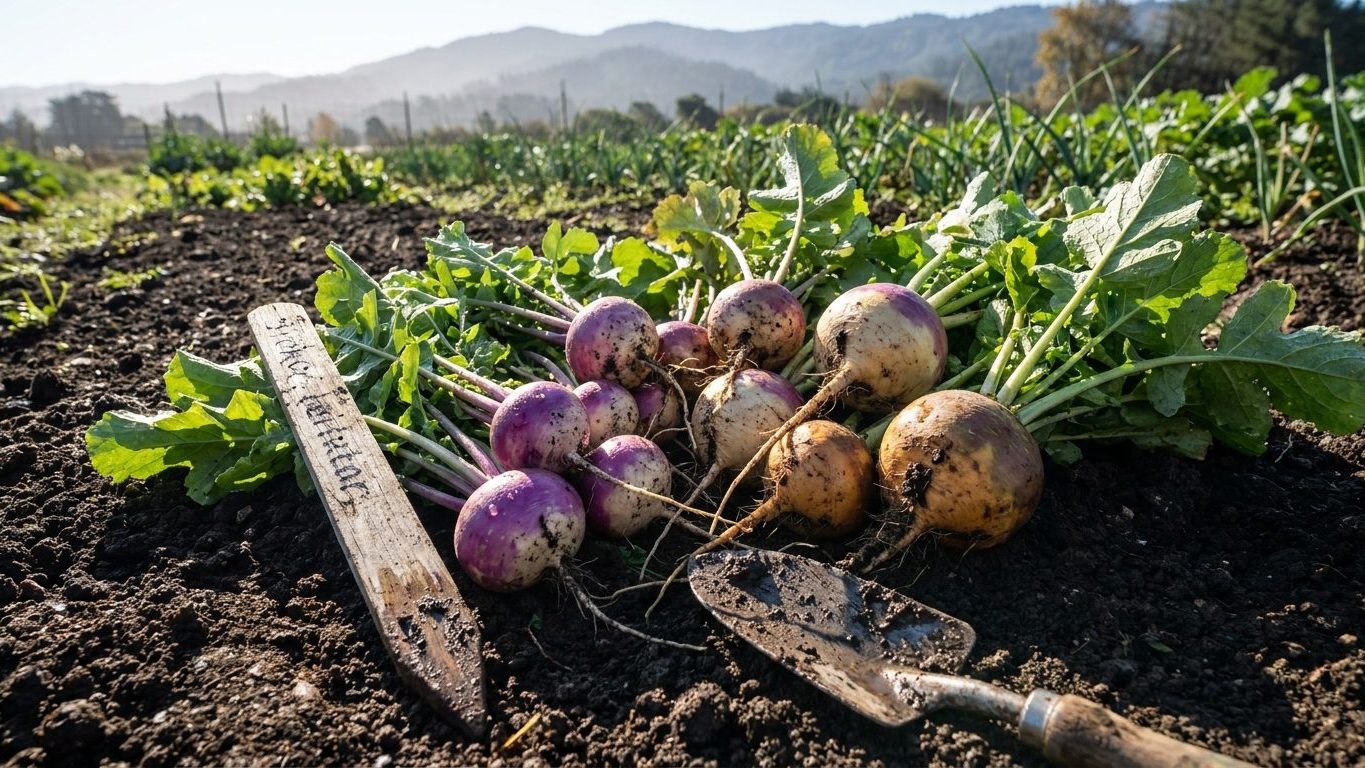

Fast turnips beat slow rutabaga in almost every Kansas garden, and timing matters more than variety choice. Purple Top White Globe, Tokyo Cross, and Hakurei mature quickly enough to dodge the state’s brutal summer heat when sown for a fall harvest. Rutabaga can work too, but only if seeded well before the season’s second half arrives.
The short answer for Kansas
Kansas gardeners get the best results treating turnips as a fall crop first, spring crop second. The state’s first fall frost lands between October 23 and November 2 at the reference station, and quick turnip varieties, the 30- to 60-day types like Purple Top White Globe, Tokyo Cross, and Hakurei, fit comfortably into that window if sown in late summer. Count backward from the earlier end of that frost range and a 60-day turnip needs to go into the ground by roughly late August.
Rutabaga is a different animal. American Purple Top and similar rutabaga varieties typically need 90 to 100 days to size up properly, which pushes the sowing deadline much earlier in the calendar. Working back from October 23, that means sow rutabaga no later than July 15 if you want roots ready before the ground freezes hard.
Spring planting is possible for both crops, since the last spring frost here runs April 4 to April 18, but it’s the riskier route. Kansas summers heat up fast once that frost date passes, and turnips sown too early in spring often bolt before the roots bulk up, especially once June arrives. Fall sowing avoids that problem entirely because the crop matures into cooling weather instead of rising heat, which is exactly why extension guidance across the Plains leans so heavily toward autumn turnip and rutabaga plantings rather than spring ones.
For most home gardens, that means two sowing dates worth marking: a rutabaga deadline in mid-July, and a turnip window that stretches into late August or even early September for the quickest varieties.
What will not work here

Long-season rutabaga varieties sown in spring are the single biggest mismatch for Kansas. The gap between the last spring frost (April 4-18) and the onset of real summer heat is short, and a rutabaga needing 100 days rarely finishes sizing before temperatures start pushing it toward bitterness and premature bolting. Spring rutabaga plantings here consistently underperform compared to fall ones, and most experienced growers in the region skip the spring attempt altogether.
Weekly watering is another quiet failure point. Turnip and rutabaga seeds need consistently moist soil to germinate, and late-summer soil in Kansas, especially in clay-heavy ground, can bake hard within a day or two under July and August sun. A once-a-week watering schedule during that stretch will leave patchy, uneven stands because the surface dries out between waterings and seeds simply don’t sprout. Germinating a fall crop here usually means light watering every day or two until seedlings are established, not a weekly soak.
Roots left in the ground too late into winter run into a separate problem. The coldest month here averages a daily minimum of 22.5°F, and turnip or rutabaga roots without a protective mulch layer can suffer freeze damage once temperatures settle into that range for extended stretches. Harvesting before the hardest freezes, or mulching heavily over roots left for winter storage in the ground, avoids losing a crop that otherwise survived the whole growing season.
Sowing rutabaga past its mid-July deadline is the third common misstep. A rutabaga started even three or four weeks late may still germinate and grow, but it won’t reach usable size before the first fall frost shuts things down, leaving gardeners with small, underdeveloped roots not worth the space they occupied all summer.
What changes across Kansas
Kansas isn’t one growing zone, it’s several stitched together, and that matters for timing decisions. The state spans USDA hardiness zones 5b through 7a, a real spread that separates the coldest northwestern counties from the milder southeastern corner near the Oklahoma border. A gardener in a 5b area faces an earlier first fall frost and a colder winter minimum than one gardening in a 7a pocket, even though both are technically “Kansas.”
That spread changes the sowing math laid out above. The frost dates and coldest-month figure cited here come from a single reference station, and gardens in colder zones within the state should expect their own first frost to arrive earlier, sometimes by one to two weeks, which pushes both the turnip and rutabaga deadlines earlier as well. A rutabaga sowing date of July 15 might need to move to July 1 for a gardener in a colder northwestern county, while a southeastern gardener in a milder pocket might stretch a week or two past that date and still finish the crop in time.
Elevation adds another layer here too. Higher ground in the western part of the state tends to see frost arrive sooner than the flatter, lower terrain further east, independent of latitude alone. There’s no single sowing date that fits every Kansas garden, and the zone range itself is the proof. Checking exactly where a given property falls on the USDA hardiness zone map, rather than assuming a flat statewide date, is the only way to know which end of that spread applies.
Where to check this for your own county
Everything above describes Kansas broadly, and a state-level answer is never as good as a county-level one. K-State Research and Extension publishes county-specific guidance that accounts for the local variation described in the previous section, and it’s worth spending a few minutes there before finalizing a planting date.
Two things are worth searching for specifically once on that site. First, a local planting calendar for the county in question, which will reflect actual frost timing for that spot rather than the single reference station cited on this page. Second, any list of turnip or rutabaga varieties that county agents have trialled or recommend for the local soil and climate, since some counties publish variety notes based on regional testing that go beyond the general Purple Top White Globe and American Purple Top recommendations given here.
Reaching out to the county extension office directly is often faster than searching the website alone. Extension agents field these exact questions every planting season and can usually give a specific sowing week for Turnips and Rutabaga based on decades of local observation, not just averaged climate data. That kind of county-level answer will always outrank a statewide one, including this page, because it accounts for the microclimate, soil type, and elevation quirks that a state-wide summary can’t capture.
Checking this against your own garden
Calendar dates are a starting point, not a guarantee, and a garden’s own signals eventually matter more than any frost table. Soil warmth is the first thing worth checking by hand before sowing turnip or rutabaga seed. If the top couple inches feel gritty-dry and hot to the touch in mid-summer, germination will struggle no matter what the calendar says, and a short delay until an evening watering cools things down often improves the stand.
Germination speed is the second signal. Turnip and rutabaga seed sown into properly moist, warm-but-not-scorching soil typically pushes up first true leaves within 7 to 10 days. A much slower emergence than that suggests the soil was too cold, too dry, or too compacted, and it’s a useful clue for adjusting timing the following season rather than blaming the variety.
The third thing to watch is early flowering. If a spring-sown turnip throws up a central flower stalk before the root has bulked up, that’s bolting, and it’s the plant’s way of reporting that heat arrived faster than expected for that particular garden’s microclimate. Noting how early that happens, relative to the last frost date, tells a gardener whether their own yard runs warmer or cooler than the reference figures used to plan the season, and that observation is worth more than any single date on this page.