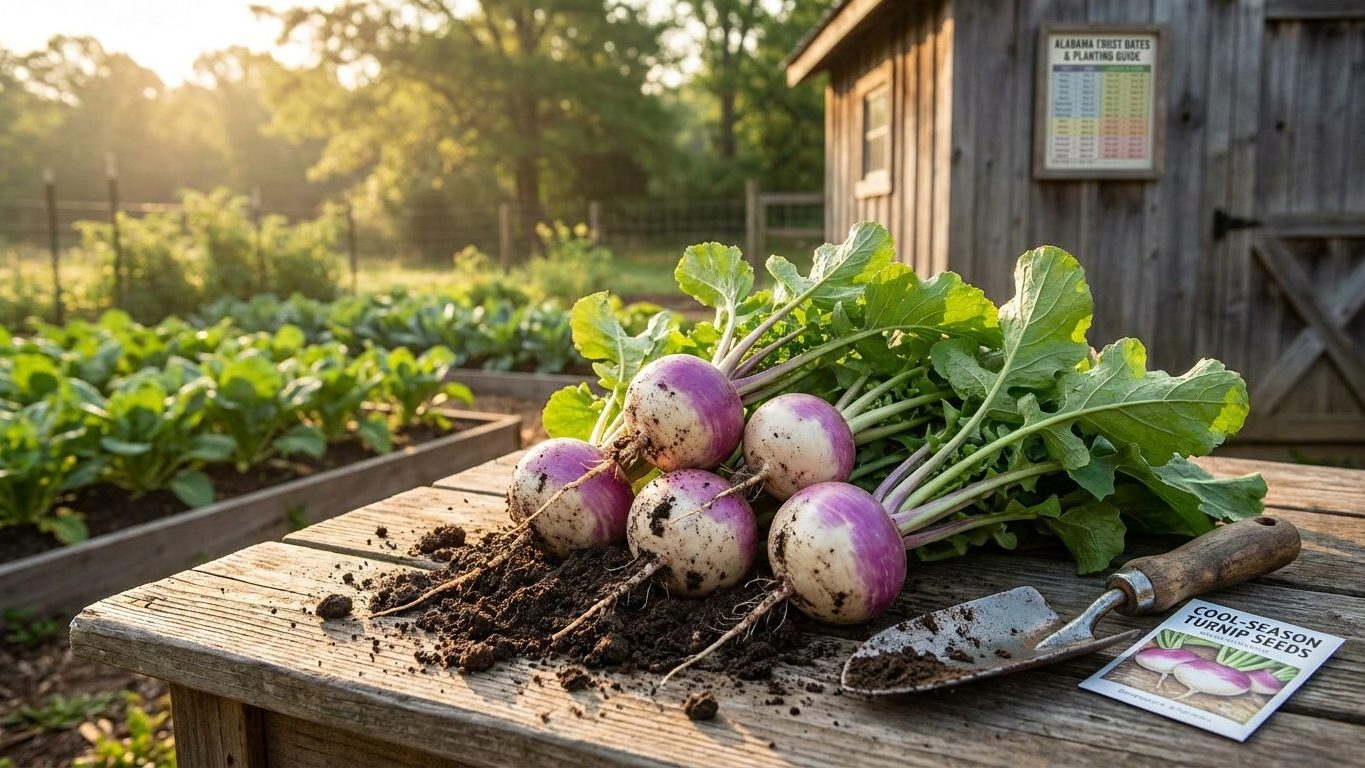

Turnip seed goes into Louisiana ground twice a year: once in early fall for a crop that grows through the mild winter, and again in mid-winter for a fast spring harvest before summer heat shuts things down. Unlike most states, frost barely factors into the Louisiana calendar. Heat does the deciding here, not cold.
The short answer for Louisiana
For a fall crop, get seed in the ground between September 1 and October 15, counting back from the first fall frost window of December 17 to January 8. Turnips run 40 to 60 days to maturity, so a September sowing reaches harvest well before that freeze window even opens, and keeps growing right through it since turnips tolerate a light freeze without much complaint. That’s the reliable planting.
The second window sits in January, timed against the last spring frost of January 18 to February 8. Because that spring frost date is so late compared to most of the country, and because Louisiana’s heat arrives fast once it arrives, a January sowing has to sprint. A 40-day turnip variety sown January 15 clears harvest by early March, well ahead of the April heat that pushes cool-season crops to bolt.
Both windows exist because of one fact specific to this state: a 32-degree freeze only occurs in 86.8 percent of years at the reference station near New Orleans. That means close to one winter in seven brings no hard freeze at all. Louisiana gardeners aren’t managing around a frost line the way a Midwest or New England grower does. They’re managing around a coldest-month average low of 46.1 degrees, which is mild enough that turnip roots and greens keep producing through most winters without protection.
That combination, a short and unreliable freeze plus a long hot season on both sides of it, is what makes the two-window approach necessary rather than optional. Sow once and stop, the way a colder-climate calendar suggests, and a Louisiana gardener misses half the productive year.
What will not work here

Rutabaga is the crop that struggles most under these numbers, and it’s worth naming directly. Rutabaga needs 90 to 120 days to size up, nearly triple what a turnip needs. Sown at the same September date as turnips, rutabaga is still in the ground when the erratic freeze window opens in late December, which isn’t necessarily fatal, but sown in January the way turnips can be, rutabaga simply runs out of season before the April heat arrives. There isn’t enough cool window left. Gardeners who plant rutabaga on a turnip schedule end up with woody, bitter roots forced to finish under stress, or roots that never finish at all.
A related failure shows up with late fall sowings pushed past mid-October in hopes of a bigger harvest. Because the fall frost date straddles the New Year and isn’t guaranteed, a late-October or November sowing gambles on cool, wet weather with no killing freeze to slow disease pressure. Louisiana’s humidity doesn’t let up just because the calendar says winter, and turnip greens sown too thick in that damp air are prone to leaf spot and rot before they ever reach harvest size.
Watering on autopilot fails here too, but not for the reason it fails in a drier state. The mistake in Louisiana isn’t under-watering, it’s ignoring drainage. Raised beds or ridged rows matter more than irrigation schedules, since a heavy fall rain sitting in a flat bed does more damage to a turnip root than a week without rain ever would.
Finally, treating the spring window as a full-season planting is a common misread. Because the last frost date runs into early February, gardeners assume they have until late spring to keep sowing. They don’t. The heat that ends the spring turnip crop has nothing to do with frost dates at all, and it arrives on its own schedule regardless of how late that last frost falls.
What changes across Louisiana
Louisiana’s hardiness zones run from 8a to 10a, a spread of two full zones across the state, so there is no single planting date that fits every parish. That range matters more for turnips than it might for a shrub or a perennial, because it tracks directly with how reliable that winter freeze is, and freeze reliability is what separates a one-window gardener from a two-window gardener.
In the northern parishes, closer to zone 8a, winters run cooler and freezes land more predictably. Gardeners there can trust the fall sowing to carry a full season of harvests without the greens turning to mush in an unseasonable warm snap, and the spring window opens a bit later relative to the encroaching heat, giving a few extra days of breathing room for a rutabaga to at least attempt a shortened crop, though it’s still a stretch.
Toward the coast and around zones 9b to 10a, the numbers cited for this page (the New Orleans-area frost dates and the 46.1-degree coldest-month minimum) apply closely. Here the fall window is the dependable one, and the spring window is the riskier of the two, since heat returns earlier and harder near the Gulf than it does upstate.
None of this tells an individual reader which zone covers their own yard. The USDA Plant Hardiness Zone Map is built for exactly that question, using average annual extreme minimum temperatures as its one variable, and checking a specific address against that map is the only way to know which end of Louisiana’s two-zone spread applies at home.
Where to check this for your own county
This page gives a state-level answer built from one reference station’s frost data. A parish-level answer will always beat it, and Louisiana has an office built to provide exactly that: the LSU AgCenter. It’s the extension service assigned to Louisiana under the USDA’s land-grant university system, and its vegetable planting guidance is drawn from trials and observations specific to Louisiana’s parishes rather than a single climate station.
Once there, the two things worth searching for are the parish-level vegetable planting calendar and the list of turnip and rutabaga varieties actually trialled in Louisiana conditions. A planting calendar built around one weather station, like the frost dates used on this page, can shift by a couple of weeks once local soil temperature and microclimate data get factored in. A county or parish-specific date, informed by years of local extension trial data, corrects for details this page can’t see: how fast a particular parish’s clay soil warms in January, or how much a river-bottom microclimate delays the first fall freeze compared to higher ground twenty miles away.
Variety trial data matters just as much as timing. Not every turnip variety on the market handles Louisiana’s humidity and compressed cool season the same way, and the AgCenter’s trial results reflect what has actually performed in-state, rather than a national seed catalog’s general description. Searching the LSU AgCenter site for a parish-specific vegetable planting guide is the single most useful next step for anyone trying to move past a state average and toward a date that matches their own soil.
Treat this page as the starting estimate, not the final word. It’s built to explain the mechanism, why Louisiana gets two sowing windows and why frost isn’t the limiting factor, but a parish office turns that mechanism into a date worth marking on a calendar.
If you follow the almanac, here is when to plant turnips by the moon. It is a tradition, not a proven method.
Checking this against your own garden
Every date above is a probability drawn from thirty years of station data, and a reader’s own soil will confirm or contradict it faster than any calendar can. Three things to watch matter more than the calendar once seed is actually in the ground.
The first is soil warmth by feel. Turnip seed germinates poorly in cold, waterlogged soil, so before an early September sowing, work a hand into the bed. Soil that feels cool and slightly damp but not cold to the wrist is ready; soil still holding summer’s baked crust needs another week.
The second is the timing of first true leaves. The rounded seed leaves that appear first aren’t the signal. Watch for the second set, the jagged true leaves, which typically show within 10 to 14 days of germination in warm Louisiana soil. A much slower emergence than that suggests the soil was cooler or wetter than ideal, a sign worth remembering for the next sowing date in that same bed.
The third is the first flush of male flowers, or bolting. If flower stalks appear on a spring-sown crop well before roots have sized up, that’s the plant reading rising soil and air temperature faster than the calendar predicted, an early signal that this particular yard runs warmer, sooner, than the state average this page is built on. Noting that one season shifts every future spring sowing at that address earlier by however many days the bolting arrived ahead of expectation, and that kind of adjustment, made from direct observation, outranks any date printed on a calendar.