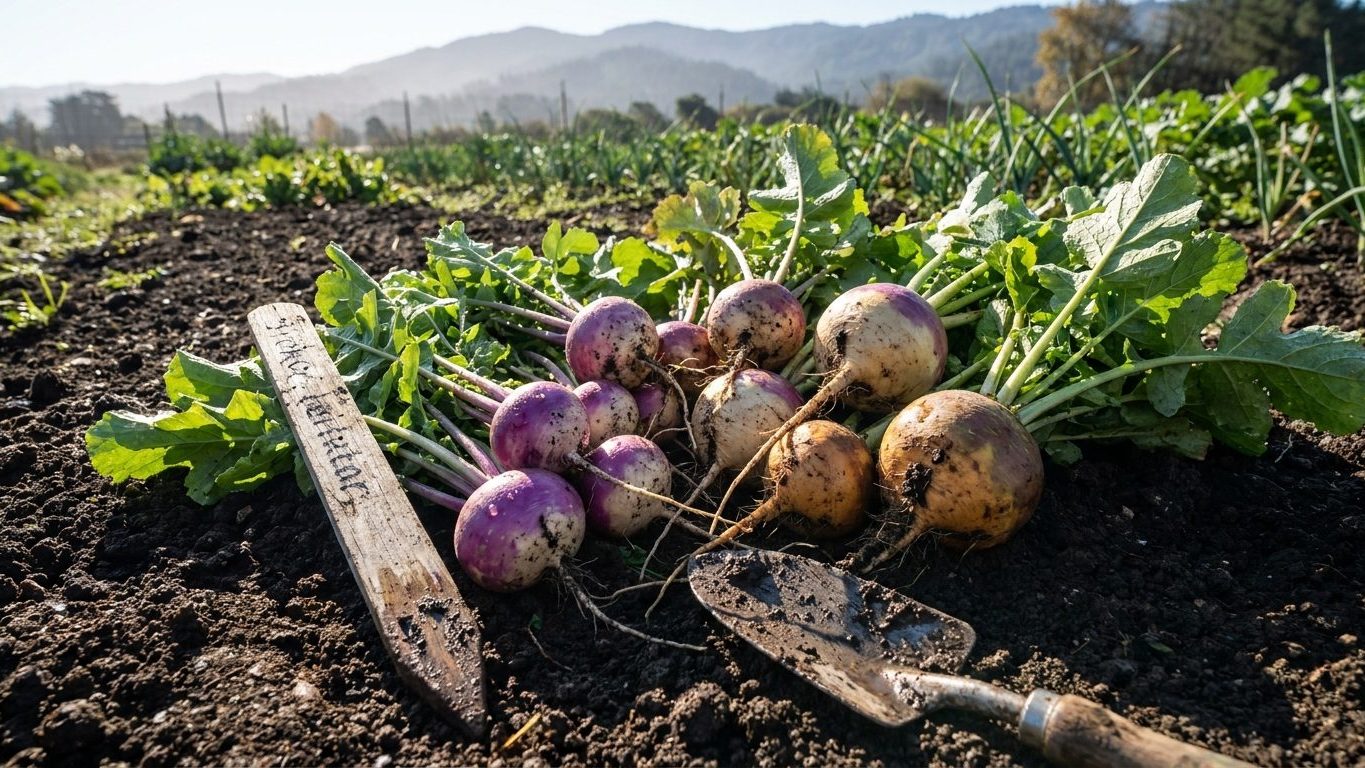

Massachusetts gardeners do best with fast turnips for spring and fall, and one solid rutabaga variety sown early enough to finish before the ground goes cold. The state’s frost window runs long enough for two turnip crops but only one rutabaga crop, and timing that single rutabaga sowing right is what separates a good harvest from a woody, undersized one.
The short answer for Massachusetts
Start with the turnips. Massachusetts frost dates give a growing season that opens around the first week of April and closes in early-to-mid November, which is enough room for a quick spring turnip crop and a second one in fall. For spring, pick a variety that matures in 40 to 55 days, something like Purple Top White Globe or a salad-type Hakurei, sown as soon as the soil can be worked after the last frost. These roots beat the July heat before it has a chance to turn them woody.
Fall is where turnips do their best work in New England gardens anyway, because cooler nights sweeten the roots instead of stressing them. Sow the same fast varieties again in early-to-mid August, and they’ll size up right as the season cools toward the first frost. A slower storage turnip, one that needs 60-plus days, still works for fall but only if it goes in the ground by late July at the latest.
Rutabaga is the crop that needs the most planning here, because it wants 80 to 100 days and hard soil-building heat is not its friend. Count backward from the first fall frost window (November 3 to 14) and a 90-day variety needs to go into the ground by early August at the latest, with late July giving more of a safety margin. American Purple Top and Laurentian are the two names most Massachusetts extension trial lists come back to, both bred for exactly this kind of long, cool finish.
None of this is a guess built on a neighboring state’s numbers. It comes directly from Boston-area frost data, which is the only reference point this page has for the whole state, a point worth remembering once you get into the section on regional differences below.
What will not work here

The single biggest mistake is treating Massachusetts like it has a long, easy autumn. It doesn’t, not everywhere. A 100-plus day rutabaga variety sown any later than early August is racing a clock it usually loses once you get away from the immediate coast, because the first fall frost in much of the state’s interior lands well before the November 14 end of the recorded range for the reference station.
Leaving roots in the ground through winter, hoping to dig them as needed, also fails here. The coldest month’s average daily low sits at 23.1°F, cold enough to damage or kill unmulched turnip and rutabaga roots left in open soil. Gardeners farther south sometimes get away with this trick; Massachusetts ground freezes too hard, too often, for it to be reliable without serious mulching and a mild pocket of the state.
Heat and spacing mistakes
Summer heat is the other quiet killer, especially for quick turnips sown in June or early July instead of spring or fall. A stretch of 85-degree days with inconsistent watering pushes turnips to bolt or turns the flesh pithy and sharp-tasting, the opposite of the sweet, tender root a cool-season crop is supposed to produce. Watering on a fixed weekly schedule doesn’t fix this; turnips need consistent moisture through any hot spell, not a once-a-week soak that lets the soil dry out in between.
Crowding is a separate problem, and a more common one. New England summers run humid enough that turnip and rutabaga plantings set too close together stay damp at the base longer after rain or dew, which is exactly the condition flea beetles and root diseases favor. Thinning aggressively, rather than leaving a full row to fend for itself, is the boring fix that actually works.
What changes across Massachusetts
Massachusetts is not one garden, and the hardiness zone range makes that obvious on its own: the USDA map places the state anywhere from zone 5a to zone 7b, a spread of five full half-zones between the coldest inland pockets and the mildest coastal and island spots. That is one of the widest internal ranges of any state this size, and it means a single planting date for the whole state is close to fiction.
The frost data behind this page comes from Boston’s Logan Airport station, a waterfront, urban site that runs milder than almost anywhere else in the state. Inland suburbs, the Connecticut River Valley, and especially the Berkshires in the west see their first fall frost noticeably earlier and their last spring frost noticeably later than the numbers quoted here. For a rutabaga grower in one of those colder pockets, that difference is not trivial: it can mean shifting the sowing date two to three weeks earlier just to keep the same 90-day window open before frost shuts it down.
Elevation compounds the effect. Higher ground in the Berkshires and the hill towns of central Massachusetts holds cold air longer into spring and collects it earlier in fall, the classic frost-pocket pattern that has nothing to do with latitude and everything to do with terrain. Cape Cod, the Islands, and the immediate South Coast sit at the other end of that spread, closer to true zone 7 conditions where the growing season runs measurably longer on both ends.
None of this means picking a different variety altogether. It means shifting the calendar this page gives you, earlier for cold pockets, later for the mild coastal edge. The right tool for figuring out which side of that spread a given spot falls on is the USDA Plant Hardiness Zone Map itself, not a guess based on county lines.
Where to check this for your own county
This page gives Massachusetts one set of numbers built around a single Boston-area weather station. Every county in the state has its own extension resources built around local trial data and local frost records, and those numbers should override anything written here when the two disagree.
The UMass Amherst Extension site is the place to start. Look specifically for two things once you’re there: a county- or region-level vegetable planting calendar, which will give sowing windows tuned to local frost data rather than the statewide range used on this page, and any variety trial results for turnips or rutabaga, which show which specific cultivars have actually performed well in Massachusetts soil and Massachusetts summers rather than just on a seed catalog page.
Cooperative extension programs run these trials county by county for a reason: soil type, elevation, and coastal proximity all shift outcomes enough that a variety that thrives in a sandy Cape Cod garden can struggle in the heavier clay soils of the Connecticut River Valley. A recommendation built on that kind of local trial data will always beat a state-level generalization, including this one.
The practical move is simple. Before committing to a sowing date pulled from this page, spend ten minutes on the UMass Extension site searching for your specific county’s vegetable planting guide. If one exists, and for most Massachusetts counties one does, that’s the number to plant by.
Checking this against your own garden
Every date on this page is a statistical average built from thirty years of weather records at one airport. Your actual garden, sitting in its own microclimate, will tell you more than any calendar once you know what to watch for.
Soil warmth by hand is the first check. Turnip and rutabaga seed germinate reliably once the soil no longer feels cold and damp to the touch, closer to the temperature of a cool basement than a refrigerator. If a handful of soil still feels chilled and clumps together rather than crumbling loosely in early April, the ground hasn’t caught up to the calendar yet regardless of what the frost-date table says.
The second signal is germination speed itself. Turnip seed sprouts fast in favorable conditions, often within a week; if it takes noticeably longer, that’s the garden telling you the soil is running colder than the season’s frost data suggests, a common story in shaded yards or low-lying spots that hold cold air.
Watch for the first true leaves after the initial seedling leaves appear, usually within two weeks of a healthy germination. Slow, stunted true-leaf growth in a spring planting is often the plant’s way of flagging soil that’s still too cool or too wet, a sign worth heeding before investing in a full row for the season ahead.