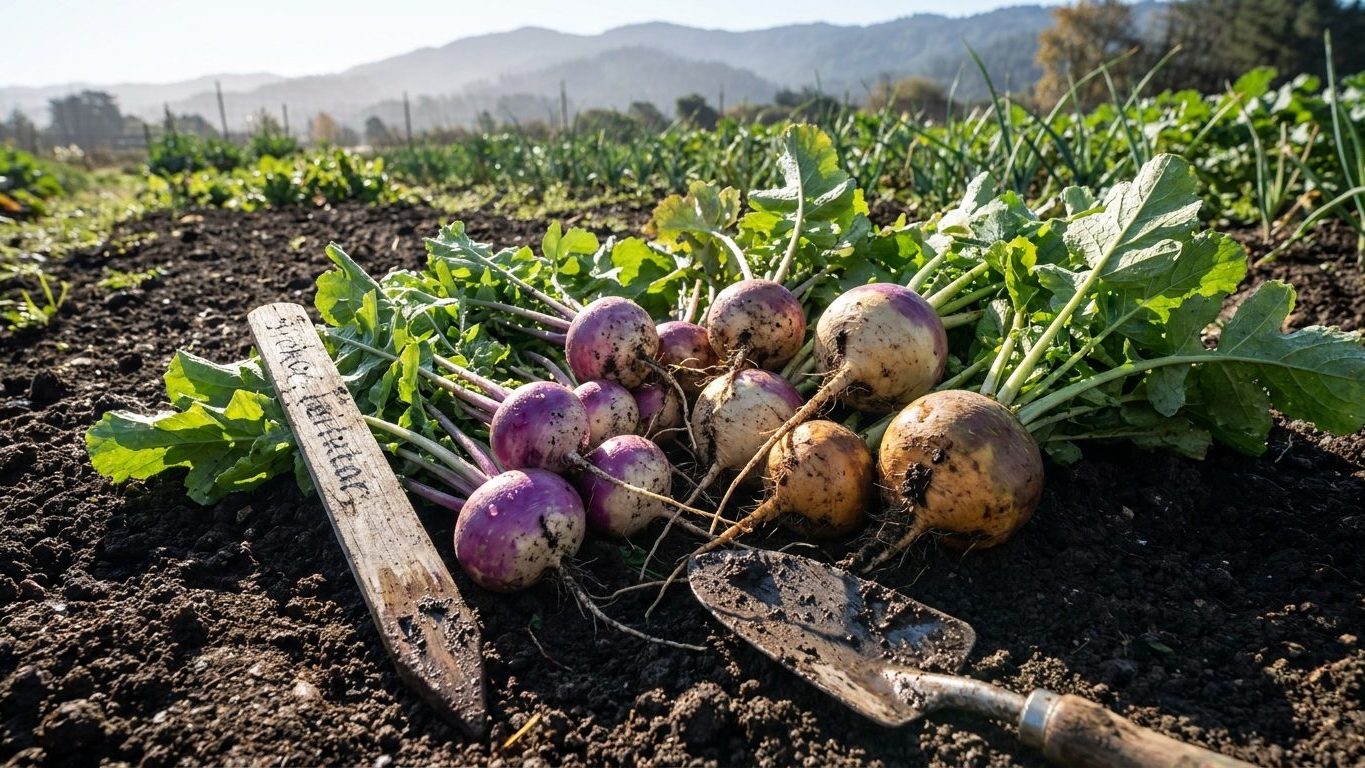

In Mississippi, quick-maturing turnip varieties work in both spring and fall plantings, but rutabaga only makes sense as a fall crop. The state’s long, warm fall window gives rutabaga the 90 to 100 cool days it needs to size up, while spring planting almost always runs into summer heat before the roots finish.
The short answer for Mississippi
Turnips split into two jobs here: quick roots and greens for spring, and a longer fall run for both roots and rutabaga. Because Mississippi’s growing season stretches from early spring frost risk clear through mid-November, gardeners actually get two shots at turnips a year, but only one realistic shot at rutabaga.
For spring, pick fast varieties that finish in 40 to 50 days from seed. Purple Top White Globe and Tokyo Cross both fit that window, and both tolerate a quick jump in temperature better than slower-maturing types. Sow them as soon as soil can be worked after the last spring frost window of March 6 to March 22, and expect harvest well before the state’s brutal early-summer heat turns the roots woody and bitter.
Fall is where Mississippi turnip growing really shines, and it’s also the only season worth trying rutabaga. Rutabaga needs 90 to 100 days of cool, steady growth to bulk up properly, and it actually improves in flavor after a light frost touches the leaves. Counting back from the first fall frost window of November 7 to November 22, that means getting rutabaga seed in the ground by late July to early August in most of the state. Miss that window and the roots stay small and fibrous going into winter.
American Purple Top and Laurentian are the two rutabaga varieties most commonly grown in the Deep South, both bred to handle the swing from hot late-summer soil to cool November nights without splitting. For fall turnips grown purely for greens, faster is still better: Seven Top and Shogoin both push usable leaves in three to four weeks and can be cut multiple times before frost shuts things down.
The pattern holds across the state: short-season turnip varieties do double duty in spring and fall, rutabaga gets one long fall run, and both crops depend far more on hitting the right sowing date than on any particular brand of seed.
What will not work here

Slow rutabaga plantings started in spring are the most common failure in Mississippi gardens. Rutabaga sown after the last spring frost in March has to bulk up right as daytime temperatures climb into the 80s and 90s by late May, and the plant simply bolts to seed instead of forming a root. The coldest month here still averages a daily minimum of 36.6°F, which tells you how mild Mississippi winters really are, but it also means summer heat arrives early and stays late, leaving almost no cool window for a spring rutabaga crop to finish.
Long-season turnip varieties bred for northern climates run into the same wall. A turnip that needs 70 or 80 days to mature, planted in spring, is still in the ground when July heat hits, and the roots turn pithy and sharp-tasting well before they reach full size. Those same varieties do better as a fall crop, but only if sown early enough to build root mass before frost, not right up against it.
Weekly watering fails Turnips and Rutabaga in a Mississippi summer sowing. Both crops need consistently moist soil to form smooth, crack-free roots, and the gap between a Tuesday watering and a Sunday one is often enough for late-July soil to dry out completely under full sun. Uneven moisture is the single biggest cause of split or hollow roots reported by home gardeners here, more than any variety choice.
Tight spacing causes a different problem in Mississippi’s humid air. Turnip and rutabaga foliage packed close together stays wet longer after summer thunderstorms, and that damp canopy is exactly what invites downy mildew and leaf spot. Standard spacing guides written for drier states undersell how much airflow matters once humidity climbs into July and August, so gardeners here need wider rows than a seed packet from a northern seed company typically recommends.
Finally, treating the whole state as one climate is its own kind of failure. A sowing date that works in the Delta can be two weeks off for a garden in the hill country or near the Tennessee line, which is exactly the next problem worth untangling.
What changes across Mississippi
Mississippi spans USDA hardiness zones 7b to 9a, a range built entirely on average extreme minimum winter temperature. That spread runs from the cooler hill country in the northeast down to the Gulf Coast, and it matters directly for fall rutabaga timing: a zone 7b garden in the north sees frost arrive noticeably earlier than a 9a garden near the coast, which shortens the cool-season window rutabaga depends on.
There is no single sowing date that fits the whole state, and any calendar claiming otherwise is glossing over a real gap. Northern counties should treat the early end of the fall frost window, around November 7, as the planning target and get rutabaga and long-season turnips in the ground correspondingly earlier. Southern and coastal counties, working closer to the November 22 end of that window, get an extra two weeks of growing time, which sometimes allows a second, smaller succession sowing of quick turnip greens after the first harvest.
Elevation plays a smaller but real role too. The hill country in the northeastern part of the state sits higher than the Delta and the coastal plain, and higher ground cools faster on clear fall nights. Gardeners there often see their first frost arrive before the state-wide window even opens, which argues for treating late July as the outer edge for rutabaga seeding rather than early August.
Because the reference frost dates used on this page come from a single airport weather station, they represent one point in a wide range, not a guarantee for every backyard. A reader gardening in a low-lying rural spot or a shaded valley should expect frost a week or two earlier in fall and later in spring than the state numbers suggest, which pushes the safe rutabaga sowing date earlier still. The map, not this page, is where that local answer lives.
Where to check this for your own county
The Mississippi State University Extension Service, at extension.msstate.edu, is the source built specifically for county-level answers this state page can’t give. A state-wide article can only describe the range of conditions across Mississippi. Extension publications are written and updated for a specific county’s soil, frost pattern, and pest pressure.
Two things are worth looking for once there. First, the county-specific vegetable planting calendar, which will list actual sowing date ranges for Turnips and Rutabaga rather than the broader state windows used here. Those calendars are built from decades of local frost records, not a single airport station, so they tend to be more precise for backyard conditions.
Second, look for any variety trial results or recommended cultivar lists published for the Delta, the hill country, or the Gulf Coast region specifically. Mississippi State’s horticulture specialists periodically test turnip and rutabaga varieties for regional performance, flagging which ones handled local humidity, disease pressure, or an unusually early frost better than others that same season. That kind of trial data reflects real growing conditions in a specific part of the state, something this page, working from state-wide climate normals, simply cannot replicate.
A county Extension office can also answer the one question no calendar fully covers: soil-specific advice. Mississippi’s soils range from heavy Delta clay to sandier coastal ground, and drainage differences between those soil types change how Turnips and Rutabaga handle a wet fall. That’s a detail worth a phone call, since the local county agent has usually seen it play out in gardens nearby. A county-level recommendation beats a state one every time, and this page is the state one.
Checking this against your own garden
No calendar date beats what the soil and plants are actually telling a gardener, and three simple checks reveal more than any frost table.
Soil warmth by feel is the first. Turnip and rutabaga seed germinates poorly in soil that still feels cold and damp rather than cool and workable; if a handful crumbles easily and feels closer to room temperature than refrigerator temperature, it’s ready for late-summer sowing regardless of the calendar date. Waiting for that feel, rather than a fixed date, accounts for the shade, slope, and soil type unique to one yard.
The first true leaves are the second signal. Turnip seedlings push up rounded seed leaves first, then a set of true, ruffled leaves that actually resemble the mature plant. That shift usually shows up within two weeks of a good germination, and a much longer wait than that signals the soil was too cool, too dry, or too compacted for vigorous early growth, useful information for the next planting.
Watching for early flowering is the third. Turnips or rutabaga that send up a flower stalk well before the root has bulked up are bolting from heat stress or a lingering cold snap, not from age. A plant that bolts early in a particular bed, season after season, is pointing at a microclimate problem, whether that’s a spot that heats up faster than the rest of the yard or one that catches a late cold pocket other beds avoid. Tracking where and when that happens over a season or two builds a far more accurate personal calendar than any state-wide frost date ever could.