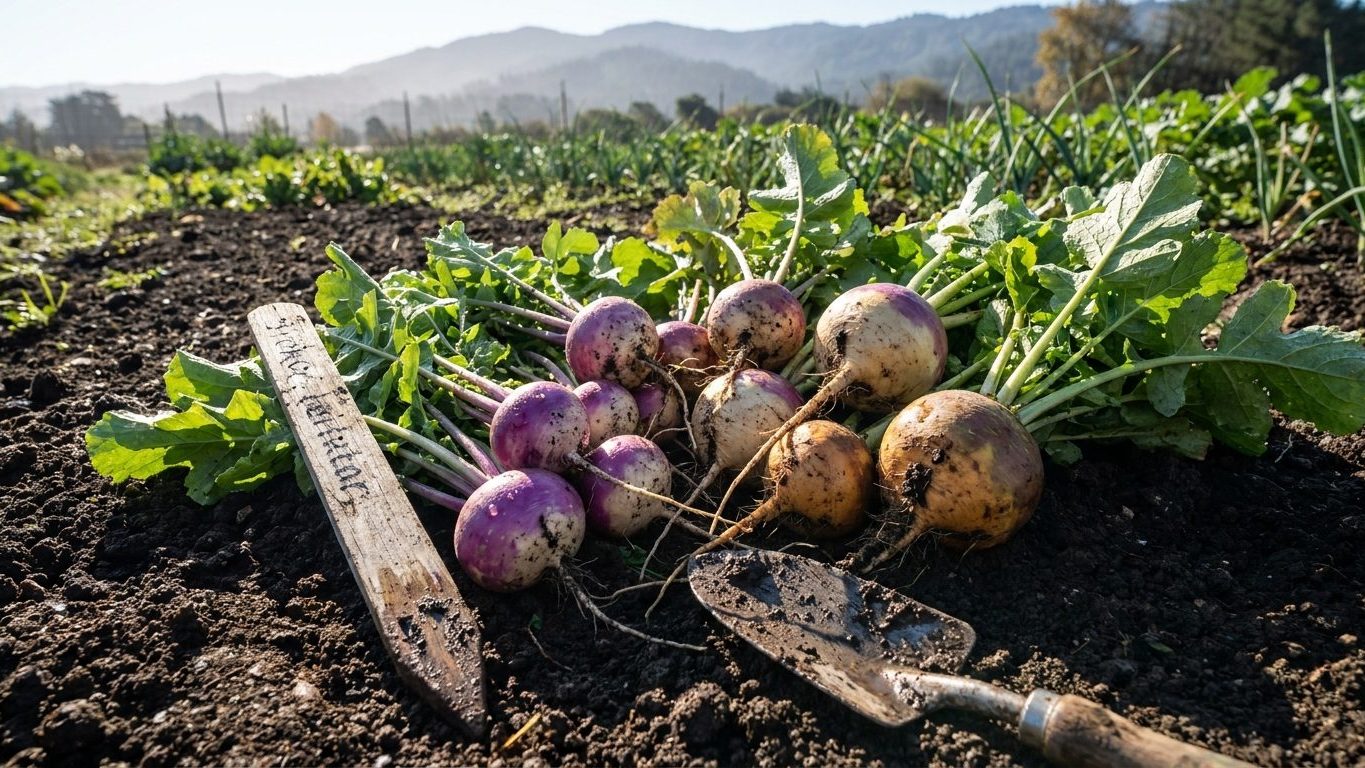

Nevada’s answer isn’t one variety, it’s a decision built on where you garden. In the high desert and mountain valleys, fast turnips like Purple Top White Globe or Tokyo Cross are the safe bet because the growing season is short. In the low-elevation southern valleys, that same short-season logic doesn’t apply, and rutabaga becomes possible as a cool-weather crop instead of a summer gamble.
The short answer for Nevada
Start with the type, not the cultivar name. Turnips split into fast roots (35 to 55 days) and standard roots (55 to 65 days), while rutabaga runs long, typically 90 to 100 days from seed to a fist-sized root. That gap in days is the whole story for Nevada, because this state doesn’t have one growing season. It has several, stacked from the Sierra foothills down to the Colorado River valley.
Where winters bite hard and summers stay short, cool, or both, fast turnips are the dependable choice. Purple Top White Globe, Hakurei, and Tokyo Cross all mature before a narrow window closes, and their leaves double as a fast, forgiving green if the root crop underperforms. Rutabaga is a harder sell in these spots. It wants a long, steady stretch of cool weather, and asking it to finish in a compressed window is asking for a woody, undersized root or an unfinished one caught by frost.
Where the climate runs warmer and the frost-free stretch is genuinely long, the calculation flips. This is where a reference station like Las Vegas becomes useful, not as a planting guide but as an illustration of how mild a low-desert winter can be: the coldest month there averages a daily minimum of 39.6°F, which is warm enough that turnips and even rutabaga can be grown as a fall-into-winter crop rather than squeezed into a short summer window. That’s a fundamentally different strategy than in the northern and high-elevation parts of the state, and it’s why “best varieties for Nevada” has to be answered by climate zone, not by a single statewide list.
So the practical rule: if you don’t know your local season length off the top of your head, default to fast turnips first. They forgive a shorter window, they forgive a late start, and they give you a second shot if the first sowing fails. Reserve rutabaga and standard-season turnips for spots where you can already point to a long, cool stretch on the calendar, whether that’s a mild low-desert fall or a favorable microclimate at lower elevation.
What will not work here

The clearest failure mode in Nevada is planting a 90-day rutabaga where the season simply won’t give it 90 usable days. Northern valleys and anywhere at meaningful elevation lose their growing window from both ends: fall frost arrives early, spring frost lingers late, and the cool, mild middle that rutabaga needs to bulk up a root never fully materializes. A rutabaga planted on the same date a fast turnip would thrive is often still setting a fist-sized root when the first hard freeze of the season shuts it down.
The opposite failure shows up in the state’s hot, dry stretches. Nevada is largely arid, and turnip roots split, turn woody, or bolt to flower when soil moisture swings between bone-dry and soaked. A gardener watering on a convenient weekly schedule, rather than reading the soil, will often see roots crack right through the shoulder or turn fibrous and sharp-tasting. Turnips and Rutabaga both want steady, even moisture, and in a dry climate that usually means checking soil more than once a week, not less, especially once the root starts to size up.
Heat is the third trap. Turnips are a cool-season crop by nature, and pushing a summer sowing into a hot, dry Nevada stretch invites bolting before the root ever forms, along with bitter, tough flesh even if a root does develop. This is less about a specific date and more about matching the crop to the cool bookends of the year, spring or fall, rather than mid-summer.
Put together, the varieties that fail here aren’t bad varieties, they’re mismatched ones. A rutabaga bred for a long, mild coastal or northern-tier season will underperform in a short Nevada window at elevation. A turnip sown into peak summer heat will bolt regardless of how carefully it was chosen. The fix in both cases is the same: shorten your day-count expectations where the season is short, and shift your sowing window to the cool edges of the year where the summer runs hot and dry.
What changes across Nevada
Nevada’s official hardiness range runs from zone 4a to 10a, and that spread is enormous by USDA standards, the kind of gap that separates a state that grows only fast turnips from one that can also grow rutabaga in a mild season. Zone 4a describes a place with brutal winter extreme minimums, the sort of cold that shortens the frost-free season dramatically. Zone 10a describes conditions closer to a desert winter that barely freezes at all. No single planting date or variety list can honestly serve both ends of that range.
A reader gardening in the north, in the mountain valleys, or at meaningfully higher elevation should assume a shorter, cooler growing window than the state’s warmest pockets, and should lean toward the fastest-maturing turnip varieties, treating rutabaga as an ambitious project rather than a default choice. A reader in the lower, warmer valleys has more room to experiment, including a fall-planted rutabaga that finishes during a mild winter stretch rather than racing a summer clock.
This isn’t a case of picking a variety and calling it done statewide. The hardiness zone spread alone tells you Nevada contains something closer to several distinct gardening climates than one. Elevation shifts things further still, since two towns at similar latitude can sit in different zones purely because one sits a few thousand feet higher. That difference shows up directly in both the length of the frost-free season and how deep the winter cold actually goes.
The one thing this page won’t do is tell an individual reader which zone applies to their own yard, because that number depends on exact location and elevation in a way a state-level article can’t resolve. What it can say is that the gap between the state’s coldest and warmest zones is wide enough that “Nevada” as a single climate doesn’t really exist for planting purposes, and the USDA’s own hardiness zone map is the tool built to narrow that down to a specific spot.
Where to check this for your own county
This page describes Nevada in broad strokes: fast turnips as the safe default, rutabaga as an option only where the season runs long and mild. That’s useful for deciding a general strategy, but it isn’t a substitute for a local recommendation, and a county-level source will always beat a state-level one for the specifics that actually matter, like exact sowing dates and which varieties have proven themselves in trials near you.
The University of Nevada, Reno Extension is the state’s land-grant extension service, and its site is the right next stop. Two things are worth hunting for there specifically. First, a county or regional planting calendar, since Extension offices typically publish sowing windows tied to local frost data rather than a single statewide date. Second, any variety trial results or recommended cultivar lists for vegetables in your area, which reflect what has actually performed well in Nevada soil and climate rather than a generic seed catalog description written for a national audience.
If your county doesn’t have its own dedicated page, the Extension office itself is worth a direct call or email. Local Extension staff and master gardener volunteers are used to fielding exactly this kind of question, and they can usually speak to microclimate quirks, like a valley that runs a few degrees colder than the surrounding area, that no map or state guide will capture.
Treat this article as the starting framework, the general logic of season length and heat that shapes the decision. Treat your county Extension office as the source that turns that framework into an actual planting date and an actual variety name for your specific yard. Where the two disagree, follow the county-level guidance, since it’s built on data closer to your own soil.
Checking this against your own garden
Even a solid county recommendation is still an average, and your own garden will tell you things no calendar can. Three simple checks, none requiring anything beyond your hands and eyes, will confirm whether the season is actually behaving the way the date on a calendar assumes it will.
Start with the soil itself. Push a finger a couple of inches into the bed before sowing. Turnip seed germinates poorly in cold, wet soil, and if it still feels chilly and damp rather than cool and workable, the ground hasn’t caught up to the calendar yet, regardless of what the date says. Waiting a few more days for that soil to warm by feel is a better guide than sowing on a fixed date.
Next, watch the first true leaves. Turnip seedlings emerge with a pair of smooth, rounded seed leaves first, then the true leaves that follow look distinctly different, more textured and turnip-shaped. Once you see two or three sets of true leaves, the plant has moved past its most fragile stage and is actively building the root, a good sign the local conditions are supporting steady growth rather than stalling it out.
Finally, keep an eye on the root shoulder as it starts to push up out of the soil surface. That’s the plant telling you it’s sizing up, and it’s also your cue to start checking size and firmness by hand rather than by the day-count on the seed packet, since a hot stretch can push a root to maturity faster than expected, while a cool spell can slow it down. Reading these three signals, soil feel, leaf stage, and shoulder emergence, will tell you more about your own microclimate than any statewide planting date ever could.