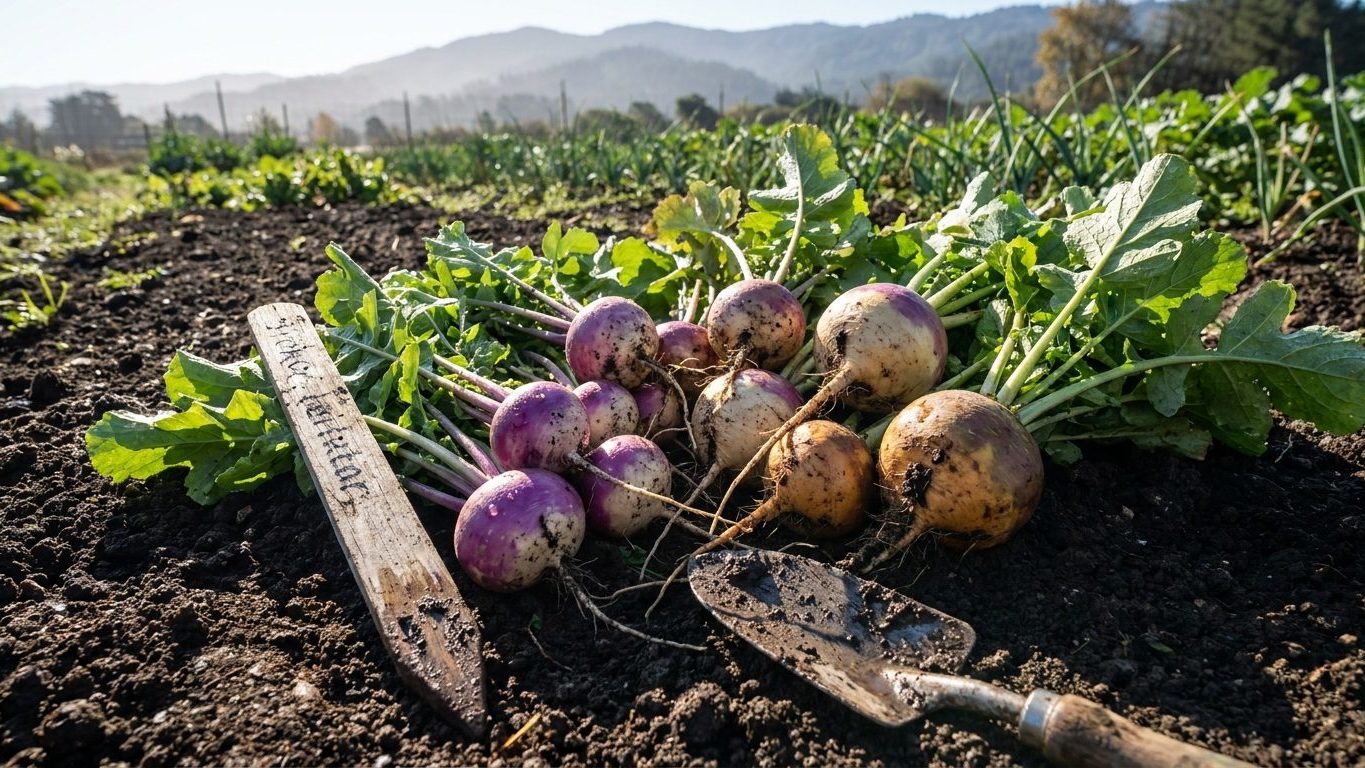

Montana’s short growing season and hard winters rule out slow-maturing types. The safest bets are fast turnips like Purple Top White Globe or Hakurei for quick roots and greens, and cold-hardy rutabaga like Laurentian or American Purple Top, sown early enough to finish before the ground locks up in October.
The short answer for Montana
Billings, the reference station for this territory, sees its last spring frost between April 29 and May 10, and its first fall frost between October 1 and October 14. That gives a working season of roughly 145 to 165 days in the mildest valley in the state. Turnips typically need 30 to 60 days from seed to usable root, so they fit comfortably in that window, even with room for a second sowing in midsummer for a fall crop. Rutabaga is a different animal. Most varieties need 90 to 100 days to bulk up properly, which means the sowing window is tight even in Billings, and tighter everywhere colder.
The decision, then, comes down to type rather than variety name alone. If the goal is fast, forgiving harvests, quick turnips sown in succession from early May through early July give the best return. Purple Top White Globe is the workhorse here: it tolerates a cool start, sizes up in about 55 days, and holds decently in the ground if a frost catches it before harvest. Hakurei, a Japanese salad turnip, matures even faster, often in 38 days, and its skin stays thin enough to eat raw, which matters when the growing window doesn’t leave much room for a slow braising vegetable to develop the sweetness people expect.
Rutabaga asks for more planning. Because it needs the full length of the season, seed should go in the ground by early June at the latest in Billings-equivalent conditions, and earlier than that anywhere colder or at elevation. Laurentian is the standard choice for northern gardens because it was bred for exactly this kind of short, cool season and holds its quality in storage afterward. American Purple Top is a close second, slightly larger at maturity but needing a few more days to get there. Neither variety will forgive a June planting date if the first frost lands on the early side of that October 1 to 14 window.
What this means practically: treat Turnips and Rutabaga as two separate crops with two separate calendars, not one root vegetable planted the same week. Turnips reward patience and multiple sowings. Rutabaga rewards getting in the ground on time and then leaving it alone.
What will not work here

Late-maturing rutabaga varieties, the ones bred for longer growing regions and needing 110 days or more, are the clearest failure point in Montana gardens. Sown any later than early June, they simply run out of season before the October frost line arrives, and a rutabaga pulled early is small, fibrous, and not worth the bed space it occupied all summer. This isn’t a matter of technique. It’s math: the days aren’t there.
Weekly watering is another quiet failure mode, particularly for turnips grown through the hotter stretch of summer in the eastern and central parts of the state. Turnips are shallow-rooted and dry out fast in a week between waterings, especially once temperatures climb into the 80s and 90s. The result isn’t a dead plant, usually. It’s a bitter, woody root and a strong push toward bolting, where the plant abandons root development and rushes to flower instead. Once a turnip bolts, the root is done. A soaking every two to three days during hot spells, rather than a deep once-a-week dose, keeps the root growing evenly instead of stalling and cracking.
Trying to overwinter rutabaga in the ground, a trick that works in milder climates, doesn’t hold up against Montana’s cold. The mean daily minimum in the coldest month at the Billings reference station sits at 17.9°F, and that’s the milder end of the state’s range. That kind of cold reaches well into the soil, especially without heavy snow cover to insulate it, and a rutabaga left in the ground past a hard freeze is likely to turn to mush rather than sweeten, the way some gardeners hope. Roots need to come out and go into cold storage, a root cellar, or a refrigerator once the ground temperature drops toward freezing, not stay buried as a natural cooler.
Tight spacing is a smaller issue here than in humid regions, since Montana’s dry air keeps foliar disease pressure lower. But crowding still matters for root size. Turnips packed closer than about 3 inches apart, or rutabaga closer than 8, will compete hard for the limited moisture available and come out undersized, which defeats the purpose of growing a root crop in the first place.
What changes across Montana
Montana spans USDA Hardiness Zones 3a through 6a, a range wide enough that no single planting date works for the whole state. That’s a four-and-a-half zone spread inside one set of borders, which is unusual even among large western states. Billings, at the milder end near 6a, gets the frost dates cited above. Higher-elevation valleys and the northern tier of counties, closer to 3a, run colder in every direction: frost can arrive later in spring, leave earlier in fall, and in some mountain valleys, show up in any month of the year regardless of season.
For a reader gardening north of the milder valleys or up in elevation, the practical shift is to move rutabaga sowing dates earlier, not later, since the growing window is shorter, not longer. Waiting for warm soil the way a gardener might in a longer-season state means missing the only stretch of days long enough to mature the crop. Turnips have more flexibility because they mature so fast, but even they benefit from an earlier first sowing and a earlier cutoff for the last one, since an unexpected September or even August frost is a real possibility at higher elevations.
The reverse also holds. A gardener in one of the warmer valley floors, closer to the 6a end of the range, has more room to experiment: a third succession sowing of turnips in late July, or a slightly later rutabaga planting than the early-June guideline above, becomes realistic where the season runs longer.
This page can’t tell an individual reader which zone applies to their own yard, since elevation, slope, and local cold-air drainage all shift the number within a single county. The USDA Plant Hardiness Zone Map is built for exactly that kind of lookup, and it’s worth checking by ZIP code or county before committing to a planting date built around Billings conditions.
Where to check this for your own county
Everything above is built on data from one reference station in one Montana valley. That’s useful for understanding the mechanics of the state’s growing season, but it isn’t a substitute for a local recommendation. The Montana State University Extension service, reachable at montana.edu/extension, maintains county offices across the state, and that’s the resource built to close the gap this page can’t.
Two things are worth looking for specifically once there. The first is a local planting calendar, county-specific if one exists, which will reflect the actual frost dates and season length for that location rather than the Billings averages used here. A county at elevation, or in the northern tier near the Canadian border, can differ from Billings by several weeks on both ends of the season, and a local calendar will already have that built in rather than requiring a reader to adjust the math themselves.
The second is variety trial information. Extension offices and the university’s horticulture research stations regularly trial vegetable varieties under real Montana conditions, not the seed catalog’s generic days-to-maturity claim written for a national audience. That local trial data can surface varieties bred for exactly the cold snaps and short seasons a given county deals with, sometimes ones not covered on a broader state page like this one.
A county recommendation beats a state one every time, for a simple reason: this page describes patterns across a territory that spans four and a half hardiness zones and a range of frost dates wide enough to matter. A county office is working with the specific numbers for that specific place. Where the two disagree, follow the county office. That’s not a hedge, it’s just how the information is built: broad enough here to explain the mechanics, narrow enough there to make the call.
Checking this against your own garden
Every date on this page is a probability built from thirty years of averages, not a promise about this particular spring. The garden itself gives better information, and it doesn’t require any equipment a home gardener doesn’t already have.
Soil warmth by feel is the first check. Turnip and rutabaga seed germinates poorly in cold, wet soil, so before sowing, press a hand two inches down into the bed. Soil that feels cool and heavy, more like a refrigerator than room temperature, usually means waiting another week or two regardless of what the calendar says. Soil that feels merely cool but crumbles rather than clumps is usually ready.
The first true leaves are the second signal. Seedlings emerge with a pair of rounded seed leaves first, but the true leaves that follow, jagged-edged and more clearly turnip- or rutabaga-shaped, tell whether the plant is actually growing on schedule or stalling in cold soil. A gap of more than two weeks between seed leaves and true leaves is a sign the bed is running colder than the general Montana averages suggest, useful information for timing the next sowing.
The third is watching for the root shoulder, the top of the developing root, to push up and peek above the soil line. That’s the visual cue that bulking has started in earnest, and it’s a more reliable harvest signal than counting days from the seed packet, since actual conditions in any given bed, shaded or sunny, sandy or heavy, run faster or slower than the average. A reader who tracks that shoulder across one season builds a better planting calendar for their own yard than any state-level page, this one included, can offer.