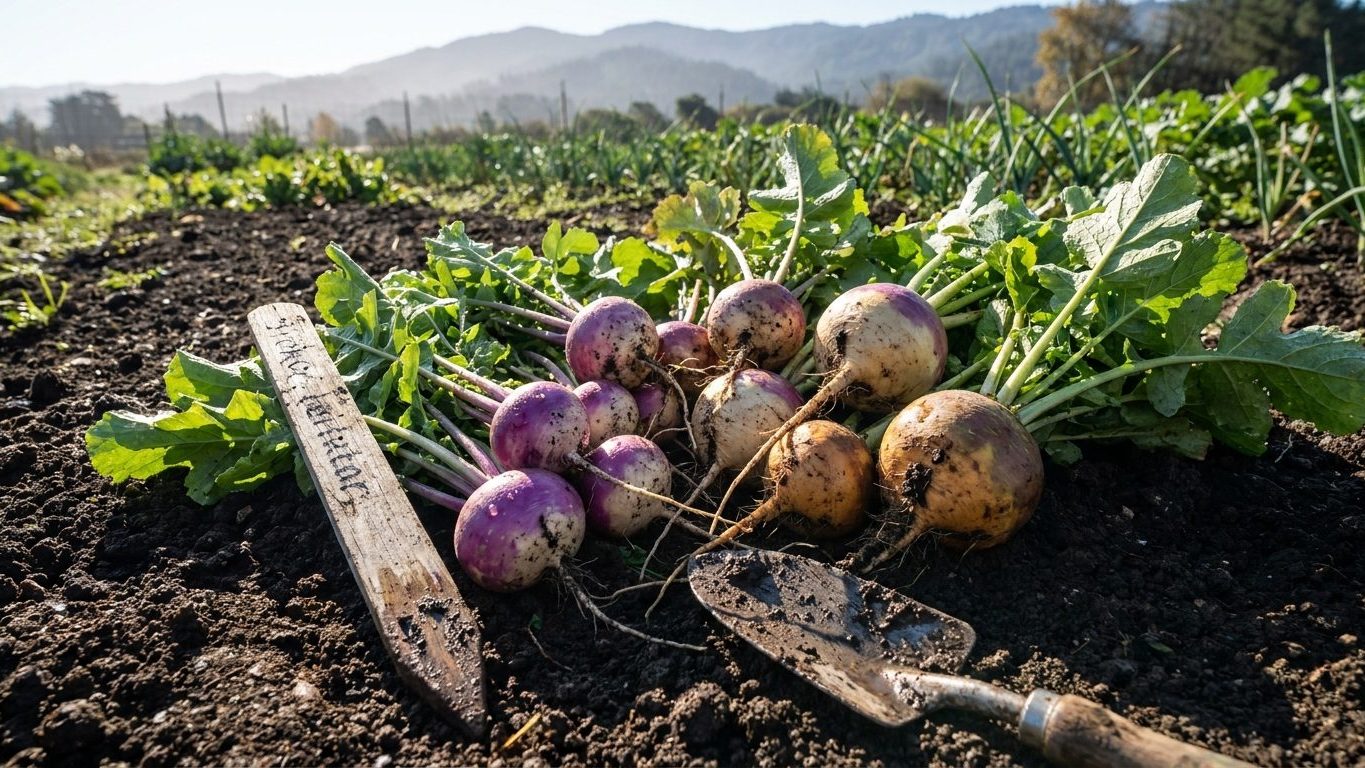

Nebraska gardeners get the best results treating Turnips and Rutabaga as two different crops entirely. Fast turnip varieties like Purple Top White Globe or Hakurei work as both a spring and fall crop across the whole state, while rutabaga only works as a single fall planting timed backward from the first freeze.
The short answer for Nebraska
Turnips and Rutabaga split into two speeds, and Nebraska’s season length decides which one you can grow twice a year and which one you get exactly one shot at. Turnips mature in 30 to 60 days depending on variety, which means a spring sowing and a second fall sowing both fit comfortably inside the frost-free window recorded at the Omaha reference station: April 12 to April 23 for the last spring freeze, October 15 to October 26 for the first fall freeze. That’s a working season of roughly five and a half to six months, plenty of room for two turnip crops with a summer gap in between.
Rutabaga is a different animal. It needs 90 to 100 days to size up a proper root, and it actually prefers to finish in cool weather rather than heat, which pushes it firmly into the fall-crop category statewide. Counting backward from the earlier end of the fall frost window (October 15) by 100 days lands you on around July 7 as the last safe rutabaga sowing date for most of the state, later than that and the roots won’t have time to bulk up before a hard freeze ends the season.
For turnips, the decision is simpler and less date-sensitive. A fast-maturing variety sown in the first half of April, right around the tail end of the frost risk window, gets harvested well before summer heat turns the roots woody. A second sowing in late July or early August, timed to mature before the October frost window, gives you a second clean harvest of tender roots without the bitterness that heat-stressed turnips develop. Varieties bred specifically for speed and mild flavor, rather than storage size, tend to perform more consistently here because they’re in and out of the ground before either extreme (spring cold snaps or midsummer heat) has much chance to stress them.
Rutabaga growers who want the classic storage root should think of it as a one-shot, cool-season-finish crop: sow by early July, harvest after a few light fall frosts have sweetened the roots, and plan on that being the only rutabaga crop of the year. Trying to squeeze in a spring rutabaga crop ahead of turnips almost never works here, because the plant hits its slow bulking phase right as Nebraska summer heat arrives, and that combination stalls root development almost every year.
What will not work here

Late-maturing rutabaga varieties sown any time after early July are the most common failure in Nebraska gardens, and the math explains why. A variety that needs 100-plus days, sown on July 20, is still bulking its root when the first fall frost window opens in mid-October. The plant survives a light frost, but the root never reaches a usable size, and gardeners pull small, fibrous rutabagas wondering what went wrong. The problem isn’t the frost. It’s that the clock ran out before the root had time to grow.
Spring-sown rutabaga is the second common mistake. Sow it in April alongside turnips, and by July the plant is trying to bulk a root while daytime temperatures sit well into the 90s. Brassica roots stop sizing properly in sustained heat, and the plant often bolts to flower instead, putting energy into a seed stalk rather than the root you wanted. Rutabaga simply isn’t built for a Nebraska summer, which is why the fall-only window matters more here than in milder climates.
Winter storage in the ground
Some gardeners in milder regions leave rutabaga in the soil through winter, insulated under mulch, and harvest as needed. That doesn’t hold up in Nebraska. The coldest month here averages a daily minimum of 15.2°F, and ground at that temperature freezes solid well below the surface, not just the top inch a layer of straw might protect. Roots left in place through a Nebraska winter are at real risk of freezing and turning to mush by the time you’d want to dig them. Harvest before the ground locks up, and store the roots indoors instead.
Tight spacing is a smaller but real problem too. Turnip and rutabaga leaves stay damp longer when crowded, and that dampness, combined with Nebraska’s humid summer stretches, invites leaf spot and root rot. Wider spacing than the seed packet’s minimum, especially for rutabaga’s longer season in the ground, gives air circulation a chance to dry foliage between rains and cuts down on disease pressure considerably.
What changes across Nebraska
Nebraska’s official hardiness range runs from 4a in the northwest to 5b in parts of the southeast, which is a wide enough spread that no single planting date works for the whole state. That two-zone-plus gap matters more for rutabaga’s tight fall window than it does for fast turnips, because a week or two of difference in first frost timing can decide whether a rutabaga root finishes sizing or gets caught mid-bulk.
Gardeners in the Panhandle and higher-elevation parts of the state, sitting closer to zone 4a, should treat the July 7 rutabaga cutoff as optimistic rather than exact, and lean toward sowing a week to ten days earlier to build in a buffer. The same goes for spring turnip sowings: colder pockets in the western part of the state often see soil warm up later than the Omaha-area dates suggest, so the first turnip sowing may need to wait a bit longer than the April 12 to April 23 window implies for that specific location.
Southeastern Nebraska, closer to zone 5b, has a bit more room on both ends. Fall frost tends to arrive nearer the later end of the October 15 to October 26 range, which gives rutabaga and second-crop turnips a few extra days to finish. That’s not a guarantee, just a tendency, and it doesn’t replace checking local conditions.
There’s no way to give a single statewide date and have it be right everywhere. The spread across 4a to 5b is the whole reason this page speaks in ranges rather than one fixed calendar, and it’s also why the next section matters as much as anything above it: find out where your own county actually sits before locking in a sowing date.
Where to check this for your own county
This page describes Nebraska in general, using a single reference station’s frost data. Your county’s actual planting window can run a week or two different in either direction, especially if you’re farther from the Missouri River valley or at higher elevation than Omaha. The tool built for that gap is the University of Nebraska-Lincoln Extension, available at extension.unl.edu.
Once there, two things are worth hunting down specifically. The first is a county-level or regional planting calendar, which will adjust the frost-date ranges used here to whatever your local weather station and elevation actually produce. The second is any variety trial data for turnips or rutabaga that UNL Extension or a county office has run, since those trials test how specific varieties perform under real Nebraska growing conditions rather than the generic maturity numbers printed on a seed packet.
A county-specific recommendation will always outrank a state-level one, because it accounts for local soil, elevation, and microclimate factors this page can’t see. Treat everything above as the statewide baseline, useful for understanding why turnips split into two crops and rutabaga into one, but defer to your extension office’s numbers when they differ from the Omaha-based dates cited here.
Extension offices also tend to know which local seed suppliers carry varieties that have actually been tested in Nebraska conditions, rather than varieties marketed nationally without regional performance data. That’s a small detail, but it often matters more than the maturity-day number on the packet.
Checking this against your own garden
Calendar dates get you close, but three direct observations in your own garden will tell you more than any date range on this page. Soil warmth is the first and most useful. Turnip seed germinates reliably once soil feels consistently cool rather than cold to the touch, roughly the way it feels a week or two after the ground has thawed for good. If the soil still feels icy at depth, wait, regardless of what the calendar says.
The second signal is the appearance of the first true leaves, the second set that emerges after the initial rounded seed leaves. Their timing tells you how your specific spot’s microclimate compares to the general range: if true leaves show up faster than expected, your garden runs warmer than the reference station, and you likely have a bit more room on both the spring and fall sowing windows than the statewide dates suggest.
The third is watching for early flower stalks on turnip greens during hot stretches, a sign of heat stress pushing the plant to bolt rather than build root. If you see that happening consistently by early June, it’s telling you your garden’s summer heat arrives earlier than the regional average, which means your spring turnip crop needs to go in and come out sooner than the general window allows, and your fall crop may need to wait a little longer to avoid the same stress.
None of these three checks requires anything beyond your hands and your eyes, and together they’ll correct for whatever gap exists between your specific plot and the reference numbers used to build this page.