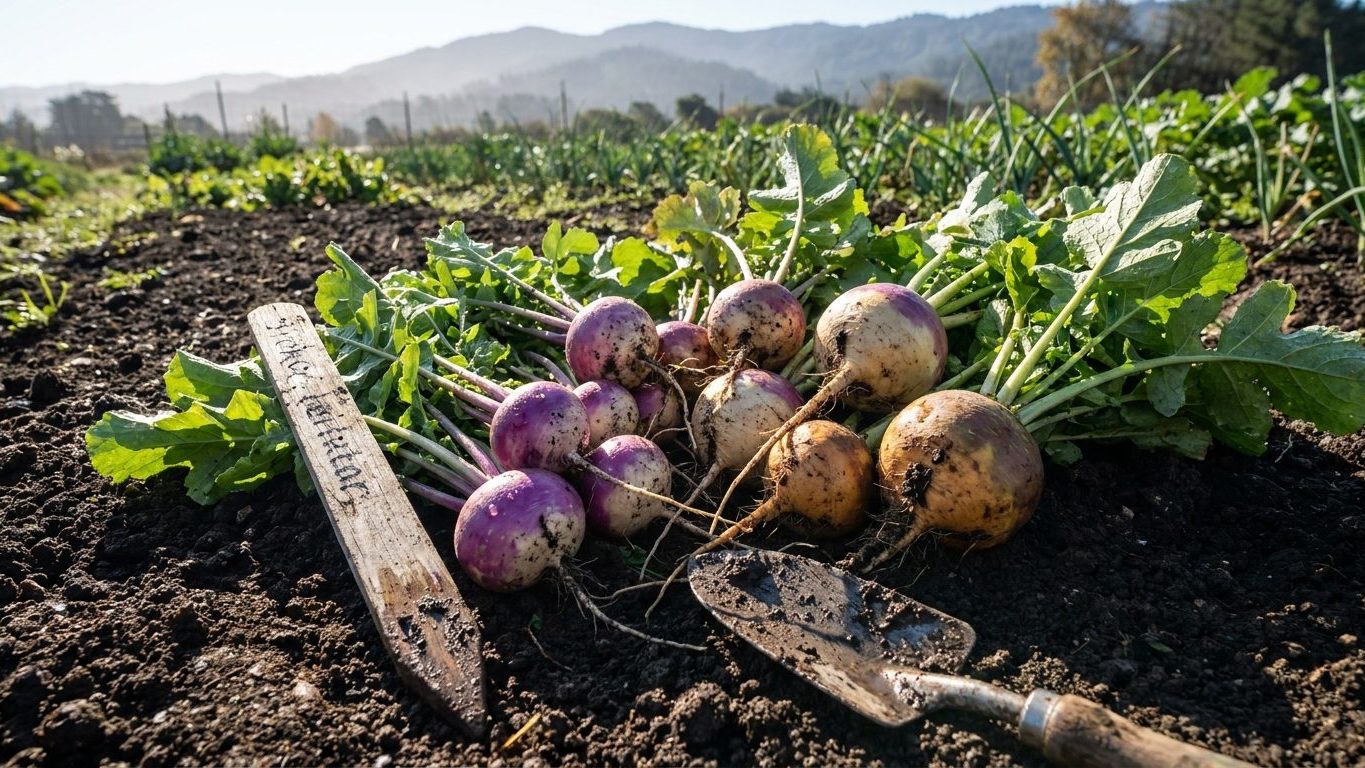

New Brunswick gardeners work inside one narrow growing window bounded by two mean frost dates, and that window is what should drive the variety choice. Quick-maturing turnips fit both a spring and a fall crop here, while rutabaga needs the whole season and performs best sown in early summer for an autumn harvest, after cool nights sweeten the roots. The province’s short season and its Canadian hardiness rating both point away from slow, heat-loving types and toward compact, cold-tolerant roots that finish before the season closes.
The short answer for New Brunswick
Environment and Climate Change Canada’s Moncton normals put the last spring frost at May 23 and the first fall frost at October 2 on average, a run of roughly 132 days. That figure is a mean, not a guarantee: in half the years on record, frost has arrived later than May 23 in spring or earlier than October 2 in fall. Treat the window as a target to aim inside, not a date to plant against.
Inside that window, the split between Turnips and Rutabaga is mostly about how fast each one needs to grow. Salad-type turnips such as Hakurei or Tokyo Cross typically size up in five to seven weeks, which leaves comfortable room on either side of the mean frost dates for a spring sowing and a second one in midsummer for fall. Storage turnips like Purple Top White Globe run closer to eight weeks and still fit twice into the season if the first crop goes in as soon as the ground can be worked.
Rutabaga is a different animal. Varieties such as Laurentian or American Purple Top need roughly 90 to 100 days from seed to a root worth storing, and they taste better after a light frost has touched the leaves. That means working backward from the mean fall frost date rather than forward from spring: sowing by early June gives a rutabaga crop enough time to bulk up before the season’s cool close, with a few weeks of buffer for the years when frost comes ahead of schedule.
| Type | Typical days to maturity | Best sowing timing in NB |
|---|---|---|
| Salad turnip (Hakurei, Tokyo Cross) | 35-50 days | Spring after soil is workable, repeat in midsummer |
| Storage turnip (Purple Top White Globe) | 50-60 days | Early spring, and again by late July for a fall crop |
| Rutabaga (Laurentian, American Purple Top) | 90-100 days | Early June, for an October harvest |
What will not work here

The clearest failure in this province is a rutabaga sown too late. A gardener who waits until midsummer, treating rutabaga like a quick fall turnip, runs out of season before the root has any size, because the crop simply needs more of the calendar than a 40-day turnip does. Once the sowing date slips past early June, the odds of a full-sized rutabaga by the mean fall frost drop fast.
Trying to overwinter roots in the ground the way a milder climate can is the second common mistake. The coldest month here averages a daily minimum of -13.9°C at the reference station, cold enough to freeze garden soil solid well below root depth. Turnips and Rutabaga left in unprotected ground through a New Brunswick winter do not survive that; roots need to be lifted and stored in a cool, humid space, not left under mulch and hoped for.
Relying on May 23 as a safe planting date is a subtler version of the same error. Because it is a mean, not a probability floor, some springs bring a hard frost well into the following week or two. Direct-sown turnip seedlings caught by a late frost with no true leaves yet can be killed outright, while a rutabaga transplant with a few sets of leaves usually shrugs it off. Gardeners who sow the moment the calendar hits that date, rather than watching the actual weather, are the ones most often replanting in June.
Finally, spacing recommendations written for a warmer, drier province do not transfer cleanly. Roots crowded to the tight end of a seed packet’s range mature smaller and more slowly in a shorter season, which matters more here than in a climate with months to spare for the crop to catch up.
What changes across New Brunswick
New Brunswick is not one climate glued together, and the numbers above come from a single reference point. Natural Resources Canada rates the Moncton area at Canadian hardiness zone 5a, using a system built on seven climate variables rather than the single winter-minimum figure behind the USDA scale used south of the border. That zone number cannot be read across into a USDA equivalent; the two scales measure different things and do not line up one to one.
What matters practically is that Moncton’s zone describes Moncton, not the province. Coastal areas along the Bay of Fundy tend to run milder through the shoulder seasons than inland and northern districts, where frost lingers later in spring and returns earlier in fall. A rutabaga sowing date built around the Moncton mean can be too late for a garden well north or inland, and comfortably early for one near the milder coast.
There is no single correct sowing date for the whole province, only a range that shifts with location. Rather than guess which end of that range applies, check Natural Resources Canada’s Plant Hardiness map for the specific municipality in question. It draws on the same seven-variable model used for the Moncton figure above, applied down to a much finer local scale, and it is the closest thing to a personalized answer this page can point toward.
Where to check this for your own county
This page describes a provincial pattern built from one weather station’s normals. A county-level planting calendar, built from local trial data, will always beat a province-wide estimate, because it accounts for the microclimate differences described above rather than averaging over them.
New Brunswick’s own agriculture department restricts automated access to its planting guidance, so the reliable starting point is the federal site at agriculture.canada.ca/en, which stays reachable and links onward to provincial and regional programs. From there, look specifically for two things: a local frost-date or planting calendar for the district in question, and any list of turnip or rutabaga varieties that have actually been trialled in New Brunswick conditions rather than recommended generically.
Provincial extension offices and county agriculture representatives also track which varieties have underperformed locally in a given year, information that never makes it onto a general seed packet. A quick call or email to a county office, referencing the municipality by name, often turns up a sowing window narrower and more useful than the mean-based estimate here.
None of this replaces the province-wide figures above; it sharpens them. The mean frost dates and the zone rating describe New Brunswick in general terms so that a county-specific answer has something to be compared against.
Checking this against your own garden
Calendar dates and zone ratings describe an average garden that does not exist. The plot in front of a gardener, with its own drainage, sun exposure and soil type, will run ahead of or behind the Moncton normals by days or weeks, and three simple checks reveal which.
Soil warmth by feel comes first. Turnip and rutabaga seed germinates poorly in cold, wet ground regardless of the date on the packet; if a handful of soil still feels cold and clammy well after May 23, the local ground is running behind the provincial mean and sowing should wait.
The appearance of the first true leaves, the second, flat-edged set that follows the rounded seed leaves, marks the point where a light frost stops being a serious threat to turnip seedlings. Their timing, faster or slower than the five-to-seven-day average for the crop, is a direct read on how warm the local microclimate actually runs that spring.
Last, watch for the root’s shoulder pushing up out of the soil surface as it swells. That moment is when a rutabaga sown in early June is on track for an October harvest or clearly behind it, and it tells more about a specific garden’s season than any regional average ever will.