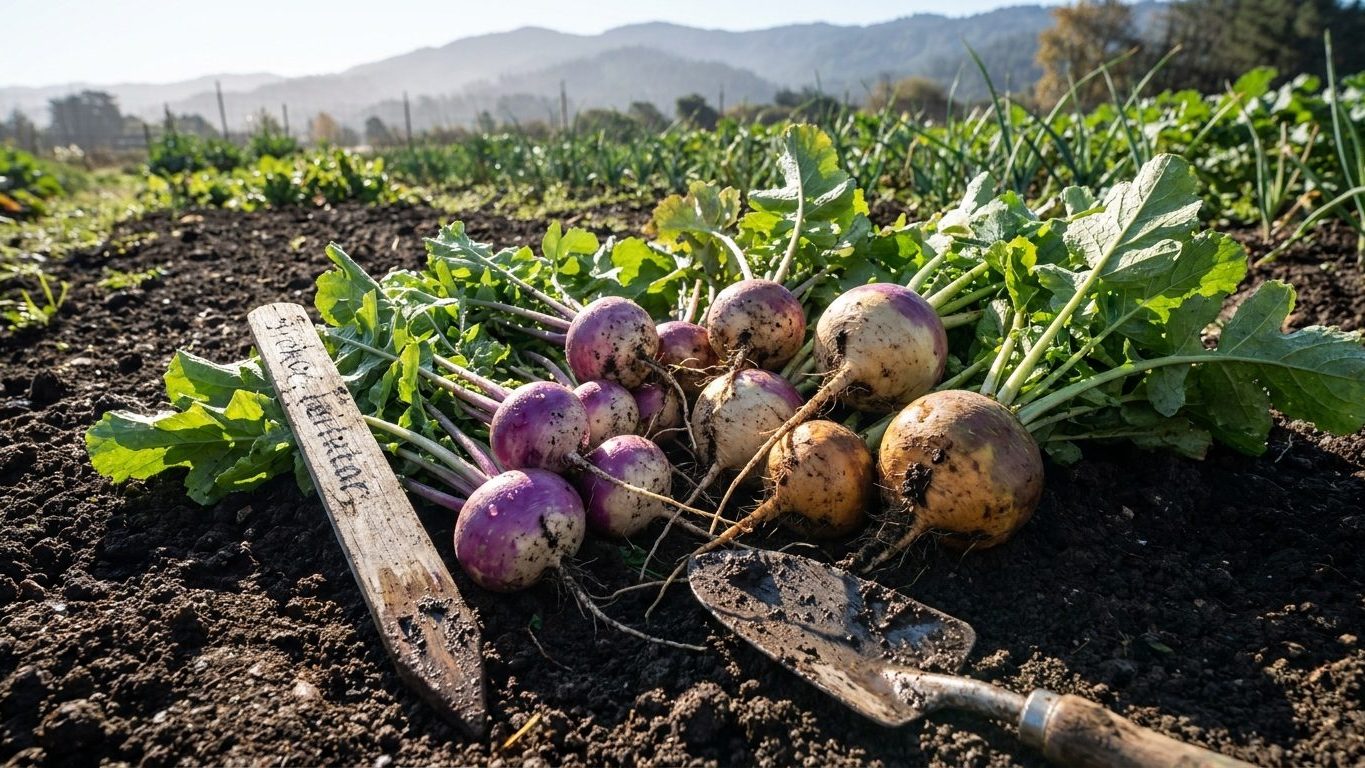

Turnips built for speed (like Purple Top White Globe or Hakurei, maturing in 40 to 55 days) do best across most of New Hampshire, while rutabaga, which needs 90 to 100 days, only pencils out in the state’s warmer, longer-season pockets and only when sown by early-to-mid July.
The short answer for New Hampshire
The choice between Turnips and Rutabaga in this state isn’t really about taste or soil preference. It’s arithmetic. Rutabaga takes roughly twice as long to bulb up as a standard turnip, and New Hampshire’s growing season, measured from the last spring frost to the first fall frost at the Manchester reference station, runs from around April 16-27 to October 13-26. That’s a workable window on paper, but rutabaga’s long clock means the sowing date has almost no margin for error, while a fast turnip can be tucked into a spring gap or a late-summer slot and still finish before the ground gives out.
For most home gardens in the state, that math favors turnips as the reliable crop and rutabaga as the one you attempt only if your site runs warm and your soil drains well. A 40-to-55-day turnip sown in late July or even early August, counting back from the earlier end of the fall frost range, still has room to mature before a hard freeze shuts things down. Rutabaga sown at the same time is gambling on the season running long.
Spring planting works differently. Turnips tolerate a light frost and can go into ground as soon as it’s workable, well before the April 16-27 window closes, because a touch of cold doesn’t bother the roots once they’re past the seedling stage. Rutabaga can technically be spring-sown too, but in practice it rarely finishes before summer heat turns the roots woody and bitter, so most experienced growers here treat it strictly as a fall crop, timed backward from the first frost rather than forward from the last one.
The decision tree, then, is short. If you want a forgiving crop with two possible planting windows a year, grow turnips, and lean on fast varieties for the fall slot. If you want rutabaga, treat it as a single-shot fall crop and sow it by mid-July so it has the full 90-plus days before the season’s coldest stretch sets in. Anything later than that is asking the plant to outrun a New Hampshire autumn, and autumns here don’t wait.
Where you garden inside the state changes these numbers, sometimes by weeks, which is worth working out before you commit a rutabaga bed to a date that only holds near the coast or in the Merrimack Valley.
What will not work here

Two mistakes account for most of the turnip and rutabaga failures reported to New Hampshire gardeners, and both trace back directly to the state’s climate numbers rather than to bad luck or bad soil.
Rutabaga sown too late
The first is planting rutabaga on a timeline borrowed from a milder state. A 100-day rutabaga sown in early August, which would be fine in parts of the mid-Atlantic, runs straight into New Hampshire’s first fall frost window of October 13-26 before it has finished bulking. Worse, the coldest month here averages a nightly minimum of just 17.1 degrees Fahrenheit, which means once the ground starts locking up in earnest, an unfinished rutabaga bed doesn’t get a second chance. There’s no mild stretch in November to bail it out. The fix isn’t a different variety so much as a different calendar: rutabaga needs its full season, and in this state that means treating mid-July as a hard planting deadline, not a suggestion.
Spring turnips that bolt
The second failure shows up earlier in the year, and it catches gardeners who think they’re being efficient by getting seed in the ground the moment the soil thaws. Turnips exposed to several weeks of cold soil right after germination, followed by a sudden warm spell, a fairly common pattern during a New Hampshire spring where the frost-free date can swing anywhere from April 16 to April 27, respond by bolting. The plant reads the cold-then-warm sequence as a signal to flower and set seed rather than build a root, and once a turnip bolts, the root turns woody and the crop is effectively lost. Waiting until soil has warmed past that early, unstable stretch, even if it means sowing a week or two after the average last frost date rather than right on it, avoids triggering the response.
A third, quieter problem is close spacing in a wet year. New Hampshire summers aren’t dry by western standards, and turnip and rutabaga roots planted too tightly in a humid stretch are more prone to rot and to the kind of leaf disease that spreads fastest where air can’t move between plants. Thinning aggressively, rather than trusting the seed packet’s minimum spacing, tends to matter more here than in drier regions.
What changes across New Hampshire
New Hampshire is not one growing climate, and the official numbers make that obvious. The state’s USDA Plant Hardiness Zones, based on the 1991-2020 normals and built purely on average annual extreme minimum temperature, span from 3b up near the Canadian border and at elevation in the White Mountains to 6a along parts of the southern tier and seacoast. That’s a difference of roughly three full zones inside one small state, which in practical terms means a 20-to-25-degree gap in the coldest temperatures a garden is expected to shrug off.
That spread changes the turnip-versus-rutabaga math directly. In the milder 6a pockets, closer to the Manchester reference figures used earlier in this article, the season is long enough that rutabaga’s mid-July deadline has some breathing room, and a second turnip planting in early August is a reasonable bet. Further north, or at higher elevation anywhere in the state, the growing season compresses from both ends: spring soil stays cold longer past the average frost date, and the first fall frost tends to arrive on the early side of any regional range rather than the late side. A gardener in one of the state’s colder zones should treat rutabaga as a marginal crop at best and shift any fall turnip planting earlier, closer to early July rather than late July, to bank extra days against an early frost.
None of this means a single adjusted date applies to “northern New Hampshire” as a block. Elevation matters as much as latitude here. A valley garden and a hillside garden a few miles apart can sit in different hardiness zones entirely, with the hillside seeing frost weeks before the valley floor does. Rather than guessing which side of that line a given yard falls on, the reliable move is checking the zone for the exact location, not the region, and reasoning from there.
Where to check this for your own county
Everything above comes from statewide reference points, mainly the Manchester weather station’s frost normals and the USDA’s zone map, and both of those tools describe averages rather than any one garden. New Hampshire’s county-level growing conditions vary enough that a state-level answer should be treated as a starting estimate, not a final schedule.
The University of New Hampshire Cooperative Extension is the authority to check next. Two things are worth looking for once there. First, a county or regional planting calendar, which will reflect local frost data than a statewide airport station can, particularly for gardens well inland or at elevation, where frost arrives earlier and lingers later than the Manchester figures suggest. Second, any list of turnip or rutabaga varieties the extension service has actually trialed in New Hampshire conditions, since regional trial results account for local disease pressure and soil types in a way that a seed catalog’s national description doesn’t.
This matters because a county-level recommendation will always beat a state-level one, and this article is, by design, the state-level one. It sets the general logic (fast turnips as the workhorse crop, rutabaga as a season-length gamble) but it can’t account for a specific valley’s cold-air drainage or a specific county’s typical first frost date. The extension service’s county contacts and Master Gardener volunteers can usually speak to those specifics directly, often based on years of local observation that no climate normal captures. Treat the UNH Extension site as the next stop before finalizing a planting date, not an optional extra.
It’s also worth asking, if a local extension office publishes one, whether there’s a specific fall-crop deadline calculated for the county rather than the whole state. Given how much the frost dates shift between the seacoast and the North Country, that single number can be more useful than anything else on this page.
Checking this against your own garden
Every date in this article is a regional average, and a reader’s actual yard will confirm or contradict it faster than any calendar can. Three signs are worth tracking, and none require anything more than paying attention.
Soil warmth by feel is the first and most useful check for spring turnip sowing. Cold, tight, damp soil that clumps when squeezed is still too cold to sow into safely, regardless of what the average frost date says that week; soil that crumbles and feels merely cool, not cold, to bare fingers a couple of inches down is a better signal that germination will proceed without the stall that invites bolting. Waiting for that feel, rather than for a specific date on the calendar, is the more reliable call in a state where frost timing can shift by a week or two between two nearby towns.
The second sign is the appearance of the first true leaves, the second set that emerges after the initial rounded seedling leaves. Their arrival marks the point where a young turnip has moved past its most bolt-sensitive stage; a garden where true leaves show up quickly after a warm stretch is running slightly ahead of the regional average, while a slow, delayed emergence suggests the soil is running cooler than the frost-date charts imply, a common pattern in shaded or low-lying yards.
The third is watching for any premature flower stalk, a thin central shoot rising from the crown before the root has bulked up. Its appearance on more than a plant or two is the clearest on-the-ground evidence that a spring planting went in too early for that specific yard’s microclimate, and it’s a useful flag to shift the sowing date later by about a week the following year, rather than trusting the average frost date exactly as printed.