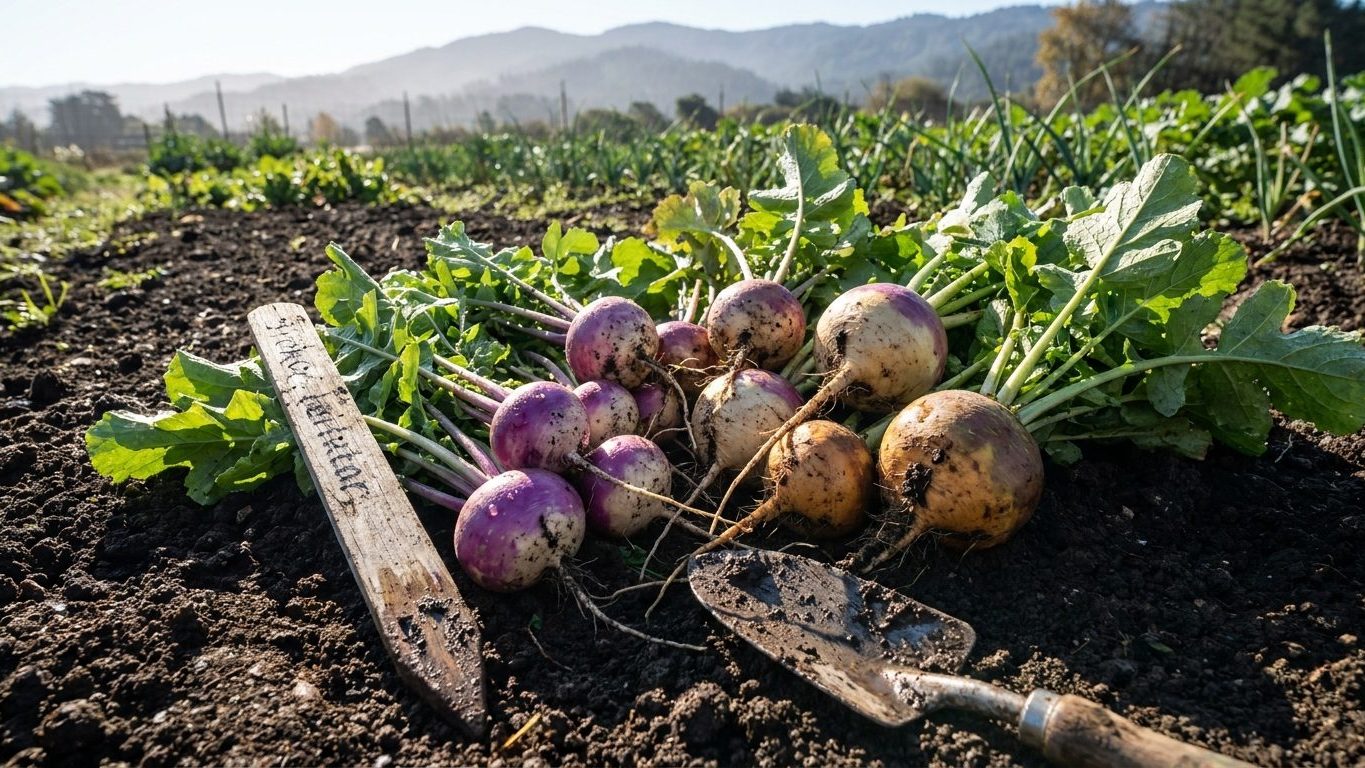

North Dakota’s cool, short season rewards fast turnips more than it rewards ambitious rutabaga. For turnips, pick a variety that matures in 35 to 55 days and direct sow it right after the last frost, with a second planting in midsummer for a fall crop. For rutabaga, pick a single 90 to 100 day variety and get seed in the ground by mid-June, because the frost dates here leave no room for a slow finisher.
The short answer for North Dakota
The number that actually drives the decision is the gap between two dates: the last spring frost at the Fargo reference station, which lands between May 4 and May 15, and the first fall frost, which arrives between September 25 and October 5. Do the math on the worst-case combination (late spring frost, early fall frost) and you get a frost-free window of about 133 days. The best-case combination stretches that to roughly 154 days. That range, not a seed packet’s cheerful “grows anywhere” claim, is what decides whether a variety belongs in a North Dakota garden.
Turnips built for 35 to 55 days fit twice inside that window. Sow the first crop the week after your last frost, harvest in June or July, then sow again in mid to late July for a fall crop that finishes sweeter thanks to cooler nights. Slower turnips, the 60 to 70 day types, only fit once, and only if planted the moment the soil can be worked.
Rutabaga plays by different rules. It wants 90 to 100 days and prefers to finish after a light frost, which converts starches to sugar and improves flavor. Working backward from a fall frost of September 25 to October 5, that means getting rutabaga seed in the ground by mid-June at the latest. Push it later and you’re gambling the whole crop on an unusually mild autumn.
| Type | Typical days to maturity | Fits the ND window? | Planting approach |
|---|---|---|---|
| Fast turnips (Hakurei-type, 35-45 days) | 35-45 | Yes, two crops possible | Direct sow after last frost; repeat in July |
| Slower turnips (Purple Top White Globe type, 55-60 days) | 55-60 | One crop only | Sow immediately after last frost |
| Standard rutabaga (American Purple Top type, 90-100 days) | 90-100 | Yes, one crop | Sow by mid-June |
| Long-season rutabaga (110+ days) | 110+ | Marginal to no | Not recommended without row cover |
Everything past that table is really a variation on the same theme: the window is fixed, and the variety has to fit inside it, not the other way around.
What will not work here

Rutabaga varieties rated at 110 days or more are the most common mistake in the state. Plant one on the same June schedule as a 95-day type and you’re asking it to finish after October 5, right at the edge of or past the first fall frost. Some years that works out. Most years it means small, underdeveloped roots pulled in a panic ahead of a hard freeze.
Weekly watering is the second failure point, and it shows up even among gardeners who chose the right variety. North Dakota summers swing between wet stretches and genuinely dry, hot weeks, and turnip and rutabaga roots respond to that inconsistency by splitting, cracking, or turning woody and bitter. Root crops need steady, even moisture, roughly an inch a week delivered in smaller, more frequent doses rather than one deep soak that leaves the soil bone-dry by day five.
Tight spacing causes trouble in the opposite direction. In years with a wet, humid stretch, especially in the heavier clay and “gumbo” soils common across parts of the state, crowded rows trap moisture around the crowns and invite rot and foliar disease. Give roots the room the seed packet recommends, and thin ruthlessly rather than leaving two plants to fight over one spot.
Then there’s the assumption that a root crop can simply overwinter in the ground, the way it might in a milder region. It can’t, not here. The mean daily minimum of North Dakota’s coldest month sits at 0.2°F, cold enough to freeze soil solid well below the depth where a rutabaga or turnip sits. Roots left in place past a hard freeze turn to mush once they thaw. Harvest before the ground locks up, then store the roots in a cold, humid space indoors, a root cellar, an unheated basement corner, or a fridge crisper for smaller batches.
None of these failures are exotic. They’re the direct, predictable result of a short season, a temperamental summer, and a genuinely brutal winter, and every one of them is avoidable once you know which number to respect.
What changes across North Dakota
North Dakota is not one garden with one answer, and the hardiness zone data makes that obvious. The state spans USDA zones 3a to 4b, which is nearly two full zones of difference between its coldest pockets and its mildest. That’s a meaningful spread. A zone 3a location can see winter extremes 10 degrees colder than a zone 4b location, and that gap shows up directly in which rutabaga varieties survive a cold snap before harvest and how much buffer a gardener needs before the first fall frost.
The practical shift for someone gardening toward the colder end of that range is to lean harder on the fastest turnip varieties and to treat rutabaga as a crop that needs planting at the earliest edge of the window rather than the middle of it. A few extra days of margin before frost matter more where winter arrives with less warning and where a wet spring can delay planting past the average last-frost date entirely.
Someone gardening toward the milder end of the zone range has more flexibility, closer to the full 154-day scenario described earlier, and can more comfortably run a second turnip planting or experiment with a slightly longer rutabaga variety without as much risk.
This page can’t tell an individual reader which end of that range their own yard falls into, and it shouldn’t try. The right move is to check the USDA Plant Hardiness Zone Map by zip code and see where a specific address actually lands before locking in a planting date built on a statewide average.
Where to check this for your own county
Everything above comes from one reference station and one statewide zone range. That’s useful for spotting the pattern, but it’s not a substitute for county-level advice, and it isn’t meant to be. The North Dakota State University Extension service publishes exactly that kind of local detail, and it’s the next stop for anyone who wants a real answer rather than a state-wide approximation.
Visit NDSU Extension and look for two specific things. First, the local planting calendar for the county in question, since frost dates can shift by a week or more between the Red River Valley, the central plains, and the western part of the state. Second, look for variety trial results or recommended cultivar lists for Turnips and Rutabaga, since NDSU and its county offices track which varieties actually perform well in regional trial gardens, not just which ones a national catalog markets to every zone at once.
A county extension office recommendation will always beat a statewide one, because it’s built from soil, microclimate, and multi-year trial data specific to that county rather than a single airport weather station averaged across ninety-plus counties. This page is useful for understanding the pattern behind the recommendation. The county office is useful for the recommendation itself.
Many county extension offices also take phone calls or walk-in questions directly, which is worth using if the online calendar doesn’t cover rutabaga specifically or if a garden sits in an unusual microclimate, like a low frost pocket near a creek bed or an exposed hilltop that runs colder than the surrounding area.
Checking this against your own garden
Every date on this page is an average built from decades of weather records, and averages miss the particular quirks of one backyard. The most reliable check is still direct observation, and it doesn’t require any equipment beyond attention.
Start with soil warmth by feel. Push a finger a couple of inches into the bed in early spring; if the soil still feels cold and slightly stiff rather than crumbly and workable, seed sown now will sit and rot before it germinates, regardless of what the calendar says. Wait for that crumbly, workable feel before the first turnip sowing.
Watch germination speed on that first planting. Turnip seed sprouting within about a week signals soil temperatures are genuinely in the right range for that microclimate. A slow, patchy germination over two or three weeks is a sign the ground is running colder than the state average, and it’s a cue to push the rutabaga planting date earlier the following year rather than later.
Finally, track the appearance of the first true leaves, the second set that follows the rounded seed leaves. Their timing, compared year to year in the same bed, becomes a personal calendar more accurate than any regional average, because it reflects the actual soil, drainage, and sun exposure of that specific plot rather than conditions measured miles away at an airport.