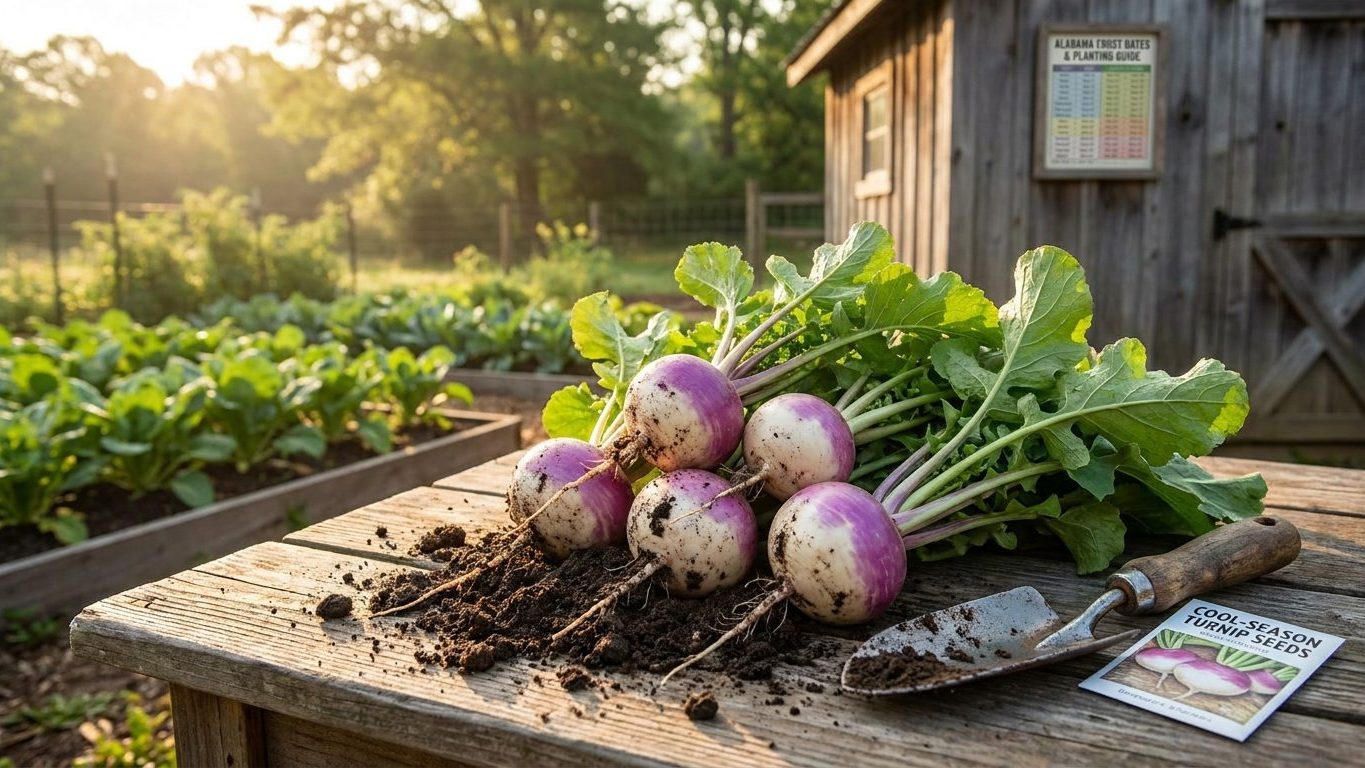

Sow spring turnips in Nova Scotia from mid-April into early May, three to four weeks ahead of the average last frost, then sow a second round from mid-July through early August for a fall crop that finishes before the ground turns hard. Both windows come from Environment and Climate Change Canada’s frost normals for Halifax Stanfield International Airport: May 7 in spring, October 18 in fall. Elsewhere in the province, adjust from there.
The short answer for Nova Scotia
Nova Scotia’s turnip calendar runs on two sowing dates: mid-April to early May for a spring crop, and mid-July to early August for a fall crop that finishes before winter locks the soil down. Both windows are built backward from one pair of numbers: the mean last spring frost of May 7 and the mean first fall frost of October 18, recorded at Halifax Stanfield International Airport over the 1981-2010 normals period.
Turnips are one of the few root crops that tolerate a touch of frost on both ends, which is why the spring window opens before, not after, that May 7 date. Seedlings shrug off light freezes into the mid-20s Fahrenheit, so a grower who waits for frost-free soil is giving up three or four productive weeks. Sowing three to four weeks ahead of May 7, mid-to-late April across most of the settled parts of the province, gets seed into soil that is still cool and moist, which is exactly the condition turnip seed germinates best in.
The fall window runs the same math backward. Turnip roots generally need 40 to 60 days from seed to harvest depending on variety, with greens ready well before that. Counting back from the mean October 18 fall frost puts the sowing deadline in early August for slower varieties, with room to push into mid-August for the quick ones. That leaves a harvest window before the ground starts to lock up for winter, which in a province rated Canadian hardiness zone 6b at the reference station tends to arrive later in the fall than in colder parts of the country, but it still arrives.
One caution outweighs both dates. Environment and Climate Change Canada’s frost normals are means, not guarantees: in any given year the last spring frost lands after May 7 roughly half the time, and the first fall frost lands before October 18 just as often. Treat both dates as the middle of a window, not a line to sow right up against. A gardener who plants exactly on May 7 and loses seedlings to a late frost has not had bad luck; they have landed on the wrong side of a coin flip that the normals themselves describe.
What will not work here

Rutabaga is the crop that trips people up in this calendar, because it gets treated like a slower turnip and sown in the same July-to-August window. It is not. Rutabaga typically needs 90 to 100 days to mature, and counting back from the mean October 18 fall frost, that pushes the sowing deadline all the way to early-to-mid July. Sow rutabaga in early August, the way you would a fall turnip, and the math simply does not close before the ground goes cold. For the slower varieties, sow no later than mid-June to leave any margin against a year when frost arrives earlier than the mean.
Leaving roots in the ground through winter, hoping to dig them later, is the second failure. Nova Scotia’s coldest month averages a daily minimum of -10.4°C (13.3°F in the Fahrenheit reading used for comparison), and ground that cold does not stay soft. Turnips and Rutabaga can take a light frost on the leaves, but roots left unprotected through a full Nova Scotia winter freeze in open ground, without a heavy mulch layer, will be damaged well before spring. Anyone counting on a January harvest from an unmulched fall planting is setting up a loss.
Tight spacing is the third mistake, and it is a climate one rather than a calendar one. Seed packet spacing guides are often written for drier growing regions, and Nova Scotia’s maritime summers run humid, with fog and coastal moisture lingering over the Annapolis Valley and the South Shore alike. Crowd turnip rows the way a catalog from a dry-summer state suggests, and that humidity sits in the canopy, encouraging downy mildew and clubroot rather than drying off between waterings. Wider rows and thinned seedlings matter more here than the seed packet lets on.
Finally, sowing right at the mean last frost date rather than ahead of it wastes the crop’s natural cold tolerance and shortens the window before summer’s warmth pushes spring-sown turnips toward bolting. The plant is built to handle the cold end of this calendar; it is the late sowing, not the early one, that causes trouble.
What changes across Nova Scotia
The zone 6b rating used above belongs to the Halifax reference station, not to the whole province. Nova Scotia is a coastline wrapped around an interior, and Natural Resources Canada’s own hardiness mapping shows areas measured several full zones colder than that Halifax figure, particularly away from the coast and at higher elevation in places like the Cape Breton highlands. A single number can describe the airport; it cannot describe a province with that much variation in elevation and distance from open water.
What that variation means in practice is a shift in both ends of the calendar, not just the spring one. Colder interior and upland districts tend to see their last spring frost arrive later than the Halifax mean and their first fall frost arrive earlier, which shrinks the growing season from both directions at once. A gardener working from the Halifax-based dates in this article, without adjusting, risks sowing a spring crop too early for a colder pocket, or a fall crop too late for one with an earlier first frost.
This is not a case where the article can hand over a fix, because the spread runs from the mildest coastal strips to some of the coldest inland ground in the Maritimes, and no single adjustment covers that whole range. The only reliable move is to check the interactive map at planthardiness.gc.ca before locking in either sowing date, and to treat the Halifax-based window in this article as the mid-province baseline rather than a fixed rule for every county.
Where to check this for your own county
Nova Scotia’s Department of Agriculture publishes provincial guidance at novascotia.ca/agri/, and that is the right next stop for anyone who wants a recommendation closer to home than a frost-normals calculation built on airport data. A county-level or district-level recommendation, where one exists, will always beat a province-wide estimate like the one built in the sections above, because it accounts for local soil, local frost pockets, and local growing conditions in a way that a single reference station cannot.
What to look for once there is specific. The department’s guidance and any affiliated county or district agricultural resources are worth checking for a local planting calendar built around the district’s own frost history rather than Halifax’s, and for a list of turnip and rutabaga varieties that have actually been trialled in that part of the province. Varieties bred for a shorter or cooler season, or ones known to hold up against local disease pressure, are the kind of detail that a province-wide article cannot responsibly guess at. Look specifically for a district or county planting calendar rather than settling for the general provincial one, if the resource offers that level of detail.
This page has done what a provincial page can do: it has taken the two verified frost dates for the reference station and built a sowing window and a set of failure points around them. It has not, and cannot, replace a recommendation built on a particular county’s own soil and frost record. Where the two disagree, the local one wins.
Some gardeners also time this by the Moon: when to plant turnips by the moon, as almanac tradition rather than fact.
Checking this against your own garden
Every date in this article is a starting point, not a verdict, and the garden itself will correct it faster than any calendar can. Three things are worth watching, and none of them require a thermometer or any other instrument.
Soil feel comes first. Turnip seed wants soil that is cool but workable, crumbling apart in the hand rather than sticking together in a cold, wet clump. If the ground still feels raw and clings together in April, the local soil has not caught up to the calendar yet, whatever the mean frost date says.
True leaves come second. Seedlings that push their first true leaves within about ten days to two weeks of sowing are growing in soil that is warm enough for the crop; a much slower emergence points to soil still running cold, often a sign of a shaded or low-lying spot that lags the rest of the yard. Watch for true leaves within 10 to 14 days as the practical check on whether the sowing date actually suited that particular bed.
Early flowering stalks come third, and they are a warning rather than a milestone. A spring-sown turnip that bolts to flower unusually early has usually been through a cold snap after germination, a sign that the bed sits in a frost pocket colder than the rest of the garden, even if the rest of the yard came through fine. That is worth remembering for next year’s sowing date, independent of anything a provincial frost normal can tell you.