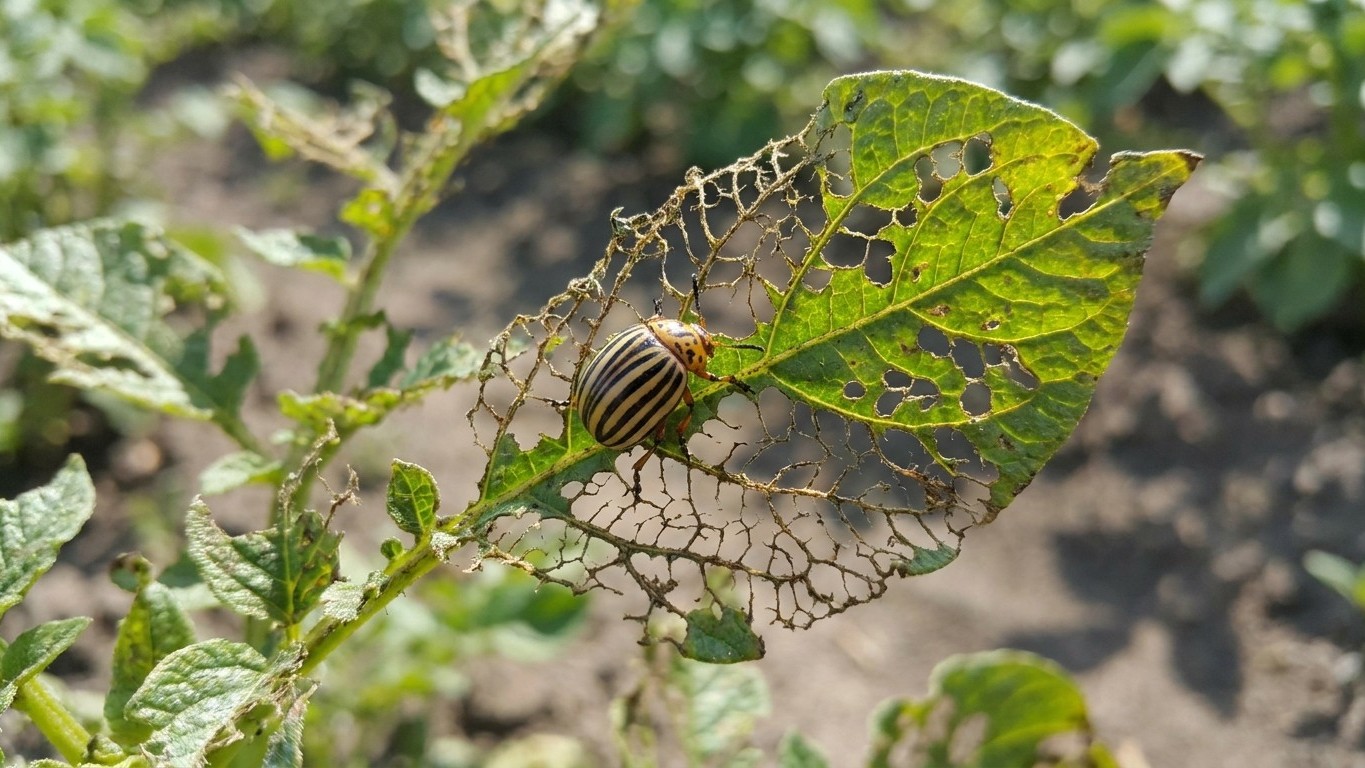

Two insects account for documented potato feeding in this region: the Colorado potato beetle, which strips foliage from the moment plants emerge, and the seedcorn maggot, which tunnels into seed pieces before shoots ever reach daylight. Timing runs off the frost-free window, not the calendar, so a planting date that shifts by a week shifts both risks with it.
Which pests attack potato in Prince Edward Island

The University of Maine Cooperative Extension documents ten insects for this region: Browntail moth (Euproctis chrysorrhoea), cabbage maggot, Colorado potato beetle, emerald ash borer, lily leaf beetle (Lilioceris lilii), seedcorn maggot (Delia platura), spotted wing drosophila, squash vine borer, striped cucumber beetle, and winter moth. Named against a potato patch, though, most of that list has nothing to do with the crop.
Browntail moth and winter moth feed on tree and shrub foliage, oak and apple among the usual hosts, not on low leafy vegetables. Emerald ash borer tunnels under the bark of ash trees exclusively; it has no mouthparts built for anything else. Lily leaf beetle is a specialist on true lilies, and it will strip a lily bed bare while ignoring a potato row two feet away. Spotted wing drosophila lays eggs in soft, thin-skinned fruit like berries and cherries, a texture nothing like a potato tuber. Squash vine borer and striped cucumber beetle both key in on cucurbits, squash, cucumber, melon, and skip potato foliage entirely. Cabbage maggot is the closest miss: it belongs to the same root-maggot family as the seedcorn maggot, but its larvae feed specifically on brassica roots, cabbage, broccoli, turnip, not on potato seed pieces.
That leaves two species the extension service actually ties to potato: Colorado potato beetle, which defoliates plants above ground, and seedcorn maggot, which damages seed pieces and sprouts below ground before or just after planting. The list documented for this territory is short, and it stays short here rather than getting padded with insects that happen to share a page with potato in a general pest guide but never touch the crop itself.
The decisive move is sorting by what the insect actually eats, not by what list it appears on — a browntail moth caterpillar on a nearby oak tells you nothing about your potato bed.
When each one shows up, and what it does first
Everything here keys off the frost-free window rather than a named month. The average last spring frost for this region runs May 16, drawn from Environment and Climate Change Canada’s Canadian Climate Normals for the Charlottetown A station. That figure is a mean, not a guarantee: in one year out of two, frost arrives later than that date, and it reflects one station in one city, not every field across the province. Northern and upland ground routinely lags weeks behind it.
Seedcorn maggot shows up first, and it shows up before the plant does. The adult fly lays eggs in cool, moist soil, often into freshly worked ground or seed pieces cut and planted while the soil is still cold and slow to dry. The larvae tunnel into the seed piece itself, and the first sign a gardener sees is not damage on a leaf but a gap in the row: seed pieces that never send up a sprout, or a weak, stunted shoot that emerges late and struggles. Because the maggot works underground on tissue that is not yet visible, by the time the missing plant is obvious the feeding is already finished.
Colorado potato beetle arrives once the plants are up and growing, typically as adults that have overwintered in soil or garden debris and walk or fly into the planting once the crop is well established. The first visible sign is ragged, irregular holes chewed into young leaves, usually starting at the edges and spreading inward as the beetle population builds. Left unchecked, adults mate and lay clusters of bright orange-yellow eggs on the undersides of leaves, and the reddish, humped larvae that hatch from those eggs do the heaviest feeding, capable of stripping a plant to bare stems within a couple of weeks if the population is large.
The practical takeaway: a missing plant early in the season points toward seedcorn maggot and cold, wet soil at planting; chewed leaves on an established plant point toward Colorado potato beetle, and the window for catching it before eggs hatch is short.
Telling the damage apart from everything else
Not every damaged potato plant has an insect behind it, and treating a nutrient problem or a watering problem as a pest problem wastes a season. The single clearest tell for an insect is finding the insect itself, or its eggs, on the plant — everything else on this list can be produced by something with no legs at all.
| Symptom | Possible cause | What distinguishes it |
|---|---|---|
| Ragged holes in leaves, edges chewed | Colorado potato beetle feeding | Adults or humped, reddish larvae visible on leaf undersides; orange-yellow egg clusters present |
| Missing plants, gaps in the row after planting | Seedcorn maggot in seed piece | Dig up an unsprouted seed piece; tunneling and small white larvae inside confirm it |
| Yellowing between leaf veins, no chewing | Nutrient deficiency | No feeding marks, no insects present; pattern follows the whole plant rather than isolated spots |
| Wilting despite moist soil | Disease or waterlogged roots | No chewed tissue; stems or roots may show discoloration or rot when checked |
| Torn or bruised foliage in patches | Wind, hail, or mechanical damage | Damage clusters on one side of the row, matching wind or equipment direction, not scattered randomly |
A stunted plant that never sprouted deserves a closer look at the seed piece before anything else, since a maggot leaves a tunnel that a nutrient problem never will. A chewed leaf without any visible beetle, larva, or egg cluster is worth a second look too, since drought stress and certain leaf diseases can leave ragged-looking margins that mimic feeding at a glance. When the cause stays unclear after checking for the insect directly, a local extension office can confirm it faster than guessing from a photo.
What actually works here, and what is a waste of time
On a growing season this short, timing does more work than any single method applied late. The single highest-value move is planting into soil that has already warmed and dried rather than rushing seed pieces into cold, wet ground right after the average frost date passes, since that cold, damp window is exactly what draws seedcorn maggot flies to lay eggs on freshly cut seed pieces. Waiting a few days for soil to warm past that damp stage does more to prevent maggot damage than any treatment applied after the fact, because once larvae are inside a seed piece, nothing reaches them there.
For Colorado potato beetle, hand-picking adults and crushing egg clusters on leaf undersides works especially well early, while the population is still small and concentrated near where beetles first walked in from field edges or overwintering sites. Checking plants every few days through the weeks right after emergence catches the problem before larvae hatch and the feeding accelerates. Physical barriers such as row covers, put in place before adults arrive and removed once plants are large enough to tolerate some feeding, keep the first wave of beetles off the crop entirely, which matters more than any later intervention since early defoliation costs the plant the most growing time.
Crop rotation, moving potato away from where it or related crops grew the previous season, reduces the number of overwintering adults that emerge close to a new planting, since beetles that walk in from a distance find fewer plants before hand-picking or covers catch them. What tends to waste time is scouting only once a season, after damage is already visible, or planting uncertified seed to save money: uncertified seed carries virus that no amount of pest management afterward can fix, and it undermines the crop regardless of how well the insects are handled. Any decision about a specific treatment for a confirmed, heavy infestation belongs with a local extension office, which knows what is registered for use in the state.
Where to check this for your own county
The University of Maine Cooperative Extension is the source for the pest list used on this page, and it maintains county-level offices that track what shows up locally, which matters because a pest documented at the regional level does not mean it is present in every garden within that region. Colorado potato beetle populations, for instance, build up unevenly depending on how close a given garden sits to where potatoes were grown the year before, and seedcorn maggot risk depends heavily on how wet and cold a particular field stays at planting time, something that varies from one side of a county to the other.
A local extension office can confirm whether a specific insect is active in a given area during a given week, something a general regional list cannot do. It can also identify an unfamiliar insect or a damage pattern that does not match anything on this page, since not every insect that turns up in a garden is one that a broad regional list captures.
The next useful step is contacting the county extension office directly with a description of the damage, or a sample if the office accepts one, rather than assuming a match based on a photo search. That single call resolves more uncertainty than any amount of comparing symptoms against a general guide.
Common questions
Does Colorado potato beetle overwinter in the soil here?
Adults commonly overwinter in soil or garden debris near where they fed the previous season, which is part of why crop rotation reduces how many beetles find a new planting quickly.
Can seedcorn maggot damage be fixed once a seed piece is infested?
No. Once larvae have tunneled into a seed piece, the damage is done; the only effective response is preventing the egg-laying conditions, cold and wet soil at planting, in the first place.
Is the May 16 frost date safe to plant on?
No. It is an average from Environment and Climate Change Canada’s Canadian Climate Normals for the Charlottetown A station, meaning frost falls later than that date about half the time. It marks the midpoint of a window, not a guaranteed safe planting day.
Why does uncertified seed matter more than pest control?
Uncertified seed can carry virus that no pest management practice afterward corrects, since the problem is already inside the plant rather than something feeding on it from outside.