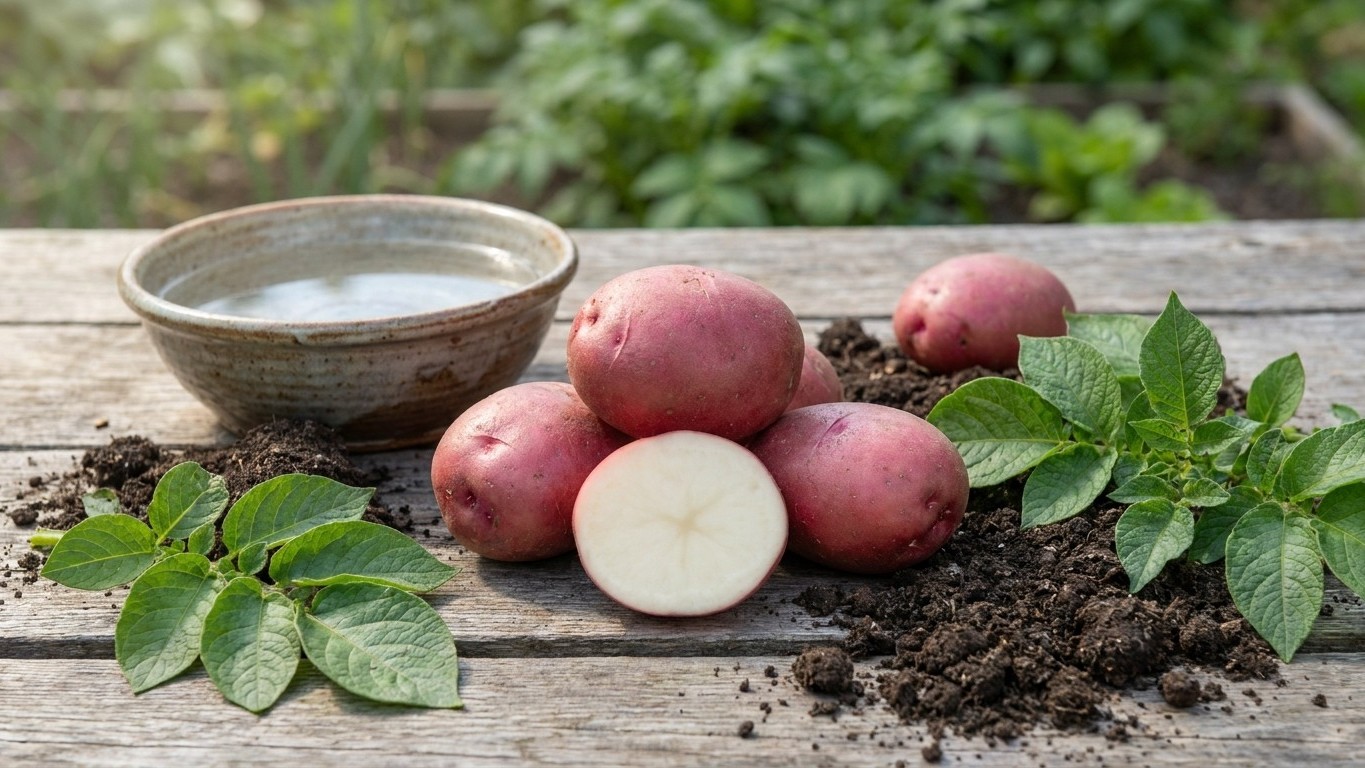

Five insects account for nearly all the documented feeding on potato in this region: Colorado potato beetle, flea beetles, seedcorn maggot, tarnished plant bug, and white grubs. Each one works on its own timetable, tied loosely to how fast the soil warms after the region’s average last spring frost, recorded as May 6 for the Montreal area. That date is a mean, not a promise, so the pests below can show up earlier or later depending on where a garden sits relative to that reference station.
Which pests attack potato in Quebec

The documented list for this region, according to the Cornell University CALS Insect Diagnostic Laboratory, UNH Cooperative Extension, and University of Maine Cooperative Extension, runs to twenty-nine species: Apple maggot, Asian jumping worms, Asiatic garden beetle, Asparagus beetles, Boxelder bug, Brown marmorated stink bug, Browntail moth, Cabbage maggot, Colorado potato beetle, Dark-winged fungus gnats, Emerald ash borer, European chafer, Flea beetles, Fourlined plant bug, Green stink bug, Imported cabbageworm, Japanese beetle, Leek moth, Lily leaf beetle, Onion maggot, Rose chafer, Seedcorn maggot, Spongy moth, Spotted wing drosophila, Squash vine borer, Striped cucumber beetle, Swede midge, Tarnished plant bug, Viburnum leaf beetle, White grubs, and Winter moth.
Most of that list has nothing to do with a potato patch. A group of tree and shrub feeders stays on woody plants: Apple maggot works apple trees, Boxelder bug feeds on boxelder, Browntail moth and Winter moth chew leaves on oak, cherry, and other trees and shrubs, Emerald ash borer and Spongy moth attack forest and yard trees, Viburnum leaf beetle stays on viburnum, and Lily leaf beetle and Rose chafer stick to lilies, roses, and grapevines.
A second group specializes in other vegetable families and skips potato entirely. Asparagus beetles need asparagus. Cabbage maggot, Imported cabbageworm, and Swede midge stay with the cabbage family. Leek moth and Onion maggot work the onion family. Squash vine borer and Striped cucumber beetle are cucurbit specialists, and Spotted wing drosophila targets soft fruit, not root crops.
A third group lives in soil or indoor growing settings without chewing on potato foliage or tubers. Asian jumping worms disturb soil structure rather than feed on living plant tissue, and Dark-winged fungus gnats breed in damp potting mix, mostly a seedling-tray problem rather than a field one.
That leaves a handful of broad feeders, Asiatic garden beetle, Fourlined plant bug, Green stink bug, Brown marmorated stink bug, Japanese beetle, and European chafer, that turn up on a wide range of plants but that these services document mainly on other hosts. None of them is the specialist that defines potato feeding here. The pests worth watching on an actual potato plant come down to five: Colorado potato beetle, Flea beetles, Seedcorn maggot, Tarnished plant bug, and White grubs. The detail that decides whether an insect matters is simple: what is it actually standing on. A beetle on the rose bush ten feet away is not a potato problem.
When each one shows up, and what it does first
None of these five pests follow a printed date. They follow soil temperature and plant growth stage, which track how far the season sits from the region’s average last spring frost, May 6, based on Environment and Climate Change Canada’s 1981-2010 climate normals for the Montreal/St-Hubert A station. That figure is a mean, not a guarantee: in one year out of two, frost arrives after May 6, and gardens north of Montreal or at higher elevation run weeks behind that station.
Seedcorn maggot is the earliest problem, and it starts before a single leaf appears. The adult fly lays eggs near seed pieces planted into cool, wet soil, often around the frost-free transition when soil is still cold. The first sign is a seed piece that never sends up a shoot, or gaps in the row where plants should be.
Flea beetles show up next, within the first couple of weeks after seedlings or transplants go in the ground. The first sign is a leaf peppered with small round holes, sometimes called a shotgun pattern, concentrated on the youngest leaves.
Colorado potato beetle follows shortly after, moving into the row as plants gain height. Adults are the first stage most gardeners notice: an orange-and-black striped beetle on the underside of a leaf, followed within days by clusters of yellow-orange eggs and then humpbacked, brick-red larvae that do the heaviest defoliation.
Tarnished plant bug arrives later, once plants are budding or flowering. Its feeding shows up first as distorted new growth or small dark, sunken spots on stems and leaf tips, rather than the open holes typical of beetles.
White grubs are the last to reveal themselves, usually not until harvest. The first sign is a tuber with shallow, ragged holes or tunnels when it comes out of the ground, with no insect visible on the plant above.
Telling the damage apart from everything else
A symptom on a potato plant rarely points to just one cause. Cold soil, sun scald, a fungal leaf spot, and a stray insect can all leave marks that look similar from a few feet away, which is why the confirming detail matters more than the first impression.
| Symptom | Possible causes | What tells them apart |
|---|---|---|
| Seed piece never sprouts, gaps in the row | Seedcorn maggot, or simple rot from cold, waterlogged soil | Dig up the seed piece: a small white larva inside points to the insect; a soft, rotted piece with no larva points to soil conditions |
| Small round holes across young leaves | Flea beetles, or wind-driven sand or hail abrasion | Flea beetle holes are numerous, round, and concentrated on new growth; hail or abrasion tends to hit one side of the plant with torn, irregular edges |
| Leaves stripped down to the veins | Colorado potato beetle larvae, or early blight (fungal) | Beetle damage removes tissue entirely, and larvae are visible on the plant; blight leaves dark, ringed spots on tissue that is still present |
| Twisted new growth, dark sunken spots on stems | Tarnished plant bug feeding, or late frost injury | Insect marks are scattered feeding punctures; frost injury is more uniform, hitting the whole top of the plant evenly after a cold night |
| Ragged holes or tunnels in harvested tubers | White grubs, or mechanical damage from digging | A cream-colored, C-shaped larva found near the tuber confirms the insect; a clean cut or bruise with no larva usually means a fork or spade did it |
None of this replaces a direct look. The reliable check is finding the insect itself, not guessing from the leaf pattern alone, which is exactly what a county or state extension office is set up to confirm from a sample or a clear photo.
What actually works here, and what is a waste of time
Rotating potato, and its relative tomato, out of the same ground for a few seasons breaks the overwintering cycle of Colorado potato beetle, since adults emerge from soil close to where last year’s crop grew. Row covers placed right after planting, before beetles or flea beetles find the row, and removed once plants flower for pollinators, do more for young plants than any later treatment. Hand-picking beetles and egg clusters in the morning works well on small plantings and costs nothing but time. Hilling soil over developing tubers buries them deeper, reducing how easily white grubs reach them from the surface.
Starting from certified seed potatoes matters more than any pest control step, since uncertified seed can carry virus that no amount of spraying will fix later. Waiting to plant until soil has genuinely warmed past the frost transition, rather than rushing in early, also cuts seedcorn maggot risk, since the fly is drawn to cold, slow-germinating, wet soil.
What wastes time: spraying on a fixed calendar without checking which life stage is actually present, since each of these five pests has a narrow window when treatment does anything at all. Treating for insects when the real problem is blight or frost injury, as covered above, burns the same effort for no result. And planting early “to get ahead” of the season usually backfires, since it hands seedcorn maggot exactly the cold, wet soil it prefers. A county or state extension office is the right place to ask what is registered for use in a given state, since this page does not recommend products.
Where to check this for your own county
The documented list above comes from three services on the US side of the border: Cornell University CALS Insect Diagnostic Laboratory, UNH Cooperative Extension, and University of Maine Cooperative Extension. Each covers its own state, including county-level offices in New York, New Hampshire, and Maine, and each runs sample and photo identification for growers who send in a question.
A pest documented across a whole state, or across a set of neighboring states, is not the same as a pest confirmed in one particular garden. Presence shifts county to county, and even field to field, depending on soil, past crop history, and how close a garden sits to woodland edge or old pasture ground.
Anyone gardening in Quebec working from this page should treat it as a regional reference point, not a local guarantee, and follow up through a Quebec-based agronomic resource or the nearest of these three services for anything found near the border. Send a photo or a physical sample rather than matching a description found online. That confirmation, not the province-wide list, is what actually tells a grower what is in the row.
Common questions
Does Quebec have its own potato pest list separate from these US services?
The facts documented on this page come from Cornell, UNH, and University of Maine extension services, which publish detailed pest data for their own states. Gardeners near the border can use this as a reference point, but local confirmation should come from a Quebec-based agronomic resource.
Which of these five pests does the most damage overall?
Colorado potato beetle is the specialist most directly tied to potato among the five, since its life cycle depends on this plant family and larvae can strip a planting quickly once they hatch.
Can flea beetle damage actually kill a potato plant?
Flea beetle feeding is mostly cosmetic on established plants, but on young seedlings the shotgun-hole damage can slow growth enough to matter, which is why protecting the row right after emergence counts more than treating later.
Should I worry about white grubs if I never see any on the leaves?
Yes. White grubs feed underground on roots and tubers, not on foliage, so the first visible sign is often at harvest. Digging a test hill mid-season is the only way to catch the problem before then.