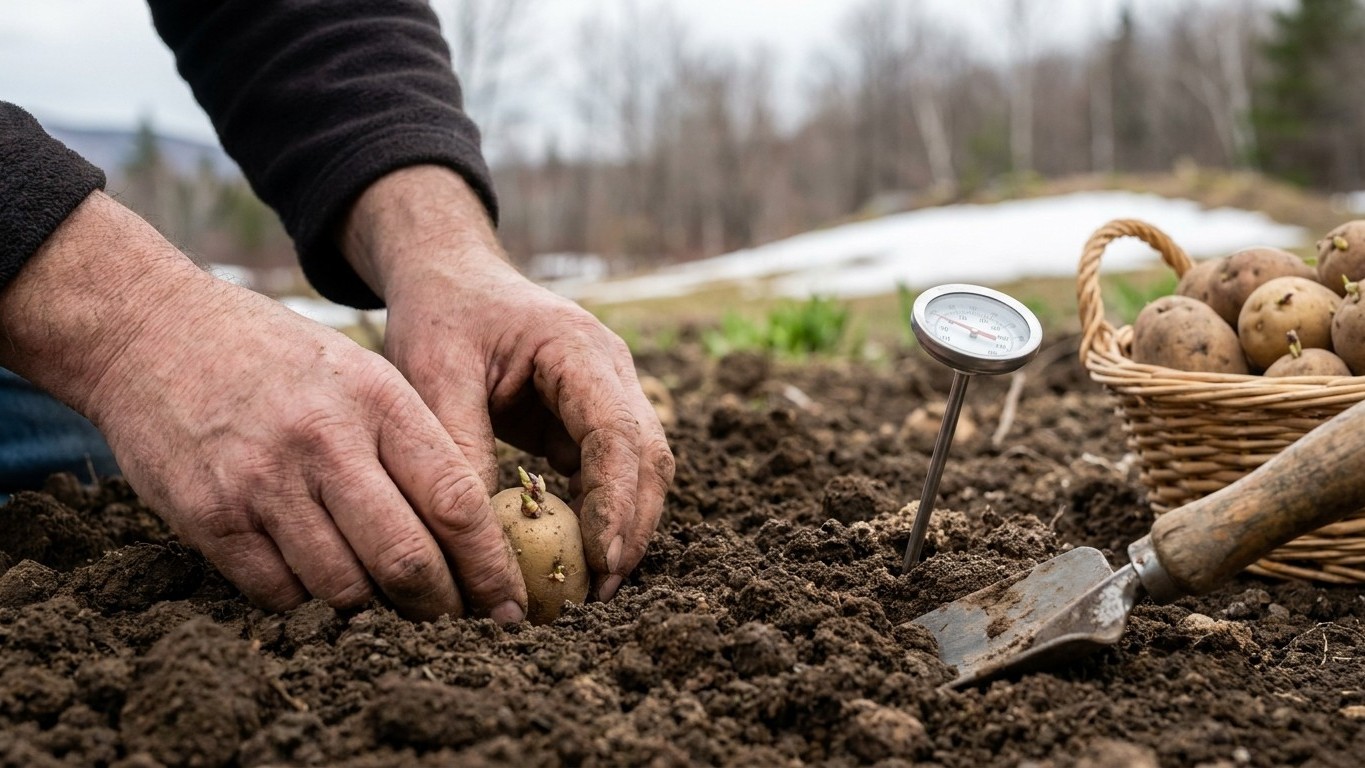

Count back 14 to 21 days from May 6, the mean last spring frost date for the Montreal/St-Hubert area (Environment and Climate Change Canada), and you land on a window running from roughly mid to late April. That’s when soil temperature, not the calendar, gives potatoes the green light: plant as soon as the ground hits 50°F. The frost date itself is an average, not a guarantee, so treat it as the middle of a range, never the edge of one.
The short answer
The figure that anchors this whole calculation is May 6, the average last spring frost date recorded by Environment and Climate Change Canada for the MONTREAL/ST-HUBERT A station, based on the Canadian Climate Normals covering 1981 to 2010. Count back 14 to 21 days from that date, following the soil-temperature guidance published by Utah State University Extension, and you get a planting window that opens around mid-April and closes in the last week of the month for the reference area around Montreal.
That arithmetic looks tidy on paper. It gets messier the moment you apply it. First, May 6 is a mean, which means in one year out of two the actual last frost falls later than that date, sometimes well later. A gardener who plants precisely 21 days ahead of a mean and treats that as a finish line is gambling with half the historical record against them. Second, this number comes from one station. A province the size of Quebec is not one climate zone: northern districts, upland farms, and anywhere away from the moderating influence of the St. Lawrence corridor run their last frost weeks behind Montreal/St-Hubert. Applying this date to a garden in the Laurentides or further north without adjustment sets a planting date that arrives too early for local conditions.
There’s also a methodological wrinkle worth flagging for anyone comparing this figure against similar planting guides for U.S. states. The Canadian normals used here cover 1981 to 2010. Figures used for American reference cities in the same planting-date family of guides typically run on the 1991-2020 normals period. The two datasets aren’t measuring the same thirty-year stretch, so a side-by-side comparison between a Quebec frost date and a U.S. one is comparing two different baselines, not two points on the same timeline.
None of that changes the core answer. For the Montreal/St-Hubert reference point, the planting window sits 14 to 21 days ahead of May 6. What changes is how much slack a gardener should build in around that window, and that depends on local soil readings more than on the date printed on a calendar page.
What actually decides it
Soil temperature, not the calendar, triggers the vine
Utah State University Extension is specific on this point: potatoes are planted as soon as the soil reaches 50°F, and that threshold typically arrives 14 to 21 days before the last frost date in a given area. The frost date is a proxy, a convenient marker that correlates with soil warming, but it isn’t the mechanism itself. Soil that’s been shaded by snowmelt runoff, sitting in heavy clay, or exposed to a cold north wind can lag well behind a neighboring plot in full sun with sandy loam, even on the same street, even on the same day. A gardener working from the calendar alone, without ever checking the dirt, is trusting a correlation instead of the cause.
This is also why the 14-to-21-day window is a range rather than a fixed number. Soil warms at different rates depending on moisture, exposure, and whether the bed was mulched or left bare over winter. A raised bed with dark soil and southern exposure might hit 50°F closer to the 21-day mark ahead of frost. A low-lying, poorly drained plot might not get there until the frost date itself has nearly arrived.
The 90°F ceiling that ends the season from the other direction
The other mechanism runs in the opposite season. Both Utah State University Extension and University of Maine Cooperative Extension Bulletin #2077 describe how tuber set and fill are inhibited once soil temperatures climb above 90°F. This isn’t a stress the plant can water its way through. Once the soil crosses that threshold, tubers stop sizing regardless of irrigation, and no amount of compensating care afterward recovers the lost growth.
This is the piece that actually decides how a gardener plans the whole season, not just the planting day. In any part of Quebec that regularly sees a run of hot soil days in mid-summer, the practical answer isn’t to push planting later and hope for a longer harvest window. It’s to plant as early as the 50°F threshold allows and treat the crop as a spring crop, dug and out of the ground before the heat arrives, rather than a plant left in place through the hottest stretch of summer hoping it keeps filling tubers. A gardener in a river valley that traps heat or on a plateau that stays cooler can apply this same logic: check the local pattern of high-heat soil days, and let that pattern, not a fixed date, decide whether the goal is an early dig or a longer season.
How to do it
- Find the last-frost mean for the specific area being planted, not just the Montreal/St-Hubert figure, since that number applies narrowly to the reference station and not to the whole province.
- Count back 14 to 21 days from that local mean to establish a target planting window, per Utah State University Extension’s soil-temperature guidance.
- Check actual soil temperature at planting depth with a soil thermometer rather than relying on the calendar window alone, and wait until the reading holds at 50°F.
- Source certified seed potatoes rather than saved tubers from a previous harvest or grocery-store stock. Uncertified seed carries virus, and that single fact matters more than any amount of extra caution taken elsewhere in the process.
- Choose a variety by its season class, early, mid-season, or late, matching that class to how much cool growing time the local frost-free stretch and summer heat pattern actually allow.
- Cut and prepare seed pieces as needed, then plant once the soil reading confirms 50°F has been reached and held, not just touched briefly.
- Track soil temperature into summer. In any area where soil regularly passes 90°F, plan to dig before that threshold is crossed rather than leaving tubers in the ground through the hottest weeks, since University of Maine Cooperative Extension confirms that heat, once it hits, can’t be reversed by watering.
What goes wrong
- Planting by the frost date alone, without ever checking soil temperature. The frost date is a proxy, not the trigger. Use a soil thermometer at planting depth and wait for a steady 50°F reading before putting seed in the ground.
- Treating May 6 as a safe date rather than a mean. In half the years on record, frost arrives later than that. Keep row cover or another frost-protection option ready through the early weeks after planting rather than assuming the risk has passed once the calendar date is behind you.
- Reusing saved seed from a previous harvest instead of buying certified stock. Uncertified seed carries virus that can undermine an entire planting regardless of how well the timing was managed. Source certified seed potatoes each season.
- Applying the Montreal/St-Hubert date to a garden well north or upland of that station. A single station’s normal doesn’t describe the whole province. Northern and upland districts run their last frost weeks behind the reference point, so the counting-back math needs a local frost date, not a borrowed one.
- Leaving tubers in the ground through a stretch of soil temperatures above 90°F. Tuber set and fill stop under that heat and watering doesn’t restore them. Where hot soil days are common, plant early and dig as a spring crop instead of extending the season into summer heat.
Common questions
Does the May 6 frost date apply everywhere in Quebec?
No. That figure comes from Environment and Climate Change Canada’s Canadian Climate Normals for the MONTREAL/ST-HUBERT A station specifically. Northern districts, upland farms, and areas away from the St. Lawrence corridor’s moderating effect see their last frost arrive weeks later, so the counting-back math needs a local frost figure, not the Montreal one, wherever the garden sits far from that reference point.
Can potatoes be planted before the local last-frost date?
Yes, and the guidance from Utah State University Extension actually expects it: planting typically happens 14 to 21 days before the last frost date, once soil temperature reaches 50°F. Potato foliage tolerates a light frost better than many garden crops, though the underlying trigger for planting is the soil reading, not simply beating the frost date by a set number of days.
How should a variety’s season class factor into the planting decision?
Both Utah State University Extension and University of Maine Cooperative Extension classify potato varieties as early, mid-season, or late rather than publishing a fixed days-to-maturity number. In an area with a short frost-free stretch or a run of hot soil days in summer, an early-season class fits better, since it reaches harvest before the 90°F ceiling on tuber growth becomes a factor. A longer, cooler growing window leaves room for mid-season or late classes.
Why does certified seed matter more than getting the date exactly right?
Because a virus problem in uncertified seed undermines the crop regardless of how precisely the planting window was calculated. Certified seed potatoes are inspected specifically to keep that risk out of the planting stock, which is a control a gardener can act on directly, unlike weather, which can only be tracked and planned around.
The Moon calendar is a separate, older custom: see when to plant potatoes by the moon, written as tradition rather than fact.