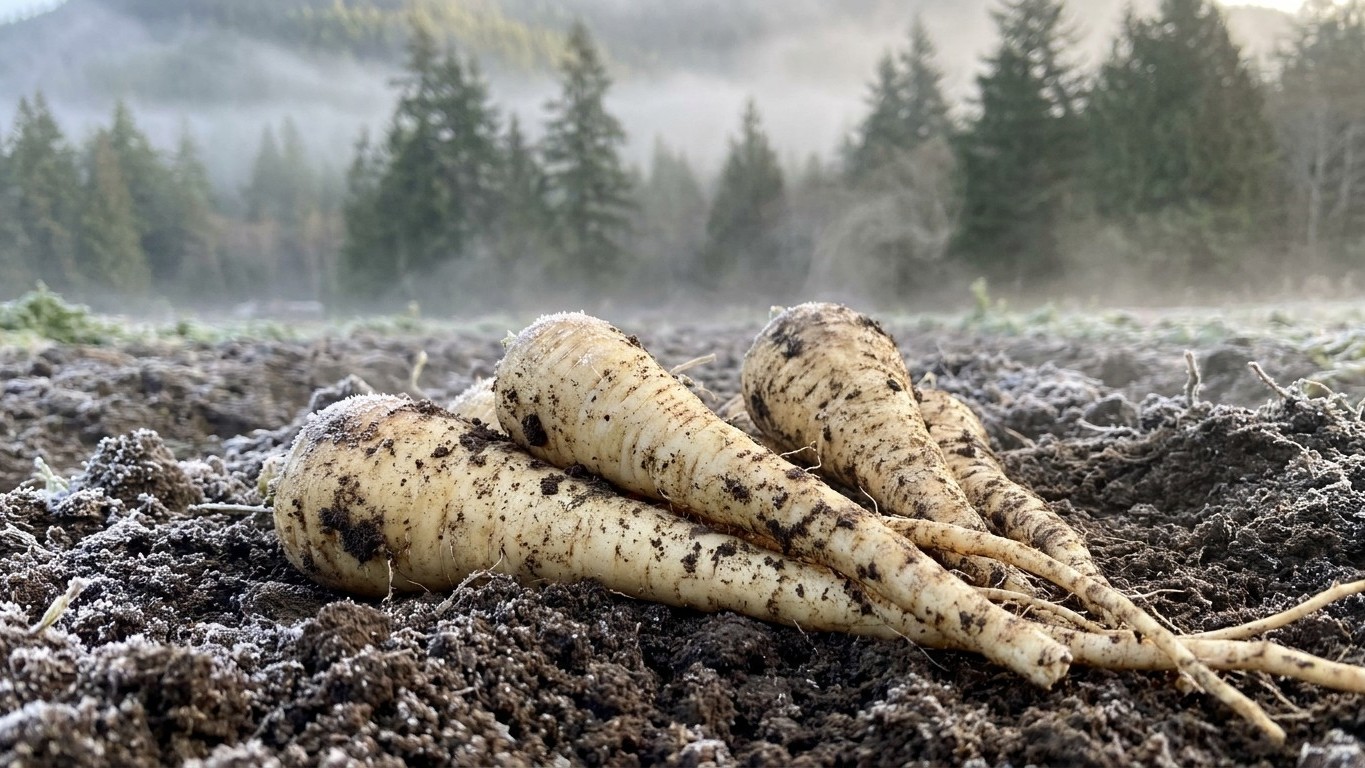

Washington gardeners growing parsnip deal with a shorter pest list than most root crops draw, because parsnip’s slow, deep taproot growth keeps a lot of general feeders from ever reaching it. The insects that do cause trouble mostly show up in two stretches: right after seedlings break the soil, and again later as the root itself thickens. WSU Extension tracks the species active on vegetable crops in this state, and only part of that list ever touches parsnip.
Which pests attack parsnip in Washington

WSU Extension documents the following insects on vegetable crops in Washington:
- Aphids
- Brown marmorated stink bug
- Cabbage maggot
- Carrot rust fly
- Colorado potato beetle
- Corn earworm and earwigs
- Cutworms and armyworms
- Flea beetles
- Imported cabbageworm and loopers
- Onion maggot and onion thrips
- Slugs
- Spider mites
- Western spotted cucumber beetle
- Wireworms
Not every name on that list belongs in a parsnip bed. Brown marmorated stink bug feeds mainly on fruiting crops and tree fruit, not a below-ground root vegetable, so it can be set aside. Cabbage maggot, imported cabbageworm and loopers are brassica specialists that need a cabbage-family host to lay eggs on. Colorado potato beetle is tied to the nightshade family, potatoes and eggplant, and has no reason to visit a carrot-family crop. Onion maggot and onion thrips track allium chemistry that parsnip doesn’t produce. Western spotted cucumber beetle is a cucurbit feeder, drawn to squash and cucumber vines, and has nothing to do with a parsnip root.
Corn earworm targets corn ears and tomato fruit and also does not apply here, but earwigs, the second half of that same listed pair, are general feeders that will chew on young vegetable seedlings of many kinds, parsnip included.
That leaves a working list for parsnip in this state: aphids, carrot rust fly, earwigs, cutworms and armyworms, flea beetles, slugs, spider mites, and wireworms. Carrot rust fly deserves special attention since parsnip and carrot share the same botanical family, Apiaceae, and the fly targets that family specifically. The rest are broad vegetable-garden feeders that happen to include parsnip on their menu rather than pests built around it.
When each one shows up, and what it does first
Parsnip is sown directly in the ground, not transplanted, and germination alone takes 14 to 21 days, according to Utah State University Extension. That stretch, seed in cold soil with nothing visible above ground, is exactly when cutworms and wireworms already in the soil do the most damage, because there’s no green growth yet to distract them from a swelling seed or root.
Once seedlings emerge, earwigs and flea beetles move in first. Earwigs leave ragged, irregular holes in young leaves, usually chewed overnight, while flea beetles punch tiny round shot-holes across the same tender leaf tissue. Both hit hardest in the first couple of weeks after emergence, when leaf tissue is thinnest and a plant has the least capacity to outgrow the damage.
Carrot rust fly follows a bit later, once the taproot has started to form below the soil line. Adults lay eggs at the base of the plant, and the larvae tunnel into the developing root, leaving rust-colored scarring and tunnels that usually aren’t visible until harvest. This is a cool-season pest, and Washington’s last spring frost window of February 27 to March 18 in western parts of the state, paired with a first fall frost arriving November 13 to November 30, gives a long, mild, damp season that suits this fly’s biology well.
Aphids and spider mites show up as the canopy fills in, aphids clustering on the undersides of leaves and along stems with sticky honeydew residue, spider mites appearing during any drier, warmer stretch as fine stippling and a dusty bronze cast on foliage. Slugs are the outlier: they’re active on cool, wet days from the moment seedlings emerge straight through the fall, since Washington’s mild, damp fall frost timing keeps soil moisture high for months. Wireworms reappear near the end, tunneling into the thickening root as it approaches its 100 to 120 day maturity mark from seeding, the window Utah State University Extension gives for parsnip to reach harvest size.
Telling the damage apart from everything else
A lot of what looks like insect damage on parsnip isn’t. Forked or split roots are the classic case, and that symptom has two separate possible causes here, not one: heavy or stony ground that physically blocks the taproot as it grows, and overwatering that encourages branching roots instead of one straight one. Neither is an insect issue, and treating it as one wastes a season.
| Symptom | Likely cause | What distinguishes it |
|---|---|---|
| Forked, branched root | Heavy/stony soil, or overwatering | No feeding marks or tunnels on the root surface itself |
| Rusty scarring, tunnels in root | Carrot rust fly larvae | Tunnels visible only when root is pulled or cut |
| Ragged holes in young leaves | Earwigs | Damage appears overnight, worst on lower leaves |
| Tiny round shot-holes in leaves | Flea beetles | Concentrated on youngest leaves, edges intact |
| Yellowing, curling foliage | Aphids, or nutrient stress | Check undersides of leaves for clusters before assuming a deficiency |
| Bronze, stippled leaves | Spider mites, or drought stress | Fine webbing under leaves points to mites |
| Seedling cut off at soil line | Cutworms | Plant severed cleanly near the base, not wilted from dryness |
Nutrient deficiency, uneven watering, and mechanical damage from a hoe or cultivator can all mimic insect feeding at a glance. A yellow, curling leaf could be aphids, or it could be a plant that dried out between waterings. The only way to tell the difference for certain in a specific garden is a closer look, and if that look doesn’t settle it, the local extension office is the next step, not a guess.
What actually works here, and what is a waste of time
Timing beats product on a crop with a 100 to 120 day season. A floating row cover put down at seeding, before carrot rust fly adults are active, blocks egg-laying entirely and is the single most reliable physical defense available for that pest, far more dependable than trying to treat larvae once they’re already inside the root. The same cover, if it’s sealed at the edges, also keeps flea beetles and earwigs off young seedlings during their most vulnerable first weeks.
Handpicking works for slugs on a small planting, especially checking after wet evenings when they’re actively feeding, and shallow cultivation before sowing exposes wireworms to birds and dry air, cutting down their numbers without any input at all. Crop rotation, keeping parsnip and carrot off the same ground in back-to-back seasons, reduces the buildup of both rust fly and wireworm populations tied to that soil.
What wastes time: treating forked roots as a pest problem, since no insect on the documented list causes forking, the fix there is soil preparation and watering, not pest control. Spraying broadly after damage is already visible on the root is also too late for carrot rust fly and wireworms, since both feed out of sight underground until harvest. And loosening or amending soil after a plant has already forked won’t unfork that root; it only helps the next planting.
Where to check this for your own county
WSU Extension is the source for everything documented on this page, and the same organization runs county-level offices across the state that track what’s actually active locally, which can differ sharply from the statewide list. Western Washington’s mild, wet climate and eastern Washington’s high desert conditions produce very different pest pressure, even though both fall under the same state-level documentation.
A pest showing up in a county extension report two counties over doesn’t mean it’s present in a specific garden, and a pest absent from the state list statewide doesn’t rule it out locally either. The county office is where general documentation turns into something specific to a particular yard, soil, and season.
The practical next step is a call or visit to the county WSU Extension office before the first sowing window opens, not after damage shows up. That’s when a local recommendation, tuned to that county’s actual pest pressure and frost timing, is worth the most.
Common questions
Does parsnip need a hard freeze to taste sweet?
It needs exposure to several weeks of frosty weather, which converts stored starch to sugar, according to Utah State University Extension. A mild winter climate can still grow a fine-looking parsnip that never develops that sweetness, since the sweetening comes from actual frost exposure, not from a general climate rating.
Can carrot rust fly be a problem even without carrots nearby?
Yes. Parsnip belongs to the same plant family as carrot, Apiaceae, and the fly targets that family directly, so a parsnip bed alone is enough of a host without any carrots planted nearby.
Is a forked parsnip root a sign of pest damage?
No insect on the documented list for this state causes forking. It points instead to heavy or stony soil blocking the taproot, or to overwatering, and the fix is soil preparation, not pest treatment.
When is the highest-risk window for parsnip seedlings?
The first two to three weeks after germination, while leaves are thinnest and the seed is still vulnerable underground. Since germination itself takes 14 to 21 days, that means the plant is exposed for roughly a month before it has enough growth to shrug off minor feeding.