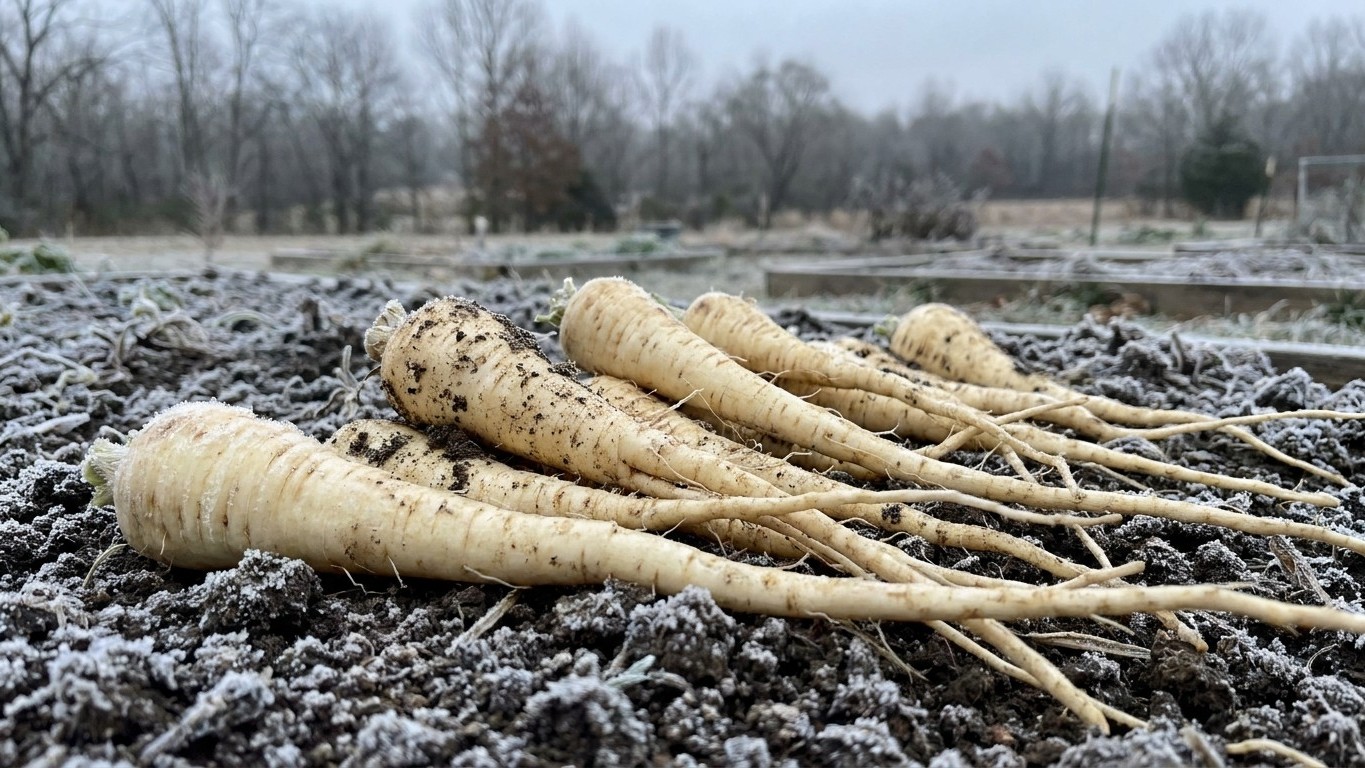

Western Washington’s frost pattern is thin, not absent. Parsnips sown here will size up into fine roots most years, but the deep, sustained cold that converts starch to sugar shows up unevenly along the Puget Sound corridor. The coldest month’s average low sits at 37.1°F, a number that changes the answer more than any hardiness zone map ever could.
The short answer
Start with the number that actually decides this: the mean minimum temperature of the coldest month at the Seattle reference station is 37.1°F, according to NOAA NCEI’s 1991-2020 Climate Normals. That is not a hard freeze. It is barely a chill. A hardiness zone rating tells you whether a perennial’s roots survive winter in the ground. It says nothing about whether a biennial root vegetable sitting in that same ground gets cold enough, often enough, to turn its stored starch into sugar. Those are two different questions, and gardeners mix them up constantly.
Parsnips need repeated exposure to frost, not just survival of it. The starch-to-sugar conversion is a metabolic response triggered by cold stress over several weeks, and a coldest-month average low hovering just above freezing means the plant is flirting with frost rather than living through it night after night. Some winters bring a stretch of clear, cold nights that dip well below that average and do the job. Other winters stay wrapped in Pacific cloud cover and rain, keeping soil temperatures mild enough that the roots simply sit there, unsweetened but perfectly edible.
So the honest answer is conditional. A parsnip grown in western Washington will almost certainly grow well: the soil moisture, the long cool season, and the mild temperatures that don’t stress the foliage all favor root development. Whether it sweetens depends on getting a real cold snap in December or January, not just a technical frost. Gardeners who leave the crop in the ground through the coldest weeks and pull roots after a hard cold spell report noticeably better flavor than those who harvest on the first frost date and call it done.
This is different from what a gardener in Minnesota or Montana experiences, where the coldest month’s average low sits far below freezing and sweetening happens almost automatically. In this maritime climate, sweetening is a bonus that depends on the particular winter, not a guarantee baked into the calendar. That uncertainty is worth building into expectations before the seed ever goes into the ground.
Does the season fit?
Parsnips are sown directly in place, never transplanted, and the clock starts at seeding, not at germination. Utah State University Extension puts the full cycle at 100 to 120 days from a sowing made 2 to 3 weeks before the last frost. Here is how that arithmetic plays out against western Washington’s frost window.
- Find the sowing date. NOAA NCEI’s 1991-2020 Normals put the last spring frost at the Seattle reference station between February 27 and March 18. Sowing 2 to 3 weeks ahead of that puts seed in the ground sometime in mid-to-late February for many gardeners, though cold, waterlogged soil this early often forces a delay of several more weeks regardless of what the frost calendar says.
- Add germination time. Parsnip seed is slow and notoriously erratic. Expect 14 to 21 days before sprouts appear. A gardener who doesn’t account for this will dig around in bare soil, assume the seed failed, and re-sow over top of seedlings that were about to emerge.
- Count forward 100 to 120 days. From a mid-to-late February sowing, 100 to 120 days lands the crop’s maturity somewhere in June through July. That is comfortably before the first fall frost, which arrives between November 13 and November 30 in this same window.
- Compare the total window. The gap between the last spring frost and the first fall frost stretches roughly eight months here, far longer than the 100- to 120-day requirement. Even a late, soil-delayed sowing in April still finishes well ahead of the first fall frost.
- Verdict: comfortable, not tight. The season fits with room to spare. The real constraint in western Washington isn’t day count, it’s soil temperature and drainage in late winter holding back that early sowing.
What goes wrong here
- Forked roots from heavy or stony ground. Puget Sound soils run from clay-heavy to glacial till in many yards, and parsnip taproots split around rocks, clay lenses, or compacted layers instead of growing straight. Utah State University Extension recommends deep, sandy soil, and where that isn’t the native condition, double digging the bed a full spade’s depth or more before sowing is the fix.
- Forked roots from overwatering. This is a separate cause from soil texture, and it matters because the region’s fall rains can waterlog beds even when the soil itself is loose. Excess moisture pushes lateral root growth and produces the same forked, stubby shape as rocky ground. Beds that drain slowly need raised rows or added grit rather than more frequent watering.
- A crop that outruns daylight, not days. The season length itself isn’t the problem in western Washington, but low light and cool soil in late winter can stall germination and early growth for weeks. Gardeners expecting a fixed calendar date for sowing get frustrated when nothing happens; waiting for workable soil matters more than chasing the frost date.
- A winter too mild to sweeten. As covered above, some winters here simply don’t deliver enough sustained cold. There’s no soil fix for this one. Leaving roots in the ground as late into winter as storage rot allows, rather than harvesting at the first light frost, gives the crop the best chance at whatever cold does arrive.
Handling parsnip foliage and roots carries a real skin hazard, and it’s one most garden guides skip entirely. North Carolina State Extension’s Plant Toolbox states it plainly: “All parts of this plant contain furocoumarins which can make skin sensitive to light causing burns so be sure to wear gloves, long sleeves and long pants when dealing with it.”
The mechanism is what makes this catch people off guard. The burn doesn’t come from the sap alone. It comes from sap plus sunlight acting together on the skin. That’s why it tends to happen on a bright day of harvest, when a gardener is pulling tops or handling roots bare-armed in full sun, and why the reaction often doesn’t show up until hours later, once the skin has had time to react to UV exposure. Because the sunlight is the trigger, washing the skin after the fact does little; the protection that actually works is covering up before contact, with gloves, long sleeves, and long pants, exactly as the source specifies. And because it’s all parts of the plant, not just the leafy tops, that caution applies to root handling too, not only to weeding around the foliage.
Checking this against your own county
The Seattle reference station gives a solid picture for the Puget Sound corridor, but Washington’s climate splits sharply at the Cascades. Frost dates, soil types, and winter cold in Spokane or the Yakima Valley look nothing like this maritime data set, and a gardener east of the mountains should not apply any of these figures directly.
Washington State University Extension, at extension.wsu.edu, maintains county offices across the state that track local frost data, soil conditions, and planting timing specific to each region. A quick call or visit to the county office nearest a given garden will confirm whether the season window and cold exposure described here actually match local conditions, or whether an eastern Washington garden needs a different calendar entirely.
Common questions
Can parsnips be sweetened by putting harvested roots in the refrigerator instead of waiting for frost in the garden?
The sweetening process described by Utah State University Extension is tied to cold stress the living plant experiences over several weeks in the ground, not a post-harvest chilling step. Refrigerating already-pulled roots is a storage method, not a substitute for field frost exposure.
Should parsnips be planted in raised beds in western Washington?
Where native soil is heavy clay or full of glacial stone, a raised bed built with a deep, loose growing medium addresses both the forking risk from obstructions and the drainage problem tied to the region’s wet fall and winter, since it lets excess water move away from the taproot more readily than flat, compacted ground.
Why did my parsnip seed fail to come up after two weeks?
Two weeks isn’t necessarily a failure. Germination takes 14 to 21 days under good conditions, and cool, damp western Washington soil in late winter can push that timeline even longer. Digging to check often disturbs seed that was still on track to sprout.
Is it safe to compost parsnip tops after harvest?
The safety concern from NC State Extension is about skin contact with the sap in sunlight, not about the plant material’s suitability for composting. The same handling precautions, gloves, long sleeves, and long pants, apply when gathering and moving the foliage to the compost pile on a sunny day.