
The direct answer: the verified sourcing behind this page does not carry a named, dated list of insects reported to attack carrot in Oregon plantings. What is documented and sourced is the ground most Oregon carrots grow in, and it explains a large share of the damage gardeners blame on pests. That distinction changes how this whole question should be answered.
Which pests attack carrot in Oregon

Here’s the honest starting point. No state agency or county pest-monitoring record naming specific insects feeding on carrot appears in the material used to build this page, so nothing gets invented here. A gardener typing “what’s eating my carrots in Oregon” deserves a straight answer rather than a species guessed at and pasted onto a page that never confirmed it’s active in this state.
What is verified, and what drives a large share of the carrot trouble reported across Oregon gardens, isn’t an insect at all. It’s the ground itself.
The soil the state is built on
Oregon’s official state soil is the Jory series, an Ultisol, an old, heavily weathered and leached soil type that runs naturally acid and low in native nutrients. USDA soil survey data puts its surface pH at about 5.6, with a texture of 14 percent sand, 34 percent clay, and 52 percent silt, and organic matter around 5.0 percent. It’s classified as well drained in the technical sense soil scientists use.
That classification is where confusion starts. “Well drained” describes how fast water moves through the whole soil profile, not how easy the top few inches are for a carrot root to push through. A soil running more than a third clay resists the straight, unobstructed growth a carrot needs. Utah State University Extension is direct about the result: carrots want deep, sandy, well-drained soil rich in organic matter, and heavy or rocky soil makes the root fork.
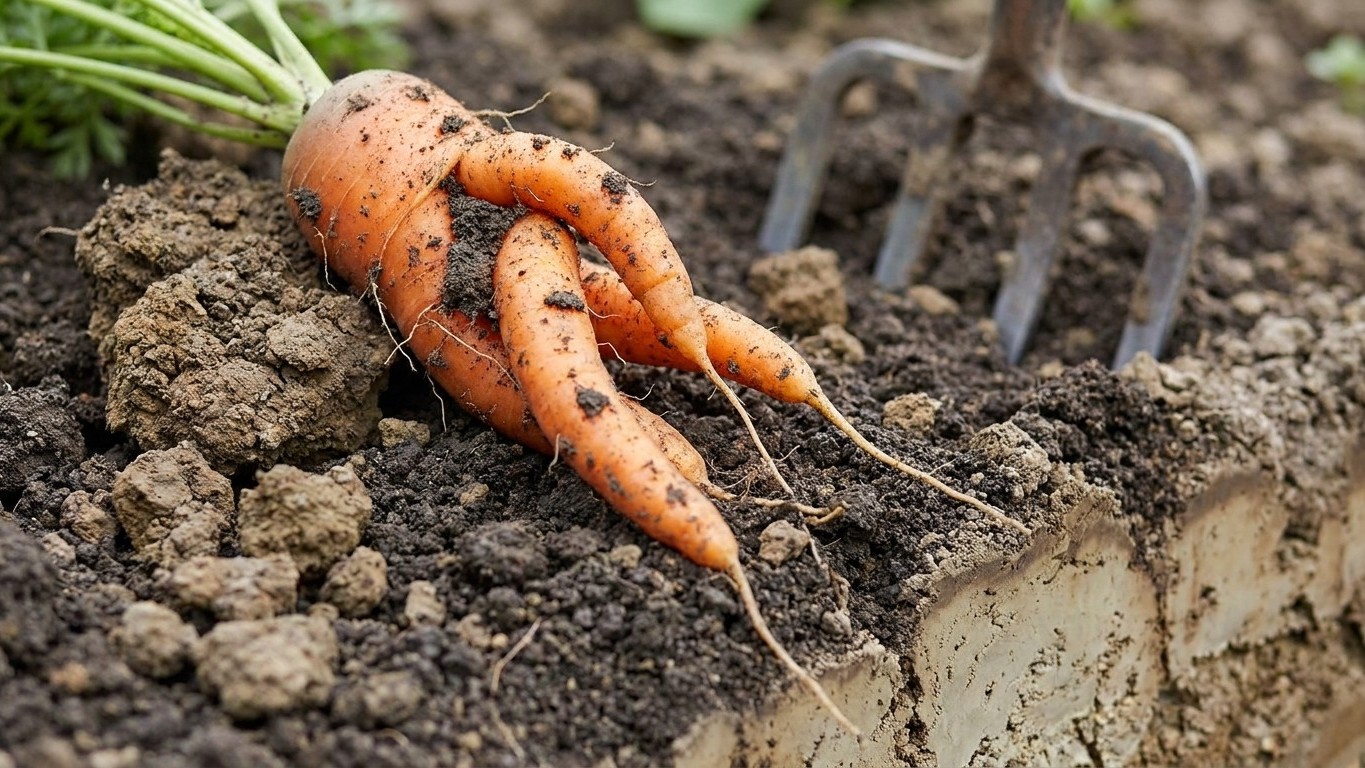
If a pulled root shows a hard kink or branches around an obstruction, suspect the soil before suspecting a bug. That forking pattern gets blamed on pests more often than it should, when no insect ever touched the root.
None of this means Oregon gardens are pest-free. It means this page won’t name a species it can’t source, and a real damage pattern deserves a local answer, not a list copied from an unrelated state.
When each one shows up, and what it does first
Carrots are sown directly into the ground, never transplanted, so every clock on this crop starts at seeding, not at a plant-out date. That single fact changes how any calendar for this crop should be read.
The earliest visible trouble usually isn’t a bite mark. It shows up when the first true leaves try to push through a crusted surface, weeks before the row looks like carrots at all. Soil that crusts from a high clay fraction, the same texture behind Oregon’s representative state soil, can hold seedlings back on its own, and a gardener who assumes something ate the seedling is often looking at a soil crust instead.
Mid-season, when root shape locks in
Once the root starts thickening, forking becomes permanent. A root meeting resistance early keeps that shape the rest of the season; it doesn’t straighten out later. This same stretch is when uneven watering shows up as clean splits, a separate problem from forking and tied to moisture swings rather than texture.
Clemson Cooperative Extension puts carrot harvest at about 65 to 75 days after planting, while the broader guidance on carrot growing, sourced to Utah State University Extension, frames the full seeding-to-harvest range at 70 to 100 days depending on conditions. Either figure runs from the day seed went into the ground, never from a transplant date, since carrots don’t get one.
What shows up first at harvest, a forked, split, or stunted root pulled from the ground, arrives at the exact moment it’s hardest to trace: was it the soil months back, the watering weeks back, or something that fed on it recently? Sorting that out is the next step.
Telling the damage apart from everything else
Nobody should get told what’s wrong in their own garden from a description online. What this section can do is lay out the signs that separate soil, water, and storage problems from an actual pest bite, so a call to the local extension office starts with better information.
| What you see | Likely cause | What separates it |
|---|---|---|
| Root forks into two or more legs | Heavy or rocky soil, resistance during root growth | Happens mid-root and below ground; insect feeding tends to leave marks near the surface |
| Root has a clean split or crack | Uneven watering | Splits are smooth and radial, not ragged or chewed |
| Surface has ragged tunnels or holes | Possible insect feeding | Irregular tunneling with no straight edge is worth photographing for extension staff |
| Tops wilt within days of harvest | Leaves still drawing moisture from the root | Cutting the tops at harvest stops it; a pest problem doesn’t resolve by trimming leaves |
| Stored roots soften or sprout early | Storage temperature too high | Roots held above 33°F soften and sprout far faster than roots held near freezing |
The one pattern on that list that consistently points away from soil, water, or storage is ragged, irregular tunneling. Everything else traces back to something a gardener controls directly: bed texture, watering schedule, or the minutes between pulling a carrot and cutting its top.
Even a ragged tunnel isn’t a confirmed pest without someone trained to look at it. A clear photo and a note on when the damage first appeared do more good for a county extension office than a guess borrowed from a different climate.
What actually works here, and what is a waste of time
Given a clay-heavy state soil and a season that runs on a seeding-to-harvest clock, the moves that pay off in Oregon carrot beds are almost all about preparation, not treatment after the fact.
Worth doing
Building a raised bed or double digging before seeding addresses exactly what Utah State University Extension flags for heavy soil: forking caused by resistance the root meets on its way down. Working compost into the row ahead of seeding raises organic matter above whatever the native ground carries, loosening a texture that starts out around a third clay in Oregon’s representative soil series. None of this works once the roots are already thickening; bed preparation has to happen before seeding.
At the other end of the season, cutting the tops off at harvest and cooling the roots toward 33°F costs nothing and pays off fast. Bunched carrots with tops still on hold for about 10 to 14 days; trimmed roots stored cold last considerably longer, because the leaves stop pulling moisture out of the root.
Not worth doing
Applying any insect treatment before an actual pest is identified is close to pointless here. Nothing in the sourced record confirms which species, if any, are active in a given Oregon county, and a product aimed at the wrong problem does nothing for a forked or split root. Treating a garden based on the state’s representative pH of 5.6 is the same mistake in a different form; native pH varies by county and by yard, and a soil test settles that question in a way no statewide figure can.
Where to check this for your own county
Oregon State University Extension Service runs county-level offices across the state, and that’s the right first call for identifying actual insect damage on carrots, not a generic search result written for a different climate. County offices track what’s active locally, something no state-level page can do, since pest pressure shifts from the Willamette Valley to the high desert to the coast within the same state.
The soil data on this page makes that point on its own. The Jory series figures represent the surface horizon averaged across 119 mapped components of that one series, not every soil in Oregon and certainly not the dirt in one specific backyard. A garden built on river-bottom fill or ground scraped down to subsoil during construction can carry none of the traits listed here. Treat the state soil numbers as a description of a tendency, clay-heavy, mildly acid, moderate in organic matter, and get an actual soil test before acting on them.
The same logic applies to pests. A species documented somewhere in the state doesn’t mean it’s present in one yard, and a species absent from state-level records isn’t proof it can’t show up locally. County extension staff, and in many counties a Master Gardener program attached to that office, exist to answer that gap with current, local information.
The next useful step isn’t more reading. It’s finding the county extension office attached to the property’s address and calling with a description, or a photo, of what’s actually growing there.
Common questions
Does every Oregon county have the same carrot pests?
No. Pest pressure changes with climate and elevation across the state, and nothing in the sourced material for this page supports a single statewide list. County extension offices track what’s active in their own area.
Is Oregon’s official state soil the same as the soil in my garden?
Not necessarily. The Jory series is the state’s representative soil under Oregon law, but a state spans hundreds of mapped soil series, and a specific yard, especially one that’s been graded, filled, or built near a river bottom, can differ completely. A soil test gives the actual number for that ground.
How long can harvested carrots be stored?
Clemson Cooperative Extension notes that bunched carrots, meaning roots with their tops still attached, keep for about 10 to 14 days. Cutting the tops off at harvest and storing the roots at 33°F with high humidity extends that considerably, since the leaves are no longer pulling moisture out of the root.
Why do carrots fork or split even in soil that looks fine on the surface?
Forking usually traces to resistance below the surface, a clay layer, compacted subsoil, or a buried rock, that a root can’t push through and grows around instead. Splitting is a different problem, tied to uneven watering rather than soil texture. Neither one is caused by an insect.