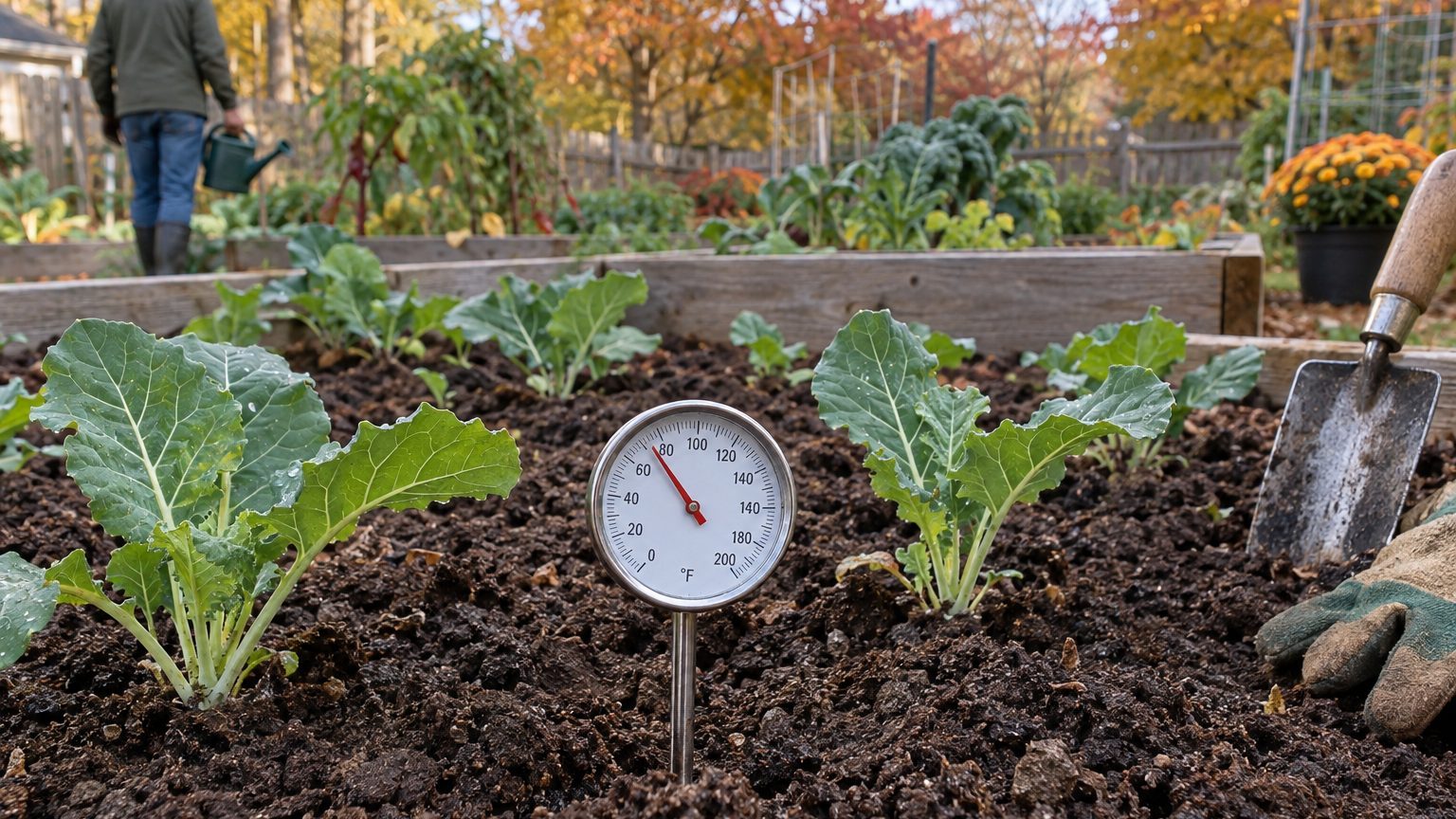

Set collards out once the soil itself has warmed, not the moment the calendar says frost season has passed. In central Indiana that generally means late April into early May, with an earlier start in the southern counties and a later one near Lake Michigan. Collards also make a strong fall crop here, sown in midsummer for harvest after the first cool nights sweeten the leaves.
When the soil is warm enough in Indiana

Frost dates get all the attention, but they’re a stand-in for the number that actually matters: soil temperature. Collard seed germinates slowly in cold ground and transplants sulk if the root zone is still chilly, so the frost calendar only tells you when the killing cold is statistically unlikely, not when the dirt is ready to grow anything.
For the Indianapolis area, NOAA’s 1991-2020 Climate Normals put the last spring freeze (32°F) at April 9 to April 21, based on 30-70% freeze probability data from station USW00093819. That’s a probability band, not a guarantee. Purdue’s own extension guidance adds a blunt caveat worth remembering: even after the published spring date passes, there’s still roughly a 10% chance of a 32°F event. If you’re setting transplants out on the early edge of that window, plan on having row cover or an old bedsheet ready for one more cold night.
Soil warms on its own schedule after that freeze risk fades, usually needing another week or two of settled weather before it’s genuinely friendly to young roots. Gardeners in the Ohio River counties can often push earlier than the Indianapolis dates suggest, while those near the Michigan border should expect to wait later, since the state’s spring frost timing shifts by more than two weeks from south to north.
Don’t skip the rotation question
Collards are brassicas, in the same family as cabbage, kale, mustard, turnip and rutabaga. Planting them where any of those grew last season, or the season before, invites the same soil-borne diseases and pest pressure right back in. If a bed hosted mustard greens or cabbage recently, treat it as brassica ground, not a fresh start, and rotate accordingly rather than just avoiding the exact same crop.
Skip synthetic seed treatments and blanket sprays as a first response to early pest pressure. Row covers set immediately after planting, and simple hand-removal of egg clusters, handle most early-season flea beetle and cabbage worm issues on a home scale without reaching for a product label.
How long the season lasts here
Pair the spring date with the fall one and you get the real working number: how many frost-free days a given Indiana garden actually has to work with. NOAA’s same 1991-2020 Climate Normals for the Indianapolis station put the first fall freeze at October 21 to October 30.
Run the two bands against each other and the frost-free window lands somewhere between 183 to 204 days, depending on whether your particular spot falls on the early or late edge of each band. That’s not a small gap. It’s the difference between a season that comfortably fits two collard plantings and one that barely fits a well-timed single crop.
A window on the longer end of that range supports a genuine second sowing: an early planting harvested through summer, followed by a fresh midsummer sowing timed to mature in the cool, mild weather of October. A shorter window changes the math. With less slack after the spring crop finishes, the fall sowing becomes the planting that matters most, and it raises the question of whether to direct-seed or start transplants indoors to buy back a couple of those lost weeks. Either way, timing a second round of collards, or squeezing in a quick planting of something else between them, is exactly what a succession sowing plan is built to handle, and it’s worth working out on paper before the season, not during it.
Southern Indiana gardeners get some real breathing room here since both frost dates shift in their favor, arriving earlier in spring and later in fall than the Indianapolis reference point. Northern counties should treat the shorter end of these ranges as the realistic planning number rather than the average.
Heat and water in Indiana

The detail that actually decides how a collard bed gets planned in Indiana isn’t summer heat, it’s winter cold. NOAA’s Climate Normals put the coldest month’s mean daily minimum at 20.9°F for the Indianapolis reference station, well below freezing on an average night, not just on a bad one.
That single figure separates two completely different ways of growing this crop. In the Deep South, where the coldest month’s average low stays mild, collards become a standing crop, picked leaf by leaf from November straight through March. Indiana’s winter doesn’t offer that. A mean daily minimum near 21°F means hard, sustained freezes are a normal part of the season, not an occasional risk, so unprotected collard plants left in the ground through deep winter are gambling against odds that don’t favor them. Here, collards behave as an autumn crop: sown in summer, harvested through the cool months, and finished off by the season’s first hard freeze rather than carried through it.
The state’s hardiness zone range of 5b to 7a (USDA Plant Hardiness Zone Map, 2023, built from 1991-2020 normals) reflects that same north-south split. Southern Indiana’s milder pocket can sometimes stretch a fall collard harvest further into winter with cover, while the northern edge of the state should plan on wrapping up well before the calendar turns to January.
Summer conditions still shape the crop, just less dramatically than that winter number does. Indiana’s growing season includes stretches of genuine heat, and cool-season brassicas like collards respond to sustained hot, humid stretches by slowing down, toughening their leaves, or bolting early if a spring planting runs too long into summer. That’s the practical case for treating the fall sowing as the reliable one: it grows into cooling, not warming, temperatures. Humid Midwest summers also favor foliar diseases like downy mildew on brassicas that stay wet too long, so morning watering at the soil line, rather than overhead in the evening, does more for the crop than any amount of extra fertilizer.
Which collards suit Indiana
None of this points to a single variety, and that’s the honest answer, not a dodge. This page can tell you what Indiana’s climate demands of a collard plant; it can’t tell you which named seed packet performs best on your particular soil, because that answer comes from local trial data this page doesn’t have.
What the territory’s numbers do tell you is which type of collard to look for. Given the frost-free window running from 183 to 204 days, an earlier-maturing type gives more margin for a fall crop that actually finishes before the hard freeze, especially in the northern counties where that window sits at the shorter end. Given the humid Midwest summer, disease resistance, particularly to the leaf diseases that spread fast in wet, still air, matters more here than it would in a drier climate. Given the heat spells that do occur, a planting arrangement with decent airflow between plants and consistent moisture at the root zone matters more than which catalog page the seed came from.
Contact Purdue Extension (extension.purdue.edu) for the specific collard varieties trialled and recommended for Indiana conditions. Their county offices track which types have actually performed well against the state’s disease pressure and freeze timing, which is a far more useful filter than anything a general growing guide can offer.
When it comes time to store what you harvest, judge each leaf and any stored root by hand, not by memory of how long it’s supposedly good for. A soft patch, a weeping spot, or any sign of mold at the crown means that piece gets discarded, regardless of how fresh the rest of the batch looks.