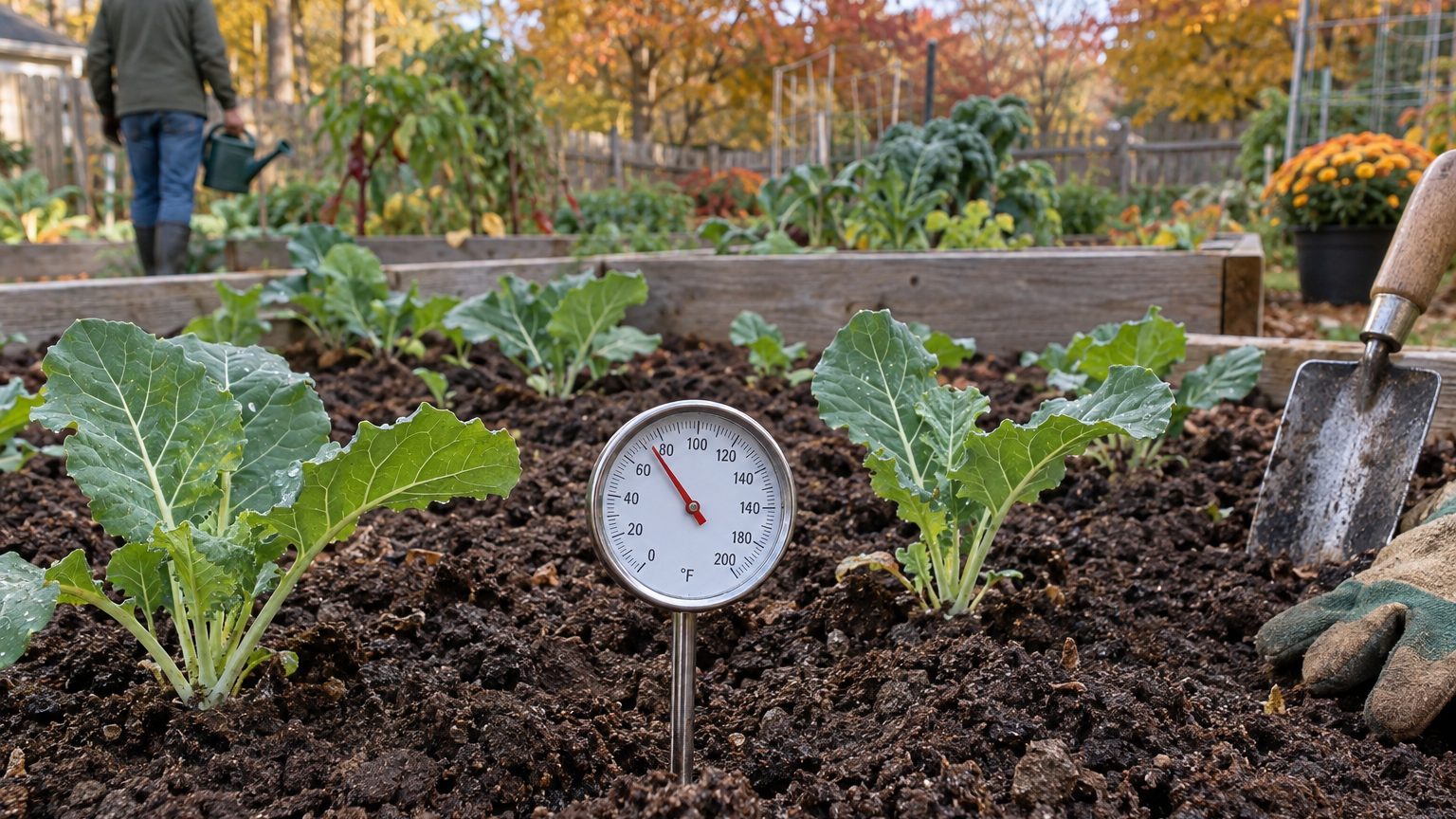

In most of Maryland, collards go into the ground once soil temperatures climb into the mid-40s and hold there, which typically lines up with mid-to-late April statewide, though mountain valleys and the Eastern Shore run on different clocks. The frost date on the calendar is only the starting signal, not the finish line.
When the soil is warm enough in Maryland

Maryland’s last spring frost falls between April 3 and April 16, according to NOAA NCEI’s 1991-2020 Climate Normals for the state’s reference station. That’s the window where a 32°F freeze has a 30 to 70 percent chance of still happening, which means it’s a probability, not a promise. Half the years in that record, frost showed up after the “average” date. Nobody should treat it as a green light by itself.
The frost date matters mostly as a stand-in for something the reader can’t see: soil temperature. Collard seed germinates poorly in cold, wet ground, and transplants sulk when the soil hasn’t caught up to the air. Soil at 4 inches deep needs roughly two to three weeks past the average last frost to reach the range collards actually want, which is why gardeners who direct-seed the week frost “ends” often watch nothing happen for a month. Waiting for the soil, not the sky, is the actual rule.
Western Maryland changes this math. Garrett and Allegany counties sit at higher elevation and colder air pools in the valleys, so frost risk there runs weeks behind the rest of the state. A transplant date that works in Baltimore can be premature in Oakland or Frostburg. The Eastern Shore runs the other direction: milder air off the Chesapeake means soil warms sooner and the safe window opens earlier than the statewide average suggests.
None of this settles which collard type to plant, and that’s deliberate. Seed catalogs list dozens of strains bred for different lengths of exposure to heat, cold, and humidity, and the ones performing best in a University of Maryland variety trial this year may not be the ones performing best five years from now. The only up-to-date answer lives with University of Maryland Extension, whose regional agents track what’s actually thriving in local trial plots. That’s a better source than any generic list, including this one.
Whatever type gets chosen, the planting bed deserves a rotation check before seed goes in. Collards are brassicas, in the same family as cabbage, kale, mustard, turnip, and rutabaga, and they share root diseases and pest pressure with all of them. A bed that grew cabbage or mustard greens last season hasn’t been rested just because this year’s crop has a different name on the seed packet.
How long the season lasts here
Stretch the calendar between Maryland’s two frost windows and the growing season runs from the last spring frost (April 3-16) to the first fall frost, which arrives between October 26 and November 5. That’s roughly six and a half months of frost-free growing in the reference data, though again, western counties and the Eastern Shore shift that window in opposite directions.
Six-plus months is generous room for collards, which don’t need the whole span to mature. A window this long allows a second sowing: an early planting that comes off the bed by midsummer, followed by a fall sowing timed to mature as the weather cools, which is when collard flavor actually improves. Growers in Territories with a four-month window don’t get that luxury; the first sowing is the only sowing, and every decision about transplanting versus direct-seeding gets weighed against a hard deadline instead of a flexible one.
Maryland’s length also changes how much risk a late-summer sowing carries. Seed going into the ground in late July or early August has time to establish roots, put on leaf growth through September, and still finish well before the average fall frost arrives in late October or early November. That’s a real second harvest window, not a race against the clock.
The catch is that “average” cuts both ways here too. A frost arriving on the early side of the October 26-November 5 band trims that fall window by a week or more, which matters most for anyone who sowed late banking on the full six-plus months. Anyone planning a second planting should read the succession sowing guide on this site before picking a date, since the math changes with each week of delay.
Heat and water in Maryland

Summer in Maryland isn’t uniformly brutal, but it isn’t gentle either, and collards respond to both halves of that equation. The crop tolerates heat better than most leafy greens, though prolonged stretches above 90°F still slow leaf production and can push flavor toward bitterness, especially without consistent moisture at the root.
What actually determines how a Maryland collard bed gets planned isn’t summer heat at all. It’s winter. The coldest month here averages a daily minimum of 25.4°F at the Baltimore reference station, per NOAA’s 1991-2020 Climate Normals. That’s cold enough to end most collard growth outright once a hard freeze sets in, which means in the majority of the state collards behave as an autumn crop: planted for a fall harvest, picked through as long as the leaves hold quality, and finished off by the season’s first serious freeze rather than carried through winter.
That 25.4°F figure is a mean minimum for the coldest month, not the record low and not a casual average temperature, and it’s the number that separates territories where collards stand in the garden all winter from territories where they don’t. Maryland’s hardiness zone range of 5b-8a (USDA Plant Hardiness Zone Map, 2023) reflects how much that winter picture shifts across the state: warmer pockets, particularly toward the southern counties and coastal areas, can let collards limp through a milder winter with row cover protection, while colder inland and mountain areas end the season decisively at first hard freeze.
On the water side, Maryland summers bring enough rainfall in most years to avoid the constant irrigation battle drier states face, but that moisture cuts both ways. Humid, still air between rain events is exactly what downy mildew and other fungal diseases favor on brassica leaves. A collard bed that gets watered at the soil line, with airflow between plants, avoids most of that pressure. One watered overhead in the evening, with leaves staying wet overnight, invites it.
Which collards suit Maryland
Reasoning from Maryland’s own numbers narrows the decision without needing a single brand name. A growing season of six-plus months removes the pressure to chase the earliest-maturing types, since there’s room for either a spring or fall crop, or both. That flexibility matters more here than in short-season territories where the earliest strains are the only realistic choice.
The state’s winter minimum changes the calculation more than its summer heat does. Where the coldest month’s average minimum sits in the low-to-mid 20s, as it does at the Baltimore reference point, a fall-harvest strategy makes more sense for most of the state than betting on a standing winter crop, except in the milder pockets near the coast or the southern counties where zone 8a conditions apply. Types bred to hold quality through a light frost, rather than ones bred purely for speed, suit that plan better.
Humidity is the last filter, and the most practical one. Because summer rainfall keeps the air damp enough to favor fungal disease, disease resistance, particularly to downy mildew and to the leaf spots that spread in wet canopies, deserves to outrank almost every other trait when comparing types. A collard that resists disease but grows a week slower beats one that’s faster but collapses under humidity by August.
None of that points to a specific variety, and it shouldn’t. Seed performance shifts from year to year and county to county, and the only people tracking that locally, with actual trial data from Maryland conditions, are at University of Maryland Extension. Their variety recommendations, published for the current season, reflect what’s been tested in this state’s soil and this state’s weather, not a generic national list. That’s the resource worth checking before buying seed, and it’s a better answer than any name this page could offer.