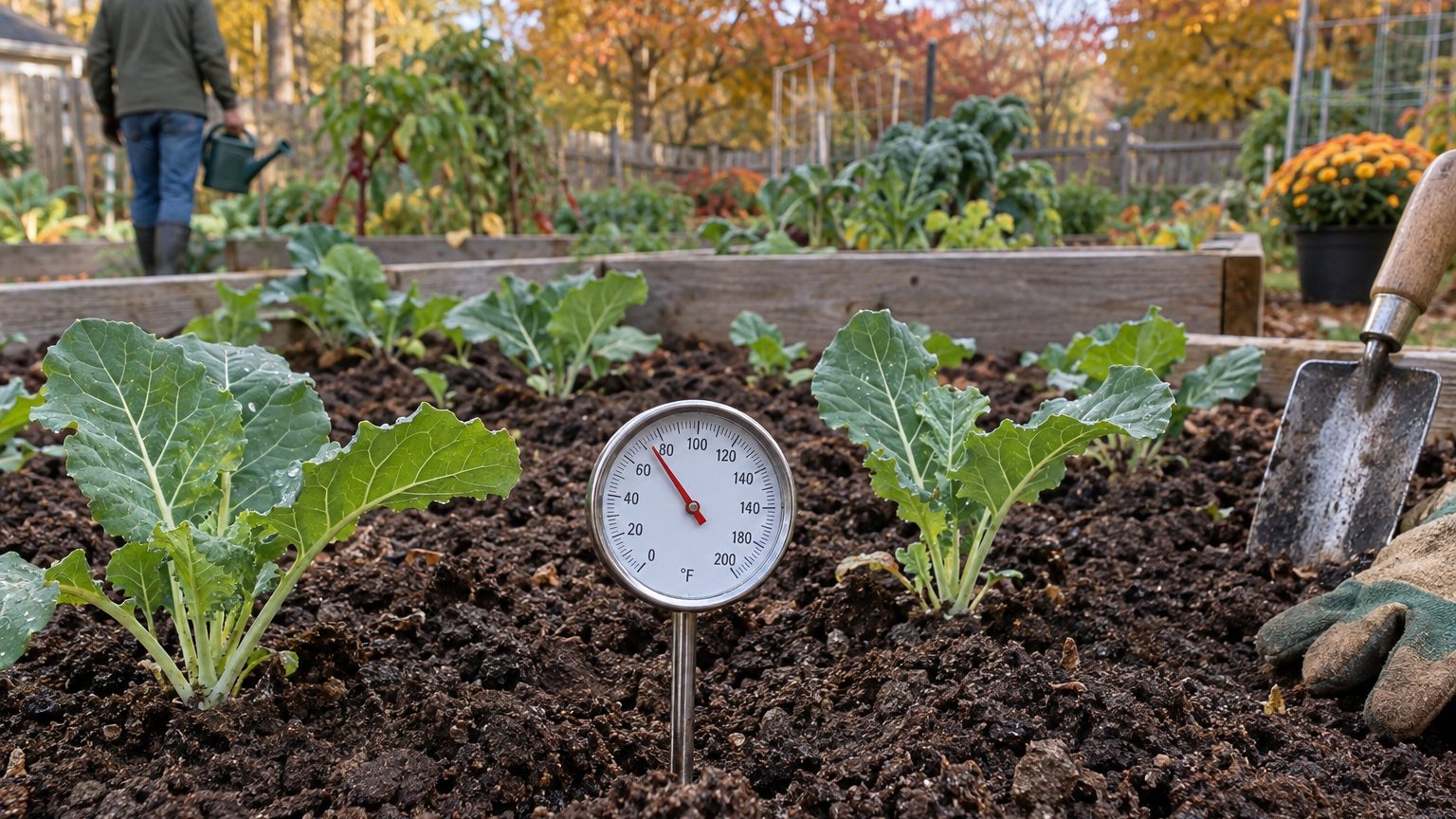

Mississippi gardeners can put collard seed or transplants in the ground almost twice a year, once the spring soil has actually warmed rather than just the calendar, and again in late summer for a fall crop that, in the mildest counties, keeps producing leaves straight through winter without ever truly stopping.
When the soil is warm enough in Mississippi

At the Jackson reference station (USW00003940), NOAA’s 1991-2020 Climate Normals put the 30-70% freeze probability window, the range in which the last spring frost most commonly falls, at March 6 to March 22. That’s not a date to circle and plant on. It’s a probability band: within that stretch there’s roughly a 30 to 70 percent chance of a 32°F freeze on any given day, which means frost can still show up after the window closes, and can also finish well before it.
The frost date gets treated as a starting gun, but for collards it’s a proxy for something else entirely: soil temperature. Air can stop freezing while the ground underneath stays cold and wet into late March, especially on heavy clay. Collard seed sown into soil still sitting below the mid-40s germinates unevenly, if it germinates at all, and more than one gardener has watched a row of seed simply rot rather than sprout because the calendar said go before the dirt agreed.
Waiting until the soil itself has warmed, rather than counting days from the last-frost date, gets a spring planting up faster and more uniformly. Transplants are more forgiving since they arrive with a root system already built, but even young plants set into cold ground stall instead of growing, which erases whatever head start the transplant was supposed to buy.
The other caution is geographic. Jackson’s airport sits in open, paved terrain that warms and cools faster than a shaded backyard or a low spot along a creek. Rural and low-lying gardens elsewhere in Mississippi typically see their own last frost arrive later than the airport average, sometimes by a week or two, with the same lag running the other direction each fall. Treat March 6 to March 22 as a reference point for the middle of the state, then confirm against your own county’s pattern before trusting a full bed of seed to it.
One more thing worth carrying into bed selection: collards are brassicas, in the same family as cabbage, kale, mustard, turnip and rutabaga. They share pest pressure and soil-borne disease risk with all of them, so a bed that grew any of those crops last season hasn’t been rested just because the leaf looked different.
How long the season lasts here
Subtracting the earliest date in the spring frost window from the earliest date in the fall window, March 6 to November 7, gives a frost-free stretch of about 246 days. Running the same math on the latest dates in each range, March 22 to November 22, lands almost exactly on the same number, 245 days. Either way, the reference station’s growing season runs close to 245 days, or roughly eight months.
That length changes what’s worth attempting, not just what’s possible. A window this long comfortably supports two separate collard plantings rather than one: an early spring sowing that finishes before the worst of summer heat slows growth and encourages bolting, and a second sowing in late summer aimed at a fall and winter harvest. Gardeners further north in the state’s hill country, where the frost-free window trims down toward the shorter end of that range, get less room for that gap between plantings and may find the spring sowing bumping directly into summer stress before a fall crop can get established.
A short window also changes how much sense transplanting makes versus direct seeding. When there’s slack in the calendar, starting seed indoors and setting out transplants costs little, since a slow start can be absorbed by the extra weeks on either end. When the window tightens, every week a transplant spends recovering from transplant shock is a week subtracted from a season that didn’t have much to spare, which tips the decision back toward direct seeding for the spring crop and reserving transplants for the fall planting, when the goal is simply to get established before the days shorten.
For gardeners weighing whether a second sowing is worth the effort in their specific location, this site’s succession-sowing guide for greens walks through the spacing and timing that make a two-crop collard season work rather than compete with itself.
Heat and water in Mississippi

Collards live one of two lives in Mississippi, and the split isn’t about how hot the summer gets. It’s about how cold the winter gets. At the Jackson reference station, the coldest month’s average daily minimum runs 36.6°F, well above the point at which collard foliage takes serious damage. That single figure is the reason collards behave as a standing crop across much of the state: where winter lows stay in that mild range, a fall planting doesn’t die back at the first freeze, it simply keeps going, picked leaf by leaf from November into March.
That isn’t universal within the state. Mississippi’s USDA hardiness zone spans 7b to 9a, a wide enough range that the coldest pockets, particularly in the northern hill counties, see harder and more frequent freezes than the Jackson average suggests. In those spots collards behave less like a standing winter crop and more like a conventional autumn crop, one that produces through fall and then ends decisively at the first hard freeze rather than pausing and resuming. The practical takeaway is to treat the winter low in your own county, not the Jackson figure and not the general reputation of Mississippi summers, as the number that decides how a fall bed gets planned.
Summer itself brings its own set of problems for collards, even without hard numbers on hand for how many days cross 90°F or how many inches of rain fall between June and August in any given part of the state. What’s consistent across Mississippi is heat combined with humidity, and that combination pushes collards toward bolting if a spring planting lingers too long into early summer, while also creating exactly the damp, still air that fungal leaf diseases favor. A planting that struggles through a hot, humid stretch isn’t usually short on water; it’s usually short on airflow, since crowded rows trap moisture against the leaves overnight and give mildew and leaf spot the conditions they need to spread.
The practical response is less about irrigation schedules and more about spacing and siting: give plants enough room that air moves between them, and where possible, plant so the bed gets some afternoon shade during the hottest stretch of summer if a spring crop is going to overlap with it at all.
Which collards suit Mississippi
None of this points to a specific variety, and that’s deliberate. The types trialled and proven under Mississippi conditions change from year to year and differ by region within the state, which makes Mississippi State University’s Extension Service, at extension.msstate.edu, the only source with a recommendation that actually reflects local trial data rather than a generic list.
What this page’s facts do support is a way of narrowing the choice by type rather than by name. With a frost-free window running close to 245 days, Mississippi gardeners aren’t forced into the earliest-maturing types the way a short-season northern garden would be, though anyone in the cooler hill counties working with a tighter window may still lean toward earlier types for the spring planting specifically, to get it finished before summer heat sets in.
Heat and humidity matter more here than speed. Given the state’s combination of hot, muggy summers, prioritizing types bred or selected for disease tolerance, particularly resistance to common fungal leaf diseases, does more for a Mississippi planting than chasing an early harvest date. Pairing that resistance with the airflow and part-shade siting discussed above covers most of what a hot, wet summer throws at a collard bed.
For the winter question, the choice depends on which side of the state’s hardiness range a garden sits on. In the milder zones near the coast and central counties, where the coldest month’s average minimum stays close to that 36.6°F figure, a type suited to standing harvest through winter gets the most use out of a fall planting. Further north, where hard freezes arrive more reliably, a type that finishes its full harvest before the first hard freeze suits the season better than one bred to stand through cold it won’t actually see spared from damage.
Whichever type gets chosen, the rotation rule stays the same: avoid setting collards into ground that carried cabbage, kale, mustard, turnip or rutabaga the previous season, since all of them share the same brassica pests and soil-borne diseases, and a rotation that swaps one for another hasn’t rested the soil at all.