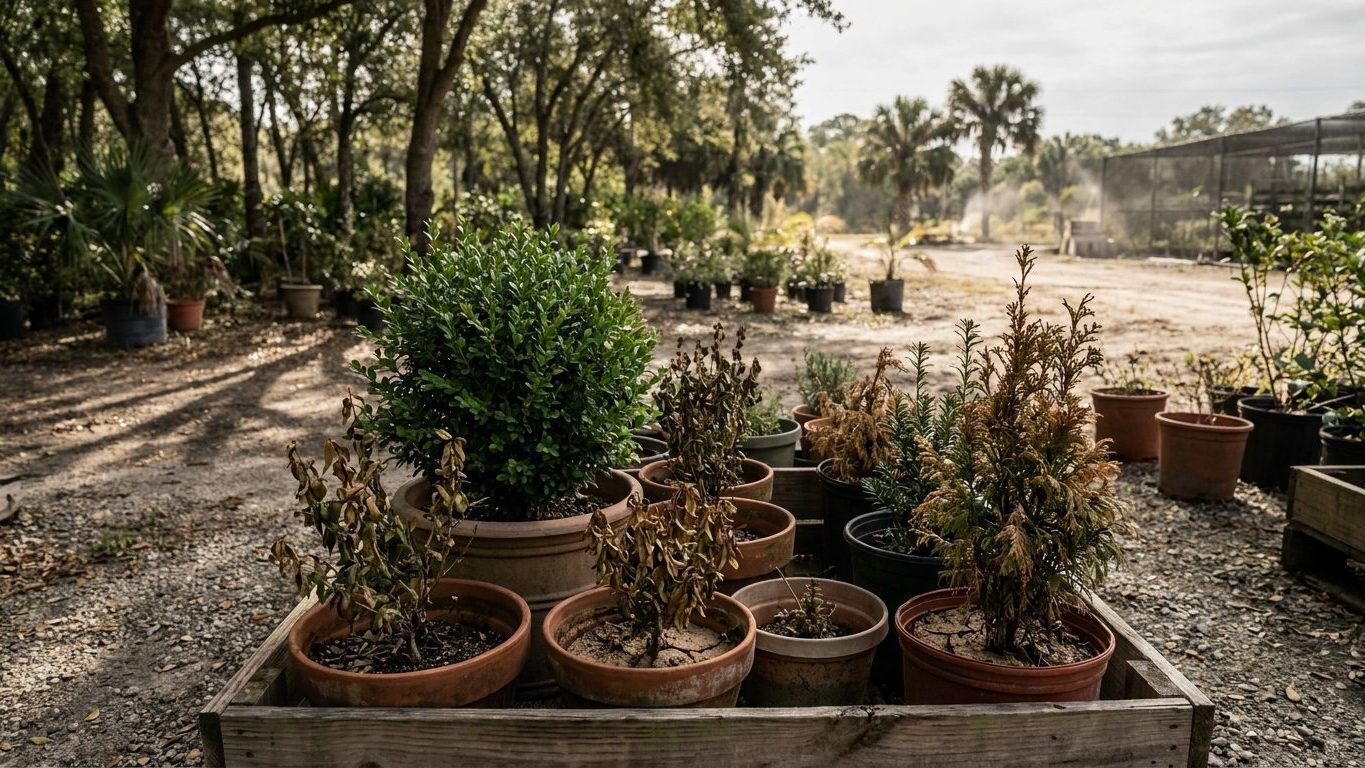

Every hedge species on this site’s list survives somewhere in New York, and none fails everywhere. That sounds reassuring until you read the zones. The state runs from 3b to 7b on the USDA Plant Hardiness Zone Map 2023, and half the list only holds in part of that range. Leyland cypress and cherry laurel need 6a or warmer, and boxwood needs 5a. Six others hold statewide. Which group you fall into depends on your address, not on what the nursery tag promises.
What actually holds in New York
The six that stop short of the cold end
The USDA zone system rests on a single variable, the average annual extreme minimum temperature. New York’s spread of 3b to 7b is wide, and three species fall out of it at the cold end. Boxwood is documented from 5a to 7b. Leyland cypress and cherry laurel are documented from 6a to 7b. Three more (inkberry holly, privet and yew) list 4a to 7b, so the coldest pockets of the state, the 3b ones, sit just outside their documented range.
| Plant | Zones | Growth | Regrows from old wood |
|---|---|---|---|
| Boxwood (Buxus sempervirens) | 5a to 7b | 3 to 6 inches a year | Yes |
| Leyland cypress (x Hesperotropsis leylandii) | 6a to 7b | 3 to 4 feet a year | No |
| Cherry laurel (Prunus laurocerasus) | 6a to 7b | 1 to 2 feet a year | Yes |
| Inkberry holly (Ilex glabra, evergreen) | 4a to 7b | 6 to 12 inches a year | Yes |
| Privet (Ligustrum vulgare) | 4a to 7b | 2 to 3 feet a year | Yes |
| Yew (Taxus x media) | 4a to 7b | 6 to 12 inches a year | Yes |
Look at the warm end of that table. Every partial species reaches 7b, the top of New York’s range, so in this state heat is not what trips them up. Cold is. The upper end of a range is often a heat limit elsewhere, but here the risk sits entirely on the north and upland side.
“Holds” also means survives, which is a lower bar than thrives. A shrub sitting at the edge of its zone can live through a hard winter and still look ragged. The zone number says nothing about wind, wet ground or a dry spring.
The six that hold statewide
These are documented as hardy across the whole 3b to 7b span:
- American hornbeam: about 12 inches a year, 6 to 15 feet as a hedge
- Winterberry holly: 6 to 12 inches a year, 5 to 15 feet, loses its leaves in winter
- Eastern red cedar: 12 to 24 inches a year, 8 to 20 feet as a screen
- Arborvitae: 6 to 9 inches a year, 4 to 15 feet
- Eastern hemlock: 12 to 24 inches a year, 10 to 20 feet
- Arrowwood viburnum: 12 to 24 inches a year, 6 to 10 feet
Three of these carry a catch that has nothing to do with cold, covered next.
The hedges you can never cut back down
Some evergreens carry all their green at the surface. Cut into the bare brown wood inside and nothing sprouts. The gap stays a gap for good. Three plants on this list behave that way, and the habit matters more than any zone number.
Leyland cypress, arborvitae and eastern red cedar
Leyland cypress is the trap. It adds 3 to 4 feet a year and is sold as a 15 to 25 foot screen, so it outgrows its spot faster than most people expect. It cannot regrow from old wood, so a neighbor’s complaint about height has no fix except removal. It also only holds in 6a to 7b in New York. Cold-zone buyers get a double problem: a hedge that may not survive winter, and one that can’t be reduced if it does.
Arborvitae, hardy statewide, shares the limit. It grows a slower 6 to 9 inches a year and is pruned in late winter before growth starts, or in midsummer, but it does not come back from hard cuts. Eastern red cedar, at 12 to 24 inches a year, is trimmed in late winter with light cuts only, and it too will not regrow from old wood.
Eastern hemlock sits in between. It does regrow from old wood, but the guidance is still light cuts only, in late spring. It forgives more than the other three, though it does not welcome a butchering.
The forgiving ones, and when to cut
Boxwood, yew, inkberry, privet, cherry laurel, hornbeam, winterberry and arrowwood all regrow from old wood. That makes them the safer picks if you might inherit a hedge that has gotten away from you, or if you want the option to reset it after a few neglected years. Privet is the most demanding of the group, needing two cuts a season, in spring and midsummer, to hold its 4 to 12 foot shape.
Timing follows the plant. Yew is cut in late spring after the new growth hardens, arrowwood right after flowering, and inkberry and winterberry in late winter while dormant. Boxwood waits for late spring, after the last frost. NOAA NCEI’s 1991-2020 normals put New York City’s last spring freeze between March 23 and April 3 (the 30 to 70 percent probability band), and its first fall freeze between November 14 and November 27. Those are Central Park figures, a dense urban site. Upstate and the Adirondacks freeze earlier in fall and later in spring, and this page does not publish frost dates for those areas.
Matching the plant to the job
Screens versus low hedges
Height decides the shortlist before anything else does. For a tall screen the candidates are Leyland cypress at 15 to 25 feet (6a and warmer, no regrowth), eastern red cedar at 8 to 20 feet, eastern hemlock at 10 to 20 feet, and cherry laurel at 6 to 15 feet (6a and warmer). Arborvitae reaches 15 feet at the top end and starts at 4 feet, which gives it range.
For a knee-to-shoulder hedge, boxwood runs 2 to 6 feet, yew 3 to 8 feet, and arrowwood viburnum 6 to 10 feet. A rule worth keeping: pick the plant whose mature height matches what you want, then trim to shape. Fighting a 20 foot plant down to 4 feet is a losing project every season.
Speed, and what you see in January
Growth rate changes how long you wait. Boxwood adds 3 to 6 inches a year, so a single extra foot of height takes two to four years. Privet at 2 to 3 feet a year fills in fast but needs those two cuts a season. Hemlock, red cedar and arrowwood sit at 12 to 24 inches a year, a workable middle.
Winter matters too. Winterberry loses its leaves, so it will not screen a driveway in January, while inkberry is evergreen and can hold the line at the same 5 to 15 foot height. Both grow 6 to 12 inches a year and both regrow from old wood. Winterberry holds statewide. Inkberry holds from 4a, leaving the 3b pockets uncovered.
For the broader how-to on spacing, shaping and upkeep, see our overview of Hedges. Neighboring states have their own splits: the same twelve species divide differently in Hedge Plants for Connecticut: What Holds, and What Only Looks Hardy, and differently again out west in Hedge Plants for Utah: What Holds, and What Only Looks Hardy.
The ground you are planting into
What the state soil tends to do
USDA lists the Honeoye series as New York’s representative soil. It is an Alfisol, a forest soil of moderate fertility that holds nutrients reasonably well. USDA NRCS Soil Data Access, queried August 29, 2026 across 66 mapped components, gives these surface values: pH about 6.3 (slightly acid), 26 percent sand, 19 percent clay, 55 percent silt, organic matter about 3.0 percent. The soil is well drained. In plain terms, this ground tends to be a loam-to-silt that neither sheds nutrients nor sits waterlogged.
That is a description of a mapped series, not of your yard. The figures apply to the surface horizon of the major components as USDA maps them, not to a worked garden bed. A state has hundreds of soil series, and river bottoms, hill country and any lot a builder has scraped or filled can look nothing like Honeoye. Treat 6.3 as a regional tendency, never as your pH.
What to do with that
Test before you buy plants. A soil test gives you your own pH and organic matter, and your county’s Cornell Cooperative Extension office can point you to the lab route and help read the results. Compacted fill under a new house is a common reason a hedge struggles despite a correct zone, and a test plus a look at how water drains after a rain will show it early.
This page holds no per-species soil tolerance data, so don’t read the Honeoye numbers as a match for any plant on the list. Zone answers the cold question, the soil test answers the ground question, and you need both.
Common questions
Which hedge plants hold across all of New York?
Six of the twelve species documented here: American hornbeam, winterberry holly, eastern red cedar, arborvitae, eastern hemlock and arrowwood viburnum. All are hardy through zones 3b to 7b, the state’s full range on the USDA Plant Hardiness Zone Map 2023.
Can I plant Leyland cypress or cherry laurel in New York?
Only where your zone is 6a to 7b, since that is their documented range. Check your own zone on the USDA map before buying. Leyland cypress also cannot regrow from old wood, so it can never be cut back to size once it gets tall.
When should I prune a new hedge?
It depends on the plant. Yew is cut in late spring after new growth hardens, arrowwood right after flowering, and winterberry and inkberry in late winter while dormant. For New York City, NOAA NCEI puts the last spring freeze between March 23 and April 3. Upstate dates run later, and this page does not publish them.
If a plant is hardy in my zone, will it thrive?
Not necessarily. Hardiness means it survives your average coldest winter night, nothing more. The USDA map is built on 1991-2020 normals, and the zone number is one variable only, so a plant on the edge of its range can live and still look rough.