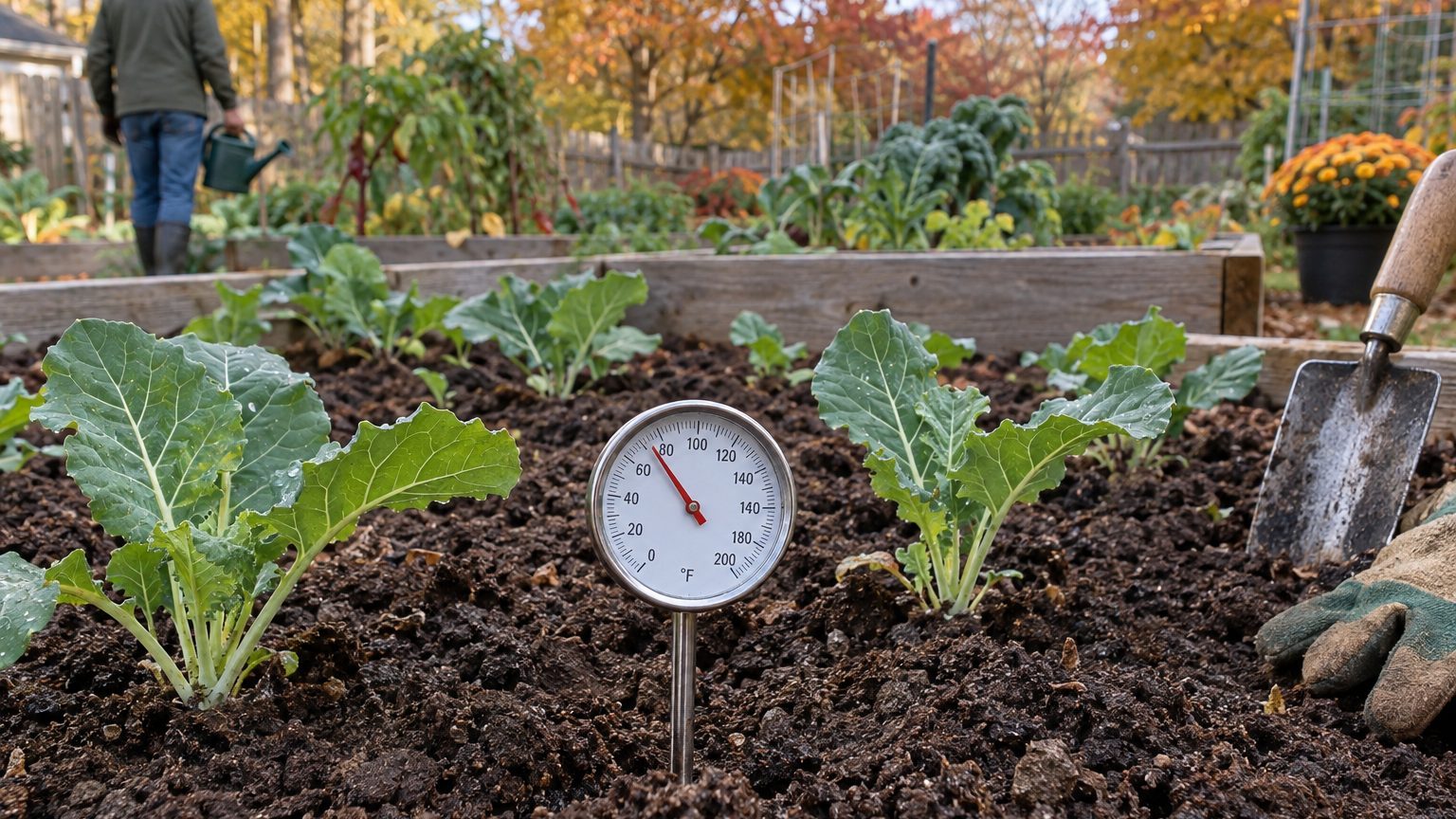

Collards can grow well in Newfoundland and Labrador, but the province’s cool, maritime climate means the calendar runs differently than it does further south. The short answer: sow after the soil has warmed past the risk of spring frost, expect one main growing window rather than a long stretch of successive plantings, and treat collards here as an autumn crop rather than a leaf-by-leaf winter one.
When the soil is warm enough in Newfoundland and Labrador

Every gardener wants a single date to circle on the calendar, but soil temperature and frost risk aren’t the same thing. Frost tells you when the air stops threatening young leaves; soil warmth tells you when roots can actually grow. Collard seedlings sulk in cold, wet ground even after the frost danger has technically passed, so the frost date is a starting reference, not the finish line.
For Newfoundland and Labrador, the figure to know is the average last spring frost of May 30, recorded at the ST JOHN’S A station and drawn from Environment and Climate Change Canada’s Canadian Climate Normals for 1981-2010. That date is a mean, not a guarantee. In roughly one year out of two, frost arrives later than May 30, sometimes well into the first week of June. Gardeners in upland or northern districts, away from the moderating influence of the coast, should expect their own local frost risk to run later still.
Waiting a week or two past that average, until the soil itself feels workable and has lost its early-spring chill, protects transplants better than racing to hit a date on paper. Direct-sown seed is even more soil-dependent since germination stalls in cold ground regardless of air temperature.
On variety choice at planting time, resist the urge to chase a specific cultivar name from a catalog written for a different climate. What matters is the type: an earlier-maturing type suits a short, cool season better than a slow one bred for long, hot summers. For the specific varieties actually trialled in this province’s conditions, the Newfoundland and Labrador Department of Fisheries, Forestry and Agriculture is the right place to ask, since local trial data means far more than a generic national seed list.
Collards belong to the brassica family, alongside cabbage, kale, mustard, turnip and rutabaga, so any pest or disease pressure that shows up on one tends to show up on all of them. A bed that grew cabbage or turnip last year hasn’t been rotated just because collards look different in the row.
How long the season lasts here
Subtracting the two average frost dates from Environment and Climate Change Canada gives a frost-free window running from May 30 to October 17, a span of roughly 140 days at the ST JOHN’S A reference station. That’s a workable stretch for a crop like collards, which don’t need blistering heat to mature, but it isn’t the kind of long, forgiving season that allows for casual timing mistakes.
A window this length generally supports one main sowing planted with intention rather than a string of casual successive plantings. It leaves enough room, though, for a gardener to consider a second, later sowing timed to mature in the cooler weeks before the average October frost, since collards often taste better after a light chill sweetens the leaves. Whether that second sowing makes sense depends on how reliably the local microclimate tracks the St. John’s average, which coastal gardeners can lean on more confidently than those inland or at elevation.
Transplanting versus direct seeding becomes a real decision inside a window this size. Starting seedlings indoors a few weeks ahead of the average last frost effectively buys back time that direct-sown seed would spend germinating in still-cool soil, and in a 140-day season that head start can be the difference between one solid harvest and a rushed, disappointing one. For a fuller breakdown of how to stagger sowings across a season of this length, the site’s succession sowing guide walks through the timing in more detail.
None of this changes the caution attached to the frost dates themselves: both May 30 and October 17 are averages pulled from 1981-2010 normals, and either edge of the season can arrive earlier or later than the mean in any given year. Planning around the middle of that range, rather than its outer edges, is the safer habit.
Heat and water in Newfoundland and Labrador

This is where the province’s climate diverges sharply from most of the collard-growing territory further south. Newfoundland and Labrador’s maritime climate keeps summer heat modest across the board, and days reaching 90°F are effectively rare to nonexistent in the province’s growing regions. Collards don’t need that kind of heat anyway, but the flip side matters more here: cool, damp summer air is exactly the condition that favors mildew, slow leaf development and fungal disease pressure on brassica crops. A gardener moving here from a hotter climate should stop thinking about shade cloth and start thinking about airflow between plants and morning leaf-drying.
Winter, not summer, is what actually decides how a collard bed gets planned in this province. Collards have two entirely different lives depending on how cold the coldest month runs. In milder pockets, gardeners pick them leaf by leaf as a standing crop clear into late winter. That pattern depends on winter lows staying gentle enough that the plant simply idles rather than freezing solid.
Newfoundland and Labrador doesn’t fit that pattern. The mean daily minimum of the coldest month sits at -8.7 °C, drawn from ECCC’s Canadian Climate Normals for the St. John’s reference station. A cold like that, arriving night after night through the depth of winter, rules out the leaf-by-leaf standing-crop approach seen in gentler coastal climates elsewhere. Here, collards behave as an autumn crop: planted for a harvest that runs up to and just past the average October hard freeze, not a plant left in the ground through the darkest months.
The province’s Canadian hardiness zone of 6a, based on Natural Resources Canada’s 1991-2020 normals for the reference city, reinforces the same point, though it’s worth remembering that figure is built on seven climate variables and doesn’t translate to a USDA zone number used on American gardening sites.
Which collards suit Newfoundland and Labrador
Reasoning from this province’s own numbers narrows the choice by type, not by brand name. A 140-day frost-free window favors an earlier-maturing type over a slow one that needs a long stretch of warmth to bulk up its leaves. A summer that rarely if ever crosses 90°F removes heat tolerance from the list of priorities entirely, freeing up the decision to focus on what actually threatens the crop here: cool, damp conditions that invite mildew and other fungal pressure. In this climate, disease resistance and good airflow habit matter more than anything bred for heat.
What this page won’t do is hand over a specific cultivar name, and that’s a deliberate choice rather than an oversight. Seed catalogs list dozens of collard types bred and trialled under wildly different conditions, and a name that performs well in a hot, humid state tells a Newfoundland and Labrador gardener almost nothing useful. The varieties actually tested under this province’s cool, short-season, high-moisture conditions are the only ones worth planting, and that information sits with the provincial Department of Fisheries, Forestry and Agriculture, not with a generic national seed guide.
Rotation deserves the same attention as variety choice. Collards, like cabbage, kale, mustard, turnip and rutabaga, are all brassicas sharing the same pest and disease pressures, so a bed that hosted any of those crops in recent seasons hasn’t actually been rested just because the current crop looks different above ground. Moving collards into ground that grew an unrelated crop the year before, and checking the site’s crop rotation guide before finalizing a bed plan, does more for long-term yield than any single variety pick.
Storage habits matter too, once the autumn harvest is in. Inspect leaves and any harvested stems for a soft patch, a weeping spot or a moldy crown before deciding anything is fit to keep; any one of those signs ends the question regardless of how sound the rest of the plant looks.