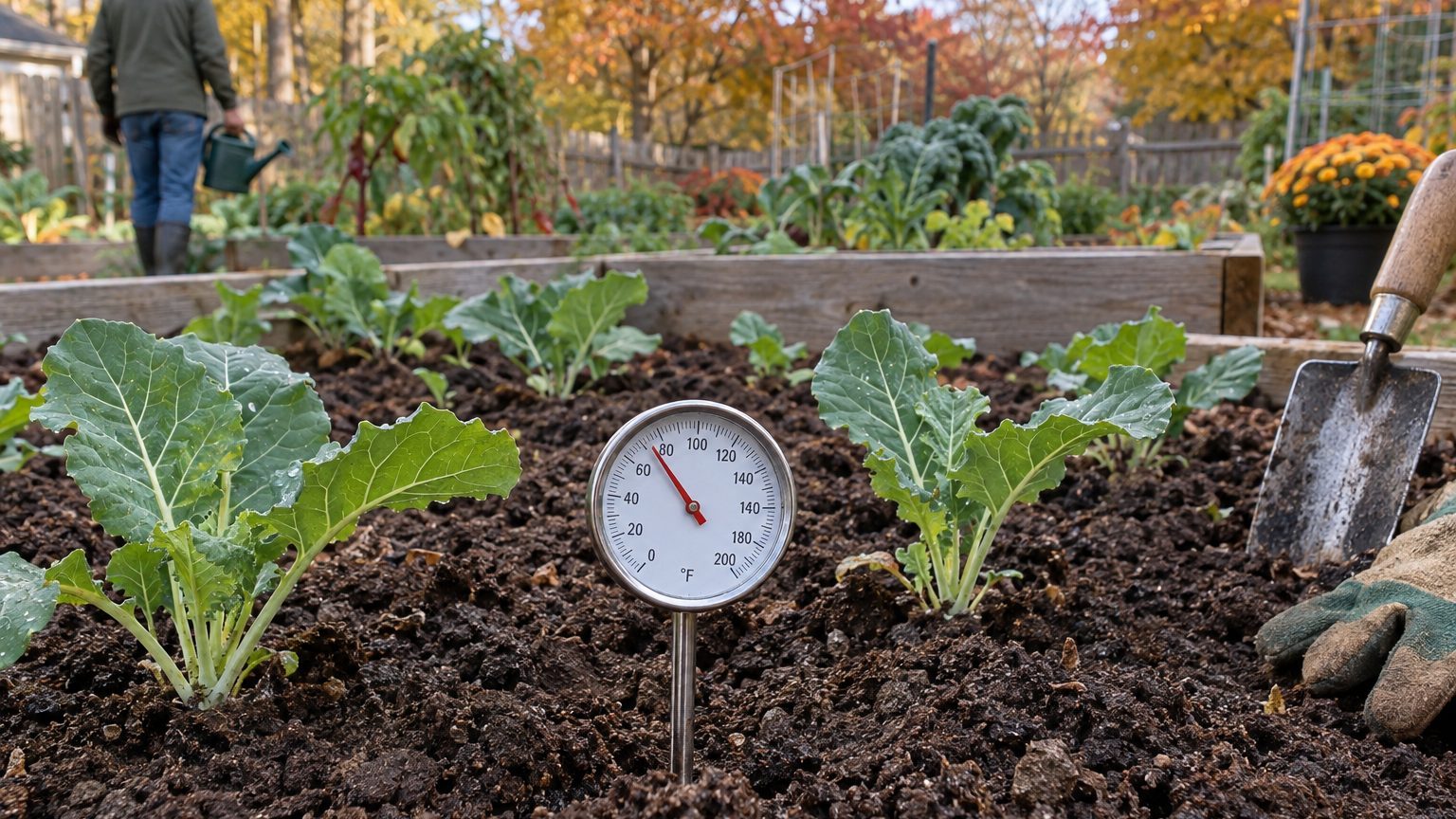

Collards go into New Jersey gardens twice a year for most home growers: a spring planting timed to the state’s last frost, and a fall planting that often outlasts it, since a light freeze only sweetens the leaves. Winter severity, more than the calendar, decides how long that second planting keeps producing.
When the soil is warm enough in New Jersey

The frost date most New Jersey gardeners lean on comes from the Newark reference station: NOAA’s 1991-2020 Climate Normals put the last spring frost between March 29 and April 6. That’s a 30-70% probability band for a 32°F freeze, not a guarantee, and it applies to the airport station itself. Gardens in the suburbs and rural counties around it, especially anything sitting in a low spot or away from paved heat, typically see frost linger a week or two longer. If your yard sits in a frost pocket in Hunterdon or Sussex County, treat early April as optimistic.
The frost date is useful shorthand, but it isn’t the number that actually governs planting. Frost risk measures air temperature at a specific hour; collards germinate and root according to soil temperature, which lags behind the air by days to weeks depending on how wet and shaded the bed is. A raised bed with dark mulch can be workable while a low clay bed nearby is still cold and soggy from spring runoff. That’s why two gardeners a mile apart, both past their local frost date, can have very different results sowing the same week.
Collards are more frost-tolerant than most vegetables, which changes the usual planting math. Direct-sown seed or transplants can go in a couple of weeks before the frost date passes, because a light freeze rarely kills established seedlings and often improves flavor later in the season. What actually holds gardeners back that early isn’t frost risk to the plant, it’s a cold, waterlogged seedbed that rots seed before it germinates. Waiting until the soil crumbles rather than clumps in your hand is a better test than watching the calendar.
Because collards belong to the same brassica family as cabbage, kale, mustard, turnip, and rutabaga, they share the same soil-borne diseases and the same pest pressure, and that matters at planting time as much as during the season. Working new collards into a bed that grew any of those crops in the past two or three years doesn’t reset anything; it just continues the same disease cycle in the soil. Rotating collards away from all of those relatives, not just away from other collards, is worth checking against your site’s crop rotation guide before you dig the bed.
How long the season lasts here
Stack the two Newark frost windows against each other and you get the outer edges of New Jersey’s frost-free season: a conservative estimate running from the latest likely spring frost, April 6, to the earliest likely fall frost, November 4, comes to roughly 212 days. Using the earlier spring date and later fall date instead stretches that to closer to 232 days. Either way, that’s over seven months, long by East Coast vegetable-garden standards and well beyond what a single quick-maturing crop needs.
What that length actually buys a gardener is choice. A season this long supports more than one collard planting in the same bed: an early spring sowing that finishes before summer heat sets in, followed by a second sowing in mid-to-late summer aimed squarely at the cooler, wetter stretch of fall and early winter. Growers working a shorter window elsewhere, where frost dates leave barely five months of open ground, don’t have that option; their spring sowing is effectively their only shot, and every week of delay narrows the harvest. New Jersey’s window is generous enough that a missed spring planting date isn’t fatal to the year.
That second sowing is also where transplants earn their place. In a short season, moving seedlings instead of direct-sowing buys precious weeks and is almost always worth the root disturbance. In New Jersey’s longer window, the calculation shifts: direct-sowing the fall crop from seed in July or August, timed against the roughly 212 to 232 days of open ground, still leaves enough runway to reach a full-sized plant before the ground locks up, without the setback risk that comes from transplanting stressed seedlings into late-summer heat. Whether to transplant or direct-sow the second round is really a question about how much of that seven-month window you’ve already spent, which is exactly the kind of decision a succession sowing plan is built to answer.
Heat and water in New Jersey

The number that actually shapes how a collard bed behaves in New Jersey isn’t a summer heat count, it’s a winter one. The Newark station’s 1991-2020 normals put the mean daily minimum temperature of the coldest month at 25.5°F. That’s not a record low and not a monthly average, it’s the typical overnight floor during the coldest stretch of a normal winter, and it’s the figure that decides whether collards can be picked leaf by leaf all winter or whether the season simply ends.
A mean coldest-month minimum in the mid-20s puts most of New Jersey well outside the range where collards behave as a true standing crop. Along the warmer, humid Gulf and South Atlantic coasts, where the coldest month rarely drops below the mid-30s, collards can be harvested leaf by leaf from November straight through March, the plant essentially dormant but alive and edible the whole time. Newark’s winters are colder than that by a wide margin, and the state’s 6a-7b hardiness range (USDA Plant Hardiness Zone Map, 1991-2020 normals) confirms it: parts of the state see average annual extreme minimums well below what a standing collard crop needs to keep producing through the coldest weeks.
Practically, that means New Jersey collards are grown as an autumn crop that runs hard until a genuine hard freeze ends it, rather than a plant left in the ground indefinitely through winter. Gardeners can still stretch the harvest with row cover or a low tunnel on the coldest nights, buying extra weeks past a light freeze, but the coldest-month minimum here means eventual dieback is the expectation, not the exception.
Summer heat and rainfall figures for the Newark station aren’t part of the dataset behind this page, so no specific heat-day count or seasonal rainfall total belongs here. What’s worth knowing in general terms is that New Jersey’s growing season includes stretches of high humidity, and humid, still air around dense collard foliage is a much bigger disease driver than heat itself. Airflow between plants and morning-only watering, keeping foliage dry overnight, do more to prevent mildew and leaf spot here than any adjustment made for daytime temperature.
Which collards suit New Jersey
New Jersey’s growing conditions point toward type, not toward any single named variety. A frost-free window of roughly 212 to 232 days is generous enough that days-to-maturity isn’t the tight constraint it would be in a shorter season, so an earlier-maturing type mainly buys insurance against a late spring or an early fall freeze rather than being strictly necessary. What matters more here is how a type handles the two real pressure points already covered: a cold winter that ends the season outright, and humid stretches that favor leaf disease.
That makes disease resistance, particularly to the fungal and bacterial leaf spots that spread fastest in humid, still air, the first thing worth asking about when choosing what to grow. A type bred or selected for resistance to common leaf diseases will hold clean, harvestable leaves longer into a wet fall than one with no such resistance, and that difference shows up directly in how many weeks of picking you get before the bed looks too rough to bother with.
This page won’t name a specific cultivar, and that’s a deliberate choice rather than an omission. Variety performance is tested locally for a reason: a type that resists disease and holds up well in coastal Cape May County can behave differently in the clay soils and colder nights of the northwest highlands. The only recommendation that means anything is one drawn from trials run in New Jersey’s own conditions, and that work already exists at the Rutgers New Jersey Agricultural Experiment Station, the state’s land-grant extension service. Checking their current vegetable variety guidance before buying seed is a better use of ten minutes than trusting a name on a seed rack.
One more practical note carries over from planting: since collards are brassicas, whatever type you choose is exposed to the same pests and soil diseases as any cabbage, kale, mustard, turnip, or rutabaga grown nearby. Choosing a disease-resistant type doesn’t replace rotation, it just adds a second layer of protection on top of it.