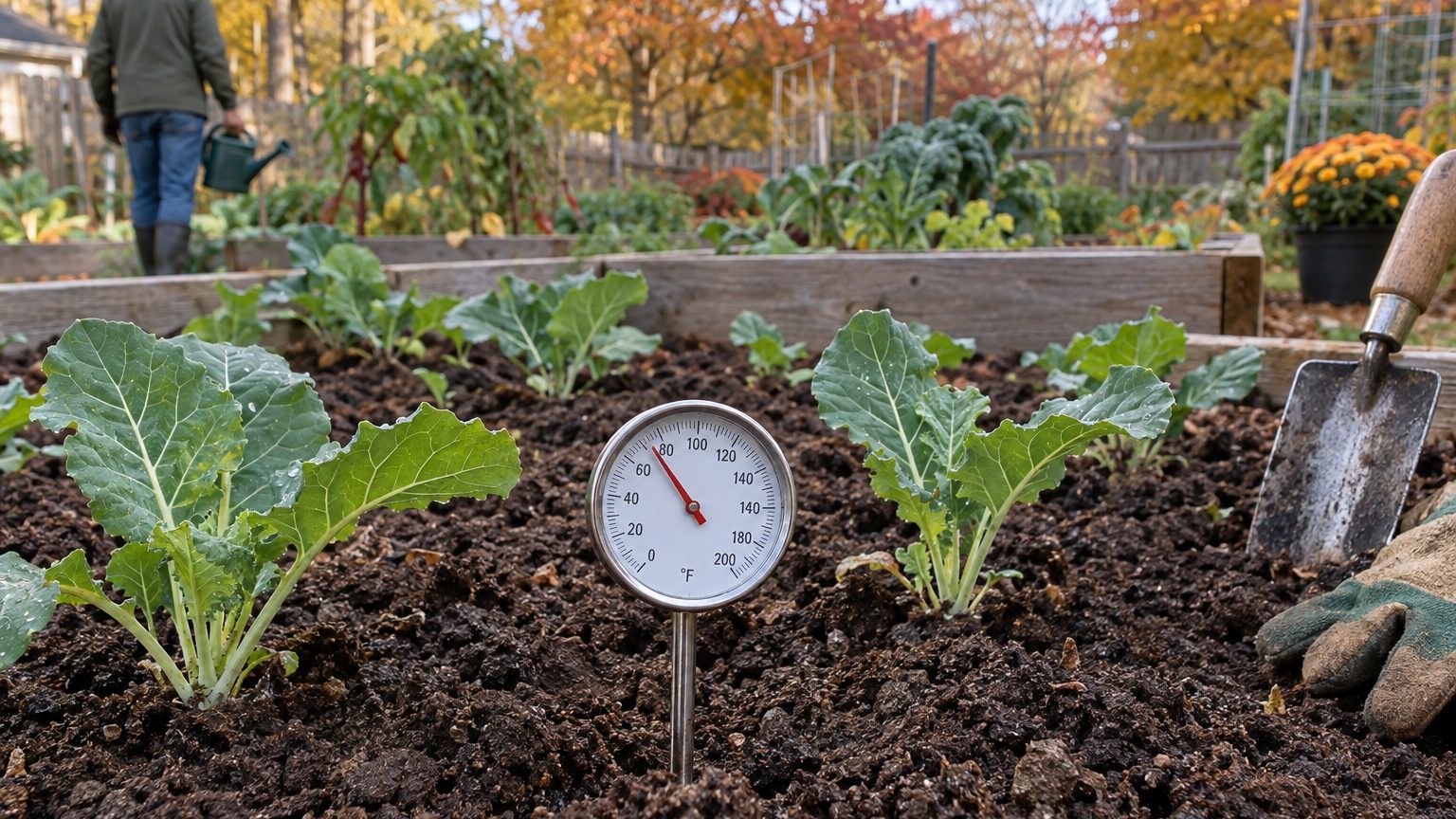

In most of Vermont, collards go into the ground sometime between mid-May and early June, and the calendar date matters far less than whether the soil itself has caught up with the air. Around Burlington, the state’s mildest pocket, that gap between “frost is over” and “soil is actually ready” tends to run one to three weeks. Elsewhere, especially at higher elevation and in the Northeast Kingdom, the wait stretches longer, because collards are responding to ground temperature, not to whatever the forecast says about frost.
When the soil is warm enough in Vermont

The National Weather Service’s climate station at Burlington International Airport, listed as USW00014742, puts the last spring frost at a 30 to 70 percent probability somewhere between April 30 and May 10, based on NOAA’s 1991-2020 Climate Normals. That’s the honest way to read it: a probability band, not a guarantee that frost stops on any particular day. Treat it as the point where frost risk starts dropping fast, not a switch that flips.
Frost is really just a stand-in for the number that matters to collards, which is soil temperature. Cold ground slows germination to a crawl and stunts transplant roots even once the air has warmed back up, so most Vermont gardeners wait one to three weeks past that last-frost window before setting transplants or direct-seeding. A few simple checks tell you more than a date on paper: soil that crumbles loosely in the hand rather than clumping, ground that feels merely cool rather than cold to the touch, and a bed that’s had a few sunny days to dry out on top.
- Soil crumbles apart instead of forming a wet clump
- Ground feels cool, not cold, when you dig four inches down
- Surface has dried enough that footprints don’t leave standing water
Burlington sits right on Lake Champlain, which is the mildest corner of the state by a wide margin. The Green Mountains and the Northeast Kingdom run substantially shorter and colder, which means gardeners in those regions often push transplanting into late May or even June rather than trusting the Burlington-based window.
Collards are brassicas, and so are turnip and rutabaga, right alongside cabbage, kale, and mustard. That whole group shares the same soil-borne diseases and the same pest pressure, so bed prep should account for whatever grew there in recent seasons. The full rotation logic for this crop family is laid out in the main guide to growing collards, which is worth checking before you decide where this year’s bed goes.
How long the season lasts here
The same Burlington station puts the first fall frost between October 3 and October 13, drawn from that same 1991-2020 Normals dataset. Both numbers come from a certified source, so the subtraction is legitimate: doing the math gives a growing season of roughly 146 to 166 days, depending on where within each window a given year actually lands. Call it about five months in an average year.
That length is workable but not generous. It’s enough to run collards from a spring or early-summer start through a fall harvest, and in a favorable year there’s enough slack behind an early planting to squeeze in a second sowing timed to finish before the October frost window closes. It is not enough margin to treat direct seeding casually, since every week spent waiting on germination outdoors is a week borrowed from an already tight season. Most Vermont growers start collards from transplants for exactly that reason, buying a few extra weeks of head start that direct seeding can’t match here.
The pillar guide to growing collards covers succession sowing timing in more depth, and the general framework there adjusts fairly easily to Vermont’s shorter frost-free stretch once you swap in the local dates above. Gardeners working with similarly compressed windows elsewhere in the North can compare notes: the same short-season math plays out for growers following the Michigan collard guide and the Minnesota collard guide, both of which deal with frost dates in the same general range as Vermont’s.
Heat and water in Vermont

This page’s certified climate record doesn’t carry a days-above-90°F count or a summer rainfall total tied to a named station, so rather than guess at those figures, it’s worth leaning on the number that actually decides how a collard bed gets planned in Vermont: how cold winter gets, not how hot summer runs.
That number is the coldest month’s mean daily minimum, measured at Burlington under NOAA’s 1991-2020 Normals, and it sits at 12.9°F. That’s not the record low and not the monthly average, it’s the typical overnight floor during the coldest stretch of winter, and it’s well below freezing by a wide margin. That single figure decides which of two completely different lives a collard plant leads. Where the coldest month stays mild, roughly at or above freezing on an average night, collards behave as a standing crop, picked leaf by leaf from November into March. Where it doesn’t, as in Vermont, the plant simply can’t survive that cold, so collards function strictly as an autumn crop: one planting, one harvest window, ending at the first hard freeze rather than stretching through winter.
Because Vermont summers run cool and humid rather than scorching, the practical risk here isn’t heat stress on the plant, it’s the opposite problem. A cool, damp summer favors mildew, slows ripening, and raises disease pressure generally, so airflow between plants and morning watering that lets leaves dry by afternoon matter more here than shade or heat protection ever would.
Vermont’s USDA hardiness zone range runs from 3b to 5b across the state, per the USDA Plant Hardiness Zone Map built on 1991-2020 Normals. Burlington itself sits toward the milder end of that range thanks to the lake’s moderating effect, while the Green Mountains and Northeast Kingdom trend toward the colder 3b end, which is another reason a single statewide zone number undersells how different a garden forty miles inland can behave compared to one on the Champlain shoreline.
Which collards suit Vermont
Reasoning from those facts rather than from a seed catalog gives a fairly clear picture of what to look for, without needing to name a specific cultivar. Because the frost-free window tops out around 166 days in a good year and collards behave here as a strict autumn crop, the earliest-maturing type available deserves first consideration, since it needs to reach harvestable size well before that first fall frost narrows in. Because summers run cool and humid rather than hot, disease resistance, particularly against downy mildew and black rot, ranks above heat tolerance on the list of things worth checking before ordering seed. And because a light frost right before the hard freeze tends to sweeten collard leaves rather than ruin them, a type known to tolerate a touch of cold without turning bitter or mushy earns its place in a short-season Vermont bed.
| Type to look for | Why it fits Vermont |
|---|---|
| Early-maturing habit | Fits inside a roughly 146 to 166 day window without racing the fall frost |
| Downy mildew / black rot resistance | Cool, humid summers raise disease pressure more than heat ever does here |
| Frost-tolerant leaf texture | A light frost before the hard freeze sweetens rather than damages the crop |
Turnip and rutabaga belong to that same brassica family as collards, cabbage, kale, and mustard, and they all pull the same pests and diseases out of soil over time. A bed that grew any of them in recent years hasn’t actually been rotated by planting collards there next, no matter how different the two crops look above ground.
Naming an exact variety here would be the wrong call, since the varieties actually trialled for Vermont’s short season and disease pressure come from local testing, not from a general list written for the whole country. The University of Vermont’s Cooperative Extension keeps that kind of current, region-specific variety information, and it’s the resource worth checking before ordering seed rather than relying on whatever a seed rack happens to stock. Their extension directory is available at uvm.edu/extension.