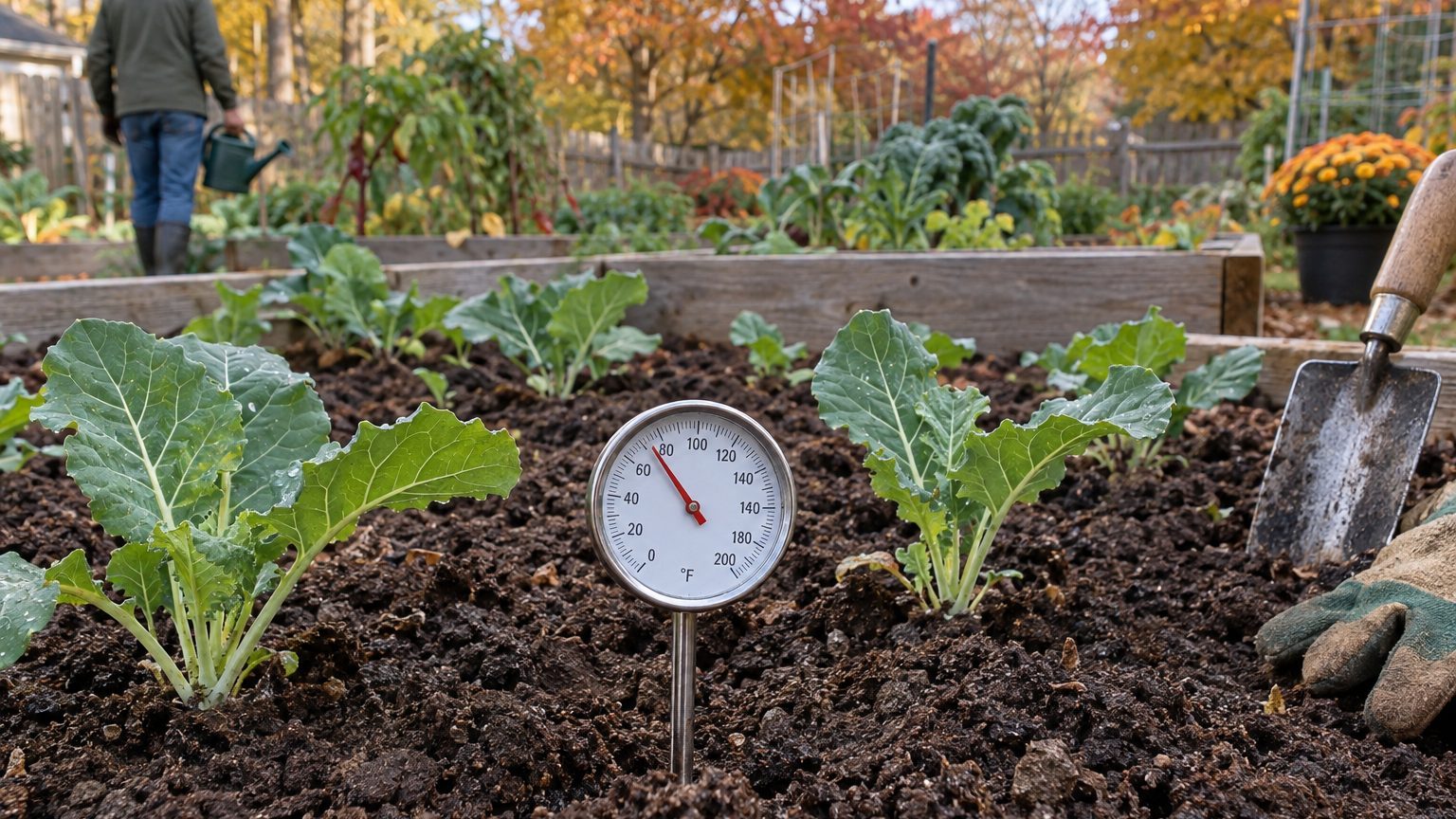

Collards go into Wisconsin soil once the ground itself is warm enough to wake the seed, not simply once the frost calendar looks friendly. In most of the state that window opens in late April, and the crop holds into an autumn or, in the mildest pockets, straight through a Milwaukee-style winter as a standing green.
When the soil is warm enough in Wisconsin

The question every Wisconsin gardener actually asks is “can I put seed or transplants in the ground yet,” and the honest answer starts with the last spring frost window: April 16 to April 29, per NOAA NCEI 1991-2020 Climate Normals for station USW00014839. That’s a 30-70% probability band, not a guarantee stamped on the calendar. Half the years in that dataset saw frost linger past the midpoint of the range, and half didn’t. Treat the date as a bet you’re placing, not a promise the weather owes you.
Frost is only a proxy for what collards actually need, which is warm soil. Air temperature can climb into the 60s while six inches down the ground is still cold and sluggish, and collard seed sitting in that cold soil just sulks, sometimes for two or three weeks, sometimes rotting before it ever cracks. The safer read: wait until the frost risk has passed and the soil has had a stretch of sun to catch up. A simple soil thermometer, or even the back-of-hand test after a few consecutive 60-degree days, tells you more than the frost date alone.
Because Wisconsin runs from USDA hardiness zone 3b in the north to 6a near the Lake Michigan shoreline, that April window shifts depending on where in the state you garden. A gardener near the lakeshore may see soil warm a week or more ahead of someone in the northern counties, where spring arrives late and leaves early. The USDA Plant Hardiness Zone Map is built on a single variable, the average annual extreme minimum temperature, so it tells you about winter survival, not about how fast your particular patch of dirt shakes off the cold. Local timing still comes down to watching your own ground.
Collards belong to the brassica family, the same clan as cabbage, kale, mustard, and their root cousins turnip and rutabaga, and that matters even at planting time. If last year’s bed grew any of those crops, the soil may already be carrying the fungal spores and pest eggs that trouble the whole group. Rotating collards into a spot that hosted cabbage the year before isn’t rotation at all, it’s just a change of scenery for the same problems. Wisconsin gardeners planning bed placement should check the crop rotation guidance on this site before deciding where the collards go this spring.
How long the season lasts here
Subtract the two frost windows and Wisconsin’s frost-free stretch runs from around April 16-29 in spring to October 17-29 in fall, both figures from the same NOAA NCEI 1991-2020 normals for station USW00014839. That’s roughly five to six months of workable ground, though the exact count depends on which end of each range your particular year lands on, and lakeshore counties often stretch a bit longer than inland ones since Lake Michigan holds warmth into autumn and delays that first hard freeze.
What that length actually buys a gardener is the real question. A five-to-six-month window is long enough to treat collards as a two-round crop rather than a single planting. Early sowing right after the spring frost risk fades gives you a summer harvest, and a second sowing in mid-to-late summer times a fall crop to mature right as the weather cools, which collards actually prefer since cool nights sweeten the leaf. That second window matters more in southern Wisconsin, where the longer stretch to the October frost date leaves enough runway for a full second round to size up before the cold shuts things down.
In the shorter-season counties, particularly inland and to the north where frost arrives well before that October 17-29 band even starts, the math changes. There, the first sowing is often the only sowing that has time to mature properly, and it shifts the transplanting decision too: a gardener starting seedlings indoors and checking their root systems for tangling or girdling before setting them out gets a head start that a short window can’t otherwise afford. For a full breakdown of how to stagger plantings and stretch a short season, the succession sowing guide on this site walks through the timing county by county.
Roughly five to six months is the number to build a planting calendar around, adjusted toward the shorter end anywhere north or inland of the lakeshore.
Heat and water in Wisconsin

Wisconsin isn’t a state where summer heat is the main obstacle to a collard bed. The days-above-90°F count and summer rainfall figures that drive planting decisions in the Deep South simply don’t apply here in the same way, and pretending otherwise would be writing the wrong climate for this territory. What actually shapes a Wisconsin collard bed is the state’s cool, often damp growing season and, more than anything, how cold the winter gets.
A cool, humid summer changes collards’ problems from heat stress to something slower and stickier: powdery mildew and downy mildew both thrive when leaves stay damp and air doesn’t move through the canopy. Spacing plants wider than you might in a drier climate, and watering at the soil line instead of overhead, does more good here than any amount of shade cloth. Slow ripening is the other quiet cost of a mild Wisconsin summer, since collards without real heat take their time bulking up, which is one more reason the season’s length, not its intensity, is the number worth tracking.
The figure that actually decides how a Wisconsin gardener should plan a collard bed is the coldest month’s average daily minimum: 17.2°F, referenced to Milwaukee, per NOAA NCEI 1991-2020 Climate Normals. That’s the mean low for the coldest month, not the record low and not a monthly average, and it draws a hard line for this crop. Where winter lows stay closer to that milder Milwaukee-area figure and the ground doesn’t lock solid for months on end, collards can behave as a standing crop, picked leaf by leaf from November into March, getting sweeter with each frost. Farther north and inland, where the coldest month runs colder than that reference and the ground freezes hard, collards are strictly an autumn crop: they get harvested clean at the first real hard freeze and the bed goes dormant.
That split means two Wisconsin gardeners a few hours apart can be running completely different collard calendars, both correct for their own backyard. The winter low decides which one you’re running, not the summer heat.
Which collards suit Wisconsin
The honest answer to “which variety should I plant” in Wisconsin is that this page can’t tell you, and shouldn’t try to. Naming a specific cultivar without knowing which ones have actually been trialled against Wisconsin’s soil, humidity, and winter swing would be a guess dressed up as advice, and it’s the kind of error a gardener with dirt on their hands catches immediately. What this page can do is point toward the type of collard that fits the conditions already laid out, and then send you to the people who test names, not types.
Given the shorter growing window found across most of the state, an earlier-maturing type of collard has a real advantage, since it clears the finish line before a northern or inland frost arrives uninvited. In the humid, cool-summer conditions common across Wisconsin, disease resistance should sit at the top of the checklist ahead of leaf size or color, because mildew pressure is the more realistic threat here than heat stress ever will be. Where a garden runs warmer, such as urban heat-island spots or particularly sheltered southern plots, giving plants airflow between rows and a bit of shade at the root zone during the hottest afternoons does more for the plant than chasing a heat-tolerant type that may not even be necessary this far north.
Where to find the actual names
The University of Wisconsin’s Cooperative Extension Service, at extension.wisc.edu, maintains the variety trial data that actually applies to this state’s soils and seasons, county by county in some cases. That’s the resource that turns “an early type with disease resistance” into an actual seed order, and it’s worth checking before every spring sowing since trial results shift as new varieties come through.
Whatever type ends up in the ground, remember the family it belongs to: collards share their pest and disease pressures with cabbage, kale, mustard, and the root brassicas turnip and rutabaga, so the bed you choose this year shouldn’t have carried any of those crops last season. Checking the state extension’s current trial list before ordering seed is the one step that replaces guesswork with a name that’s actually been tested against Wisconsin weather.