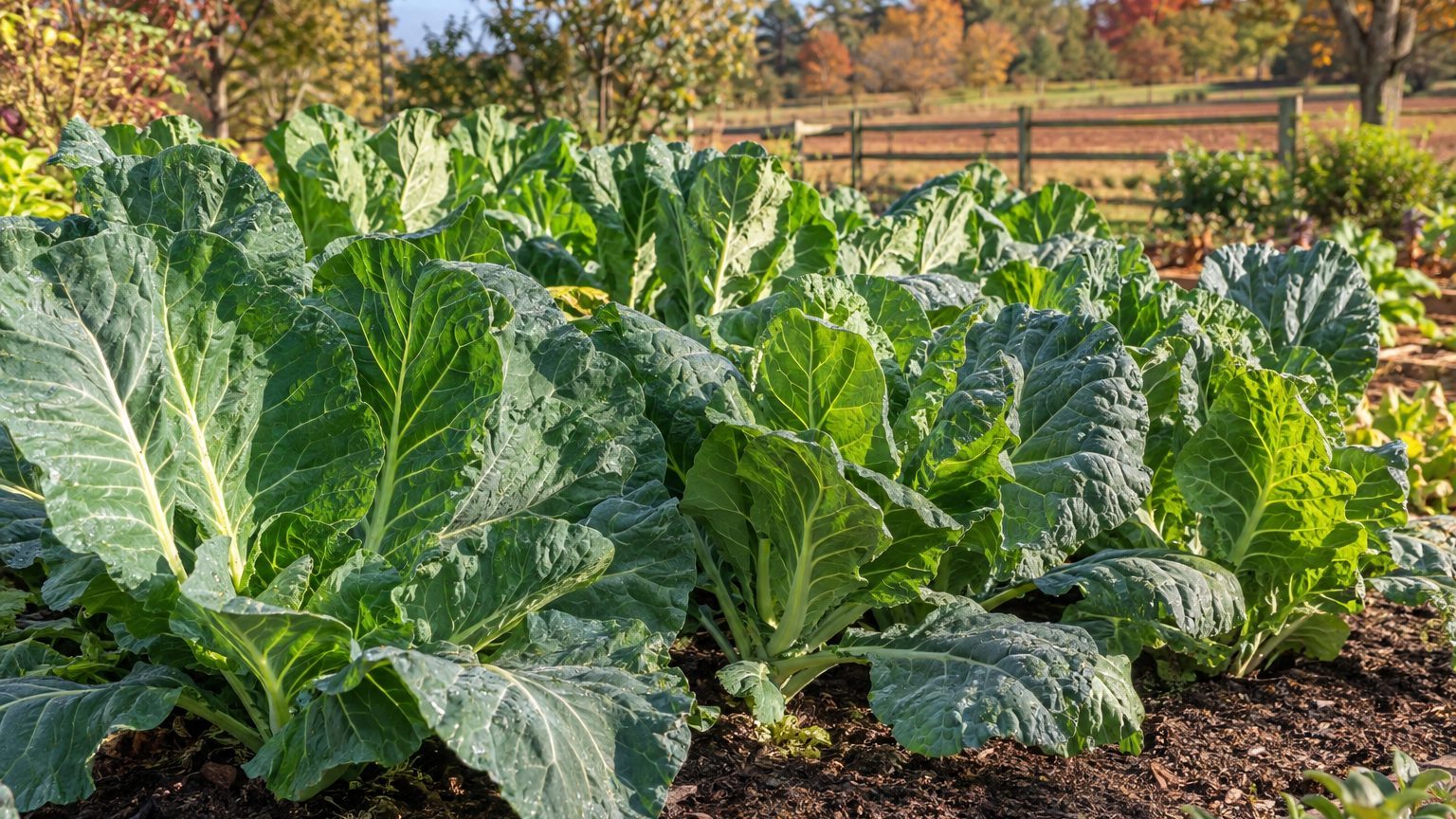

Alabama’s long, mild season favors heat-tolerant, slow-bolt collard varieties like Georgia Southern and Vates for spring planting, and fast-maturing types for a late-summer fall crop. The state’s frost-free stretch runs long enough that most gardeners here get two solid windows a year, not one.
The short answer for Alabama
Alabama’s growing season is generous by national standards, and that changes which collard varieties make sense here. With a last spring frost falling between March 19 and April 3, and the first fall frost not arriving until November 2 to November 16, gardeners in this state are working with a season that stretches well past what a fast-bolting Northern variety was ever bred for.
That length matters because collards planted too early in spring race straight into summer heat, and heat is what triggers bolting, the plant sending up a flower stalk and turning bitter. Slow-bolt types like Vates or Georgia Southern buy time against that. For a fall crop, the math runs the other direction: a reader planting in late July or August needs a variety that reaches harvest size before that first fall frost shows up, which in much of Alabama could be as early as November 2.
The state’s hardiness range, 7a to 9a, also means winter isn’t a hard stop for collards the way it is farther north. The coldest month’s average daily minimum sits at 33.1°F at the Huntsville reference station, barely below freezing on an average night. Collards tolerate that easily, and a light frost actually sweetens the leaves by converting some starches to sugars, a trait that makes fall and winter harvest genuinely better eating than a summer one.
So the decision by type looks like this: pick a slow-bolt, heat-tolerant variety for the spring sowing, and a quicker-maturing one for the fall sowing, timed backward from that November frost window. Waxy-leaved, heat-resistant types also handle Alabama’s humid summer better, since thinner, tender leaves scorch and blister faster in sustained heat and moisture. If a seed packet doesn’t say slow-bolt or heat-tolerant, treat that as a spring-planting risk in this state, not a guarantee it’ll perform.
What will not work here

Fast-bolting collard varieties, the kind bred for short Northern seasons where getting to harvest quickly matters more than holding in heat, are the clearest mismatch for Alabama. Planted in early spring here, they hit bolting temperatures well before the plant has built real leaf mass, and once a collard bolts, the leaves turn tough and bitter fast. That’s not a minor yield hit, it’s often a wasted planting.
The reverse mistake shows up with timing rather than variety. Alabama’s spring frost window is short, typically landing somewhere between March 19 and April 3, which gives a gardener only a couple of weeks of real flexibility before soil and air temperatures climb into bolt-triggering territory. Planting a slow-to-establish variety too late in that window means it never gets a real head start before summer heat arrives, and it struggles the whole season instead of producing.
Weekly watering also fails more often in Alabama than gardeners expect, especially during the hot stretch between the spring window and fall planting. Collards have shallow, wide-spreading roots, and a dry spell during peak summer heat stresses the plant into premature flowering just as surely as a heat wave does. This isn’t a state where a “water it once a week and forget it” approach holds up through July and August.
Humidity changes spacing decisions
Alabama’s summer humidity also punishes tight spacing choices that might be fine in a drier climate. Collards packed close together hold moisture on their leaves longer after rain or dew, and that damp, still air between plants is exactly what fungal leaf diseases like downy mildew need to spread. Gardeners who plant at the tighter end of a seed packet’s spacing range here often see disease pressure that a Southwestern gardener planting the same variety, at the same spacing, never encounters.
None of this means collards are hard to grow in Alabama. It means the failures here are specific: bolting from heat and poor timing, stress from underwatering in summer, and disease from crowding in humid air, not the winter-kill problems that define collard growing farther north.
What changes across Alabama
Alabama is not one climate, and treating it like one is where a lot of variety recommendations go wrong. The state’s hardiness range spans 7a to 9a, a spread wide enough that a garden in the northern part of the state and one near the Gulf Coast can be working with genuinely different winters, even though both are technically “Alabama.”
The 33.1°F coldest-month average minimum cited here comes from the Huntsville reference station, in the northern part of the state. Gardeners closer to the coast, in the milder end of that 9a range, typically see winters run noticeably warmer than that figure suggests, which means collards there can often be treated as a near year-round crop rather than a plant that goes dormant or gets covered during the coldest weeks. A gardener in the northern zone 7a stretch, by contrast, should expect winters closer to or below that 33.1°F average minimum, and treat any hard freeze forecast as a reason to have row cover ready, even though collards generally shrug off frost better than most garden vegetables.
Elevation shifts this further. Higher ground in the northern part of the state can run colder than the valley and lowland readings that feed the official normals, which pushes both the spring and fall frost dates in the opposite direction of what a gardener at lower elevation nearby experiences. There isn’t one frost calendar for Alabama, there’s a spread, and a reader’s own county sits somewhere inside it, not necessarily at the state average.
The practical takeaway is that this page can describe the range and the mechanism, but it can’t tell an individual reader which end of that 7a to 9a range their own garden falls into. That’s a job for a local map and a local frost record, not a state-wide summary.
Where to check this for your own county
The Alabama Cooperative Extension System is the source built specifically to close the gap this page can’t close. State-level information like the frost dates and hardiness range above is useful for understanding the mechanism, but it isn’t a substitute for a county-level planting calendar built from local trial data.
Two things are worth looking for once a reader gets there. First, the county’s own vegetable planting calendar, which will list actual local sowing windows for collards and other greens rather than the state-wide averages used here. Second, any list of varieties that Alabama’s extension agents have actually trialled in local conditions, since a variety that performs well in coastal Alabama’s humidity and mild winters isn’t automatically the same variety that performs best in the northern part of the state’s shorter, cooler window.
Extension offices also track disease and pest pressure specific to a county, information this page has no way to capture. If downy mildew or a particular cabbage-family pest has been a recurring problem in a specific county, that office will know it, and that knowledge should outweigh a general varietal recommendation made at the state level.
The honest framing here is that a county recommendation beats a state one every time there’s a conflict between them. This page describes Alabama broadly, using reference-station data and statewide hardiness ranges. A county extension agent, or a county-specific planting guide, is working from finer-grained, locally verified information. When the two disagree, the local source wins. The most useful single step a reader can take after finishing this page is to search their own county’s name alongside “vegetable planting guide” on the aces.edu site and compare what comes up against what’s written here.
Checking this against your own garden
Every date on this page is built from averages, and averages describe a station, not a specific backyard. A reader’s own observations, made in their own garden, outrank any calendar figure here, and there are three simple things worth watching instead of waiting on a date.
Soil warmth by feel is the first. Collard seed germinates reliably once the soil has warmed past the point where it no longer feels cold to bare skin a couple of inches down, generally sometime after that early spring frost window has passed. If the soil still feels chilly at that depth in early April, waiting a few more days matters more than sticking to a printed date.
The second is watching for the first true leaves on young seedlings, the second set of leaves that actually look like miniature collard leaves rather than the rounded seed leaves that emerge first. That stage signals the plant has moved past its most fragile point and is establishing a real root system, which is the moment thinning to proper spacing makes sense.
The third, and the one that matters most for timing a spring planting’s endpoint, is watching for the first sign of a flower stalk starting to form at the plant’s center. That’s the visible start of bolting, and it usually shows up faster than a gardener expects once a hot spell hits. Spotting the first flower stalk early is the clearest signal that a particular spot in the garden, whether it’s a sunnier corner or a bed with less airflow, runs hotter than the rest of the yard, which is worth remembering for next year’s planting plan more than any single date on a calendar.