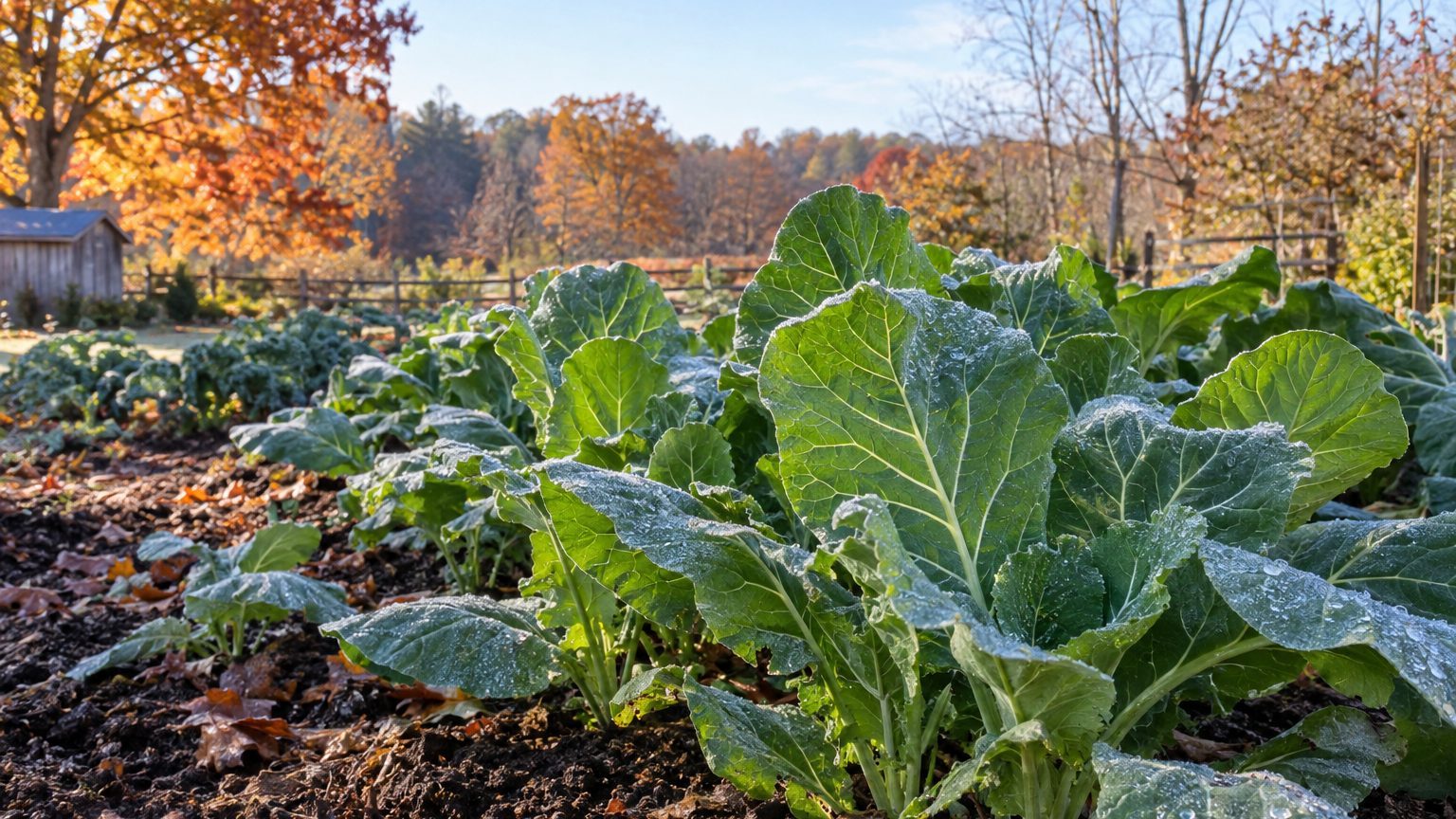

Collards in British Columbia go into the ground twice: a spring sowing timed to the region’s mean last frost of March 18, and a fall sowing counted back from the mean first frost of November 10. Coastal gardens can stretch both windows further than the numbers below suggest, but the calendar itself starts with those two dates.
The short answer for British Columbia
Collards are biennials grown as an annual crop, and they tolerate a touch of frost better than almost any vegetable in the garden. That’s why the two sowing windows in BC hang directly off the region’s frost dates rather than off summer heat, which is rarely the limiting factor here the way it is further south.
For a spring crop, start seed indoors roughly four to six weeks ahead of the mean last frost of March 18, which puts a tray under lights sometime in early February, then move transplants outside once the ground has dried enough to work. Direct-sowing outdoors in early March is possible for hardened-off seed, but the frost date itself is only a midpoint: Environment and Climate Change Canada’s own normals mean that in one year out of two, frost arrives later than March 18. Treat that date as the center of a range, not a green light.
The fall crop is the more forgiving of the two and, for a lot of BC gardeners, the more productive. Count back from the mean first fall frost of November 10 and aim to have seedlings in the ground by the second half of July to early August, so plants are sizing up through the cooling days of September and October. Collards actually improve with a light frost, converting starches to sugars in the leaf, so a fall crop that runs into the first cold snap isn’t a failure, it’s the point. Mid-July to early August is the window worth writing on a calendar.
What this page can’t tell you is which of those two windows suits your particular garden better, because “British Columbia” covers everything from mild coastal valleys to interior benches that see hard frost long before Vancouver does. The frost dates above come from a single reference station, and the next two sections explain why that matters more here than it would in a smaller, more uniform state.
What will not work here

The single biggest mistake in this region isn’t sowing too late, it’s trusting the mean last frost as if it were a guarantee. A gardener who sets out unhardened transplants on March 19 because “the frost date has passed” is gambling on a coin flip, since the mean by definition means half of all years run later. Collard seedlings can shrug off a light frost once they’ve hardened, but a cold snap on tender, greenhouse-soft transplants will still set them back hard or kill them outright.
Wet winter soil is the other trap that catches gardeners who learned collards in a drier climate. Coastal BC’s mild winters, with a coldest-month average minimum of just 0.8°C (33.5°F), mean the ground rarely freezes solid near sea level, but it also rarely dries out. Collards planted in heavy, poorly drained clay through a rainy fall and winter are prone to root rot and stem collapse long before cold itself becomes the problem. Raised beds or ridged rows aren’t optional in the wetter parts of the province; they’re the difference between a fall crop that survives into December and one that turns to mush by November.
Where interior and northern gardens diverge
Everything above assumes something close to the coastal climate the frost dates were measured in. Interior valleys and anywhere at real elevation see a shorter frost-free stretch and colder winter minimums than the coast, which means the generous fall-sowing window that works near Vancouver can simply not exist in a garden where hard frost lands weeks earlier. A calendar built on a mild coastal reference station will overpromise in those gardens, and a grower there needs to shift both the spring and fall windows earlier rather than assume the province-wide dates apply.
Tight spacing is the third failure mode, and it’s specific to the coast’s damp air rather than to heat. Crowded collards in a humid microclimate hold moisture on the leaf surface long after a sunny-climate garden would have dried off, inviting the fungal and bacterial leaf spots that thrive in still, wet air. Wider spacing and good airflow matter more here than the seed packet’s minimum distance suggests.
What changes across British Columbia
British Columbia is not one growing region, and the hardiness data makes that plain rather than subtle. The reference city behind this page’s frost dates sits at Canadian hardiness zone 9a, one of the mildest zones anywhere in the country. That number describes a specific coastal location, not the province as a whole, and it comes from a system built on seven climate variables rather than the single-variable USDA system American gardeners may be used to, so it isn’t directly comparable to a US zone number even where the digits look similar.
The spread across BC from that coastal 9a benchmark is large. Interior valleys, the northern half of the province, and anywhere at meaningful elevation all sit in colder zones than the coastal reference, in some cases dramatically so, and there is no single hardiness number that describes “British Columbia” the way there might be for a smaller, flatter state. A gardener working from this page’s dates while gardening in the Cariboo, the Kootenays, or anywhere north of Prince George should assume both frost dates need to move earlier and the safe sowing window needs to shrink accordingly.
The practical shift for anyone outside the mild coastal belt is to move the spring sowing later and the fall sowing earlier, compressing the season rather than stretching it. Don’t guess at which zone applies to your own address from general geography. Natural Resources Canada’s Plant Hardiness site lets you look up a specific location directly, and that lookup will tell you far more than any provincial average can.
Where to check this for your own county
Everything on this page describes British Columbia at the provincial level, built from a single reference station’s frost normals. That’s useful for a starting estimate, but it is not a substitute for local guidance, and the province’s own agriculture resources exist precisely to fill that gap. British Columbia’s Ministry of Agriculture and Food maintains its programs and regional information at https://www2.gov.bc.ca/gov/content/industry/agriculture-seafood, and that’s the right place to look next.
What’s worth searching for there specifically is any regional planting calendar for vegetable crops in your part of the province, since BC’s growing conditions vary enough between the coast, the Okanagan, and the north that a single provincial date rarely fits everyone equally well. Also worth checking is whether any regional trial has tested particular collard varieties for local disease pressure or cold tolerance, since a variety proven reliable on Vancouver Island isn’t automatically the one to plant in a colder interior garden.
A county-level or regional recommendation will always beat a provincial one, for the simple reason that it’s built on data closer to your actual soil and microclimate. This page works from a single weather station’s normals precisely because it has to speak to the whole province at once; a regional resource doesn’t have that constraint, and its guidance should generally override anything written here when the two disagree.
Some gardeners also time this by the Moon: when to plant collard greens by the moon, as almanac tradition rather than fact.
Checking this against your own garden
Every date on this page is a regional average, and your own garden will disagree with it in small ways every year. The reading that matters more than the calendar is soil warmth by feel: if a handful of soil in the planned bed feels cold and sticky rather than crumbly and just cool, seed and transplants alike will sit and sulk regardless of what the calendar says. That single check catches a late, wet spring that a fixed date can’t.
The second signal to watch is how quickly seedlings put out their first true leaves after the initial seed leaves appear. A quick, sturdy push to true leaves within a week or two of germination signals a garden running warmer and drier than the regional average, and a fall sowing there can often go in a little later than the mid-July guideline above. A slow, stalled seedling stage points the other way, toward a garden that runs cooler than the reference station, and argues for sowing earlier next season rather than trusting the provincial window.
The third signal belongs to plants left in the ground into a second season: watch for the first flower stalks rising from the center of an overwintered plant. That bolting is the plant’s own clock telling you the harvest window has closed for that planting, regardless of what the calendar predicted, and it’s a far more reliable marker of your own garden’s particular season than any mean frost date ever will be.