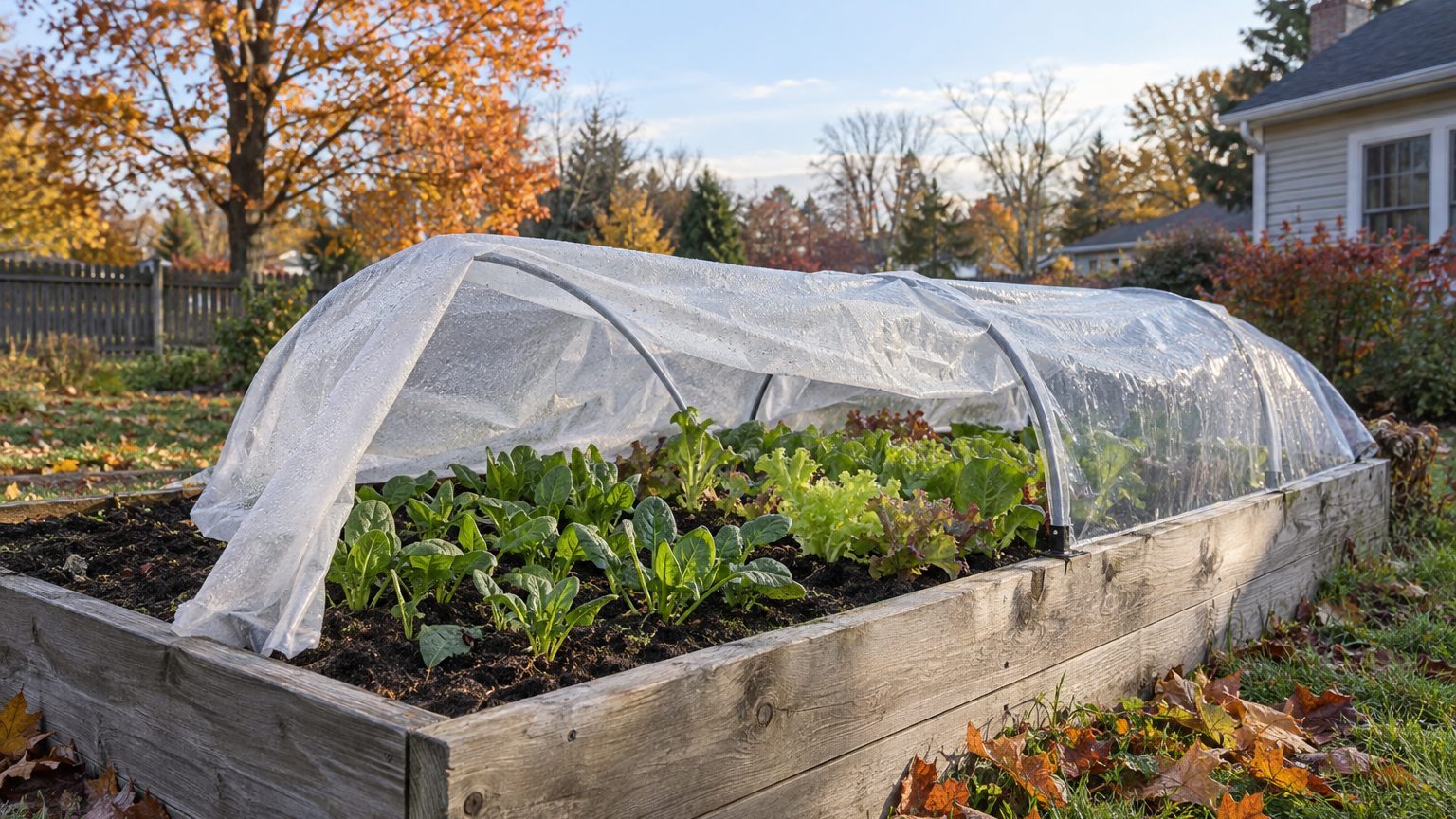

At Whitehorse, the mean last spring frost is June 5 and the mean first fall frost is August 25. Season extension in Yukon is about protecting both ends of that short window and making better use of the middle. Covers help, but they shift the limits without removing them. What you can do, and when, depends on soil warmth and daylight more than on the calendar.
When the soil is warm enough in Yukon
The date most gardeners ask about is June 5. That is the average last spring frost at the Whitehorse A station, from Environment and Climate Change Canada’s 1981-2010 normals. It is a mean, so in about one year out of two the last frost lands later. Treat it as the middle of a window rather than a safe date. It also describes one airport, and northern or upland districts of the territory can run weeks behind it.
Frost is only a proxy, though. Warmth-loving seedlings do not wait for the frost risk to end. They wait for the soil, and soil warms after the frost risk has passed, not alongside it. Cold ground slows roots long after the air has stopped dipping below freezing. A bean seed in cold, wet soil rots rather than sprouts, and a transplant in cold ground stalls and sulks for weeks.
What a cover does with that gap
A cover works on the soil as much as the air. By day, the ground absorbs sun under the fabric or glazing. By night, that stored heat radiates upward and is held by the still air trapped beneath. A second layer, such as a light fabric inside a tunnel, adds another pocket of still air. The gain is real, but it varies with the material, the night, the wind, and whether the ground was already warm. A cover on cold, wet soil on a windy night gives far less than the same cover on warm soil under calm, clear skies.
That is why placing a cover over the bed a couple of weeks before planting is one of the most useful passive tricks. It starts the warming early, and a soil thermometer tells you when the ground has caught up with the seed packet’s minimum.
A cover shifts the frost limit. It does not remove it. A clear, still night with a hard frost can take a covered bed as easily as an open one if the cover was thin or the ground was cold. And any closed structure, such as a cold frame, must be vented on sunny days. In spring sun a shut frame can cook its contents within an hour, even when the air outside is cool. Everything here stays passive, with no heaters, lamps, or candles under a cover. Fire and carbon monoxide are not worth the risk.
How long the season lasts here
Count from June 5 to August 25 and you get 81 days. That is the gap between the two mean frost dates at Whitehorse A. Both are means from the same 1981-2010 normals, so in half of years the spring frost arrives later and in half the fall frost arrives earlier. The window is a midpoint, not a guarantee. Those normals also cover a different period than the 1991-2020 figures used for the US pages on this site.
| Measure (Whitehorse A, 1981-2010) | Value |
|---|---|
| Mean last spring frost | June 5 |
| Mean first fall frost | August 25 |
| Days between the two | 81 |
What does 81 days allow? For many gardens, one sowing and one harvest. A long window leaves room for a second sowing of the same crop once the first is out. A window this short makes the first sowing the only one for anything that needs a full season to mature. Fast crops, such as radishes and leafy greens, can still be sown in staggered batches within the window. The Extending the Season: What a Cover Buys, and What It Cannot page covers what a cover adds at each end, and the succession sowing guide on this site walks through the spacing of those batches.
Transplanting changes in a short window. Starting seedlings indoors buys weeks that the calendar will not give, which matters for anything slow. But every transplant takes a root check, a pause while it re-establishes. In a longer season that pause is cheap. Here it eats into the 81 days. So transplant the crops that tolerate moving, such as brassicas, and direct-sow the ones that resent it, such as carrots and other long roots. Gardeners in neighboring Alaska face the same arithmetic, and Extending the Growing Season in Alaska shows how the same trade-off plays out there.
Heat and water in Yukon
Most season-extension pages lean on two numbers: days above 90 F and summer rainfall. This page does not carry a verified count of either for Yukon, so it gives none. That is a choice, not an oversight. In a territory where frost can arrive in late August, a count of 90 F days is not what governs your crops. A hot-climate page, like Extending the Growing Season in Nevada, worries about shade and root cooling. Here the governing facts are light and cold together.
Start with light. Whitehorse sits at 60.71 degrees north. That is the latitude of the reference city, not of the whole territory, so someone in the far north near Dawson or Old Crow should check their own latitude, because day length shifts the picture. Summer days are very long, and long days are what tell an onion to stop making leaves and start making a bulb. But the same latitude means daylight falls off quickly in late summer. The date it drops below what a crop needs to grow arrives earlier the farther north you are. After that date a cover no longer grows anything. It holds the crop alive, which is useful but a different job.
Then cold. The mean daily minimum of the coldest month at Whitehorse is -19.2 °C (-2.6 °F), from the 1981-2010 normals. The hardiness zone for the city is 1b in the Canadian system, from Natural Resources Canada’s plant hardiness site. That is not a USDA zone, and it does not convert to one, since the Canadian system uses seven climate variables and the USDA system uses one.
The coldest month matters for choosing the cover. A light fabric can carry a crop through a frosty shoulder-season night. It will not carry anything through deep cold. For hardy greens held into the cold months, only a framed structure with a second layer inside has a chance, and even then the gain is real but variable, never a fixed number of degrees. Remember that vents matter on bright days in any closed frame.
If a summer turns cool and damp, the problems shift. You get mildew, slow ripening, and disease pressure in crowded beds. A tight, unvented tunnel makes all of this worse. Airflow is a plant-health tool here, not only a cooling one.
Which season extension suit Yukon
Choose by type, not by cultivar name, and reason from the facts above. A short season favors the earliest-maturing types of each crop, the ones bred to finish within the 81 days between the mean frost dates, or fewer in a bad year. Cold-tolerant leafy and root crops give you the most margin. For heat-lovers, such as tomatoes, only the earliest types in a framed structure with soil pre-warmed under cover are realistic.
Humid or cool-damp stretches push disease resistance to the top of the list, ahead of yield. A resistant type that finishes is worth more than a heavy producer that molds in a wet August. And while a hot summer is not the territory’s governing risk, a closed frame can still overheat on a bright June day. Airflow and shade at the root, such as a mulch over the soil, keep roots from cooking inside a structure.
This page names no cultivar, and that is deliberate. The only recommendation that means anything is a variety trialled locally, in Yukon soil and light, and this page does not have those trial results. A list copied from a southern catalog would be a guess. For what has actually been grown and tested near you, ask Agriculture and Agri-Food Canada, and the territorial agriculture office, which can point to local trial results.
Also pair the choice with the cover. Fabric suits the early and late edges of the season. A framed structure suits holding crops into cold. Both stay passive, with no heat source added. For a wider view of what any cover can and cannot do, return to the season extension overview.
Common questions
Is June 5 a safe date to plant out tender crops?
No. It is the mean last spring frost at Whitehorse A, so in about one year out of two the last frost comes later. Soil warmth matters more than the date, and a soil thermometer is a better guide than the calendar.
How many frost-free days can I expect?
Between the mean dates of June 5 and August 25 there are 81 days at Whitehorse A. That is the midpoint of a variable window, and districts to the north or at higher elevation run shorter.
Will a cover make my crops frost-proof?
No. A cover shifts the limit by trapping heat from the soil in still air, and the gain varies with material, wind, and how warm the ground was. A hard, clear night can still take a covered bed.
Can I use Canadian hardiness zone 1b to pick plants from a US catalog?
Not directly. Zone 1b is the Canadian system’s rating for Whitehorse and does not convert to a USDA zone. For reference, the coldest month there averages a daily minimum of -19.2 °C, and local trial results are a better guide than any zone number.