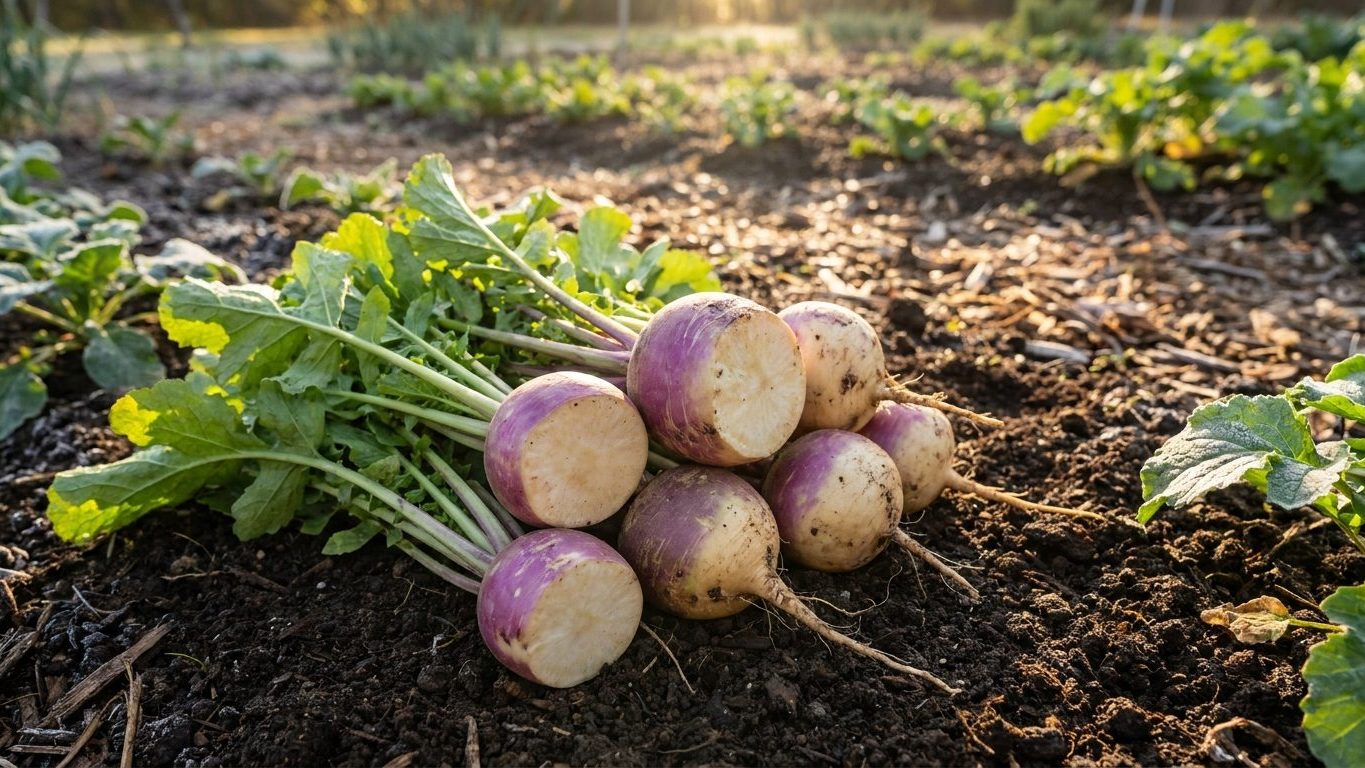

Turnips and rutabaga grow well in Illinois, and the fall crop is the one that pays off. Spring sowing waits for workable, warming soil, and the roots have to size up before summer heat arrives. Rutabaga wants a long, cool stretch to fill out, so it belongs in the second half of the year. Frost dates, summer weather and winter cold each shape the plan.
When the soil is warm enough in Illinois
At the Chicago reference station, the last spring frost falls between April 11 and April 22. That comes from the NOAA NCEI 1991-2020 Climate Normals, which mark the band where the chance of a 32F freeze sits between 30 and 70 percent (station data file). These are airport figures, not your yard’s. Suburban and rural gardens usually see the last spring frost one to two weeks later, and more at elevation, so check your own county before you pencil in a date. It is also a probability, not a promise, and any given spring can break either way.
Why frost is only a proxy
Turnips and rutabaga do not wait for the last frost. They wait for warm soil, and soil warms after the frost risk ends, not alongside it. Both crops shrug off a light frost once they are up, which is why gardeners sow them early. Cold, saturated ground is another matter: seed sits, germinates unevenly or rots. A date on the calendar says nothing about what is happening three inches down.
What to check in the bed
Push a soil thermometer a few inches into the bed in the morning, when it reads coolest, and check that the soil crumbles in your hand instead of smearing into a ball. If it does both, sow. If you are working a heavy clay bed that stays soggy into May, as many Illinois yards do, waiting a week costs little.
Spring turnips are a race. A quick, small-rooted type sown as soon as the ground allows can be pulled before summer heat turns roots woody and sends plants to seed. Larger storage turnips and rutabaga are poor bets for that slot because they need more time than a spring window gives them. They do best sown in summer for a fall harvest. To place that sowing, count backward from the first fall frost band (October 24 to November 3 at the same reference station) using the maturity time printed on your seed packet, then add a buffer for slow germination in dry summer soil.
Turnip and rutabaga are brassicas, and so are cabbage, kale, broccoli and mustard. They share pests and soil diseases with all of them. Rotating them into the bed where cabbage grew last year rotates nothing. For the wider growing basics, see Growing Turnips and Rutabaga: An Autumn Crop, Sweetened by Frost.
How long the season lasts here
Put the two frost bands side by side and the arithmetic is straightforward. At the Chicago reference station:
| Event | Window (NOAA NCEI 1991-2020, 32F, 30-70% band) |
|---|---|
| Last spring frost | April 11 to April 22 |
| First fall frost | October 24 to November 3 |
From April 22 to October 24 is 185 days. From April 11 to November 3 is 206. The frost-free window at the reference city therefore runs roughly 185 to 206 days. Because suburban and rural gardens typically start later in spring and end earlier in fall, often by one to two weeks at each end, your own window may be a month shorter than the airport’s in the worst case.
What does that length allow? A great deal, as these crops go. They are cool-season plants that tolerate light frost, so they use the shoulders of the window as well as the middle. A window of this size fits a quick spring sowing of small turnips and a separate fall sowing for the main crop, with room for a second or third spring sowing a couple of weeks apart if you want a longer harvest. The succession sowing guide on this site lays out how to stagger those sowings so the rows do not all mature in one week.
The window also settles the transplanting question. Taproot crops resent disturbance, and a bent or damaged root grows forked or stunted. With 185 days or more to work with, direct sowing is the better default in nearly every Illinois bed. Transplanting only earns its root check when a bed opens up late, after an early crop of peas or garlic, and you are racing the fall frost. If you do transplant, start the seedlings small, in deep cells, and look at the roots before planting: a root that has circled or bent is better composted than planted.
A cooler Great Lakes neighbor is covered in Growing Turnips and Rutabaga in Michigan, and comparing the two shows how much a few weeks of frost-free time change the plan.
Heat and water in Illinois
This page does not carry a verified count of days above 90 F or a summer rainfall total for Illinois, so it will not quote either. Look up your county’s normals from the National Weather Service or the state climatologist. What is safe to say is this: turnips and rutabaga are autumn crops, and the numbers that govern them most are cold ones.
The winter low decides the roots’ fate
At the Chicago reference station, the mean daily minimum of the coldest month is 18.8 F (NOAA NCEI Climate Normals 1991-2020). That is an average of the nightly lows, so plenty of nights run colder. At that level, soil can freeze hard, and roots left in the ground under mulch are a gamble in the northern part of the state. Treat mulch as a way to extend harvest into late fall, not as a plan for winter. Lift the roots before the ground freezes solid, and store only those that are sound.
Illinois spans USDA hardiness zones 5a to 7b (USDA Plant Hardiness Zone Map 2023, 1991-2020 normals), a wide spread. A gardener in the southern end of the state faces a milder winter than the Chicago figure, so the lift-or-leave decision shifts. That figure still describes only one reference city.
Frost sweetening has a clock on it
Cold nights make these roots sweeter, because the plant converts starch to sugar as temperatures drop. The sweetening stretch runs from the first 32F nights, at the reference station between October 24 and November 3, until the ground freezes hard. How long that gap lasts changes from year to year, and nothing on this page can promise it. A crop that matures early and sits through several frosty weeks tastes better than one pulled in a warm spell.
If summers run warm and damp
Illinois summers can be warm and humid. In that weather, brassica crops tend to suffer from fungal leaf spots, downy mildew and slow, uneven root development. Water at the base of the plants, in the morning, instead of soaking foliage at night. Mulch evens out moisture swings that crack or toughen roots. Thin the seedlings promptly so air moves between the leaves. A cool, damp summer would bring the same problems, with slower ripening on top, and the same remedies apply. For a mild, wet contrast, see Growing Turnips and Rutabaga in Oregon.
Which turnips and rutabaga suit Illinois
Choose by type, and then by what your extension office has trialled. Naming a variety here would be a guess. Variety performance depends on soil, disease pressure and local trials, and this page has none of that data. University of Illinois Extension does, and its county offices can tell you what grew well near you. That advice outweighs anything a general article can offer.
Here is how the state’s conditions point toward types:
- A window of roughly 185 to 206 days at the reference city, less in the country. The earliest-maturing small turnips suit spring sowings and late rescue plantings. Rutabaga, which needs the longest cool stretch, should go in during summer with the first fall frost counted back, and it is the crop that suffers most if your window runs short.
- Warm, humid summers. Favor types bred for airflow and good leaf cover, whose tops shade the shoulders of the root. Space them properly. Crowded rows hold moisture and invite disease.
- Disease pressure. In a humid climate, resistance listed in the seed description should be your first criterion, ahead of color or shape. Rotate away from every brassica for several years, and remember that cabbage, kale and mustard count.
Large storage roots need a look before they go into any cool space. Check each one for a soft patch, a weeping spot or a moldy crown. Any of those ends the question: discard the root. A firm, clean look does not make a root safe, and this page cannot promise how long any root will keep. Store only the sound ones, check them regularly, and cook or discard whatever starts to turn.
Common questions
When can I sow turnips in spring in Illinois?
Once the soil is workable and warming, which usually comes after the last frost band (April 11 to April 22 at the Chicago reference station). Suburban and rural gardens run a week or two later. Use a soil thermometer instead of the date.
Can I leave turnips and rutabaga in the ground over winter?
Not reliably. The coldest-month mean daily minimum at the Chicago reference station is 18.8 F, and hard ground freezes can damage roots. Mulch buys time in late fall, but lift roots before the ground freezes solid, especially in the northern part of the state.
Is rutabaga a good choice for Illinois gardens?
Yes, as a fall crop sown in summer. It needs a long, cool stretch, so count back from the first fall frost band (October 24 to November 3 at the reference station), and shorten that margin if you garden in the country.
Which varieties should I plant?
Ask University of Illinois Extension for the varieties trialled in your county. This page recommends types only, because a variety name without local trial data is a guess.