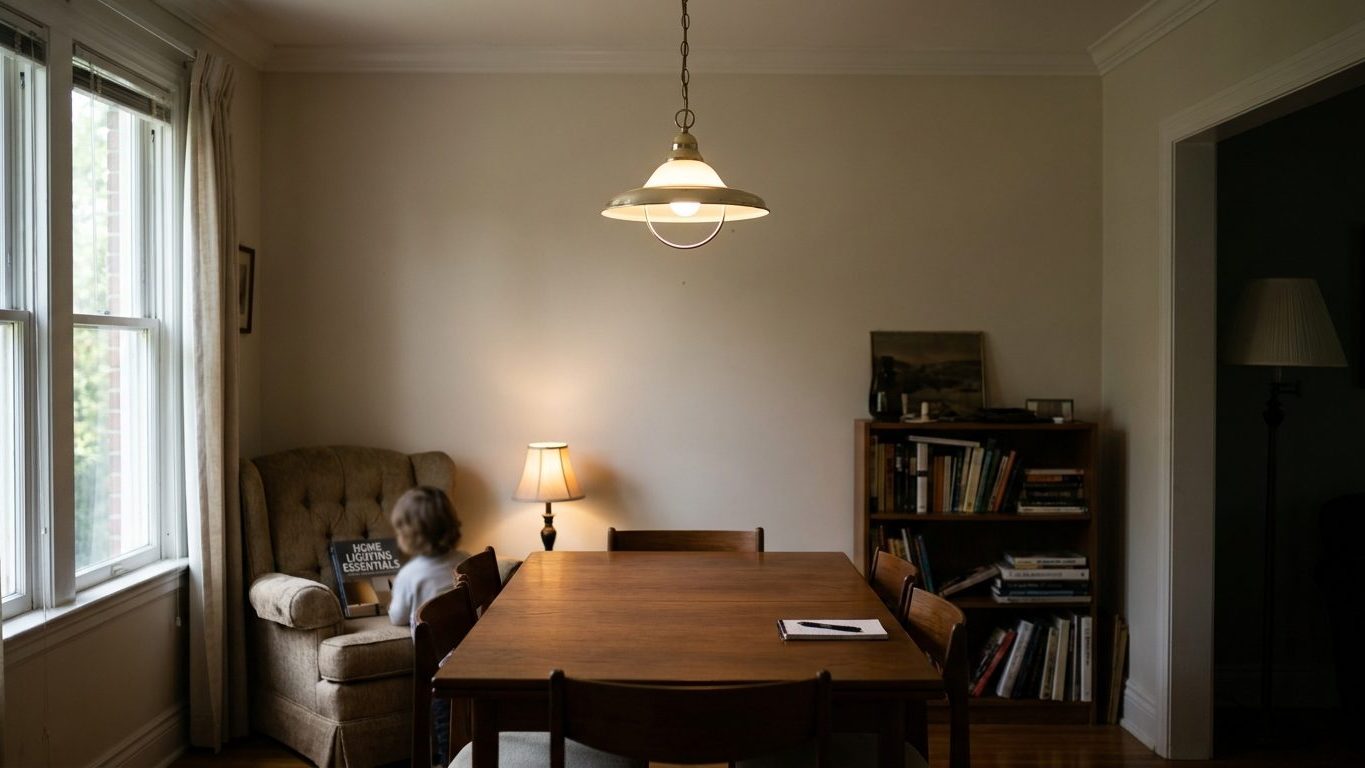

A single ceiling fixture in the middle of a room feels like enough light because it reaches every corner. It doesn’t fail on brightness. It fails on direction: one source overhead casts every shadow the same way, flattening faces, countertops, and reading material alike. Fix it by adding at least one lower light source, at eye level or below, before you touch the switch on that ceiling fixture at all.
What is actually going on

Light behaves like anything else in a room: it comes from a direction, and that direction leaves a shadow. A single fixture in the center of the ceiling sends light straight down. Every object under it gets lit on top and shadowed underneath, including you. A face lit only from above throws shadows into the eye sockets and under the nose and chin, the same effect a flashlight held under the chin produces at a campfire. A kitchen counter lit the same way shows every crumb and knife mark in dark relief, but the inside of a cabinet or anything at eye level stays dim no matter how bright the bulb is.
This is a geometry problem, not a wattage problem. A brighter bulb in that same fixture makes the flattening worse, not better, because it increases the contrast between the lit top surfaces and the shadowed vertical ones. The room can read as evenly bright on a light meter and unevenly lit to a human eye, which is the instrument that actually matters here.
The center-ceiling fixture became standard for a practical reason that has nothing to do with how a finished room should look: it is the cheapest place to run a single wire and the easiest box to frame during construction. One overhead point is a wiring convenience, not a lighting decision, and most rooms wired that way were wired before anyone walked through the finished space with furniture in place.
The usual height for a ceiling fixture over an open floor sits well above head height by convention, not by rule, and that convention is exactly what causes the flattening. The higher and more central the source, the more uniform the shadow direction across the whole room. A lamp at seated eye height, by contrast, throws shadows sideways and downward from a much lower angle, closer to how daylight from a window actually behaves. That is the real reason a lamp-lit room reads as warmer and more finished than a ceiling-lit one, even at the identical total brightness.
Doing it
A well-lit room actually runs on three separate jobs, and one ceiling fixture is trying and failing to do all three at once. Ambient light fills the room so you can move through it safely. Task light is aimed at a specific surface where you read, cook, or work. Accent light points at something you want the eye to land on, a piece of art, a plant, a textured wall. None of the three needs new wiring to add.
| Layer | Job | Where it usually goes | What skipping it looks like |
|---|---|---|---|
| Ambient | General fill light for the whole room | Ceiling fixture, or several lamps spread around the perimeter | A dim room with bright pools and dark gaps you have to walk through |
| Task | Focused light for one activity: reading, chopping, applying makeup | Close to the surface, at working height: a desk lamp, under-cabinet strip, mirror light | Squinting at the page, or working in your own shadow because the light sits behind you |
| Accent | Draws the eye to one object rather than lighting the room | Aimed light or a small fixture close to the object itself | A room that photographs flat because nothing in it stands out from anything else |
Adding each layer without touching a wire
Adding all three without touching the wiring is mostly a matter of using outlets you already have. A plug-in floor or table lamp near a sofa or chair covers ambient fill in a corner the ceiling fixture doesn’t reach well. A clamp lamp or a plug-in under-cabinet light strip covers task lighting over a counter or desk without an electrician. A small plug-in picture light aimed at a shelf or a piece of art covers the third layer. Where you mount that light should key off the art itself rather than a fixed number on a tape measure, the same logic covered in How High to Hang a Picture. Wall-mounted versions of any of these still need a solid anchor point behind the drywall, a separate question from the wiring itself.
Control matters as much as placement. Three lamps on three separate switches you have to walk around the room to operate defeats the point. A plug-in lamp dimmer or smart plug lets you bring the ambient layer down in the evening without touching the task or accent layers at all. This is also where people hit a wall they didn’t expect: an LED bulb that flickers, buzzes, or won’t dim smoothly on an older dimmer switch, a mismatch between the dimmer and the bulb rather than a fault in either one, covered in Dimming Modern Bulbs: Why It Often Fails.
Starting from a single ceiling fixture and nothing else, add ambient first because you need to see the room at all, task second at whichever surface you actually use daily, and accent last, since it is the layer that improves a room that already works rather than the one that makes an unusable room usable.
What it looks like when it goes wrong
Most of the visible failures are cosmetic and easy to correct once you know what you are looking at. A room with harsh, under-lit faces and hard-edged shadows on the wall behind every lamp is missing diffusion, not brightness. Swapping a bare or clear bulb for a frosted one, or adding a fabric shade, softens the shadow edge without changing the layer plan at all. A room with a bright pool of light around each lamp and a genuinely dark gap between them is missing a layer, usually ambient fill, and the fix is another lamp or fixture in the gap rather than a brighter bulb in the ones you already have.
Some failures are cosmetic but harder to fix because they are wiring decisions rather than furniture decisions. A ceiling fixture placed dead center in a room that has since been furnished off-center, so the main seating area sits in shadow while an empty corner gets the light, cannot be fixed with a different bulb or shade. That one is a rewiring or a relocation, not a styling fix, which is why older houses often need an electrician before a lighting plan rather than after one.
Safety failures, kept separate from looks
A few signs are not about how the room looks and should never be treated as a lamp-shade problem. A bulb that runs hot enough to discolor a shade, a fixture that feels warm on the outside of its housing, or a dimmer that hums under load are signs of a mismatch between the bulb, the dimmer, and the fixture’s rated wattage, and the fix is correcting that mismatch immediately rather than living with it.
- Flickering that follows the dimmer, not the bulb type: check dimmer and bulb compatibility before assuming the fixture is failing
- A wall sconce that wiggles or has come loose from the wall: stop using it until it is reattached to something solid behind the drywall
- A warm-to-the-touch switch plate or outlet cover: treat this as an electrical fault to have checked, not styled around
- A permanent extension cord run to a lamp because the nearest outlet is inconveniently placed: the fix is an added outlet, not a longer cord
Anything involving heat, buzzing, or a loose wall fixture is worth a licensed electrician’s look before you decide it is a decorating problem a different lamp can solve.
What to settle first
Before adding any fixture that attaches to a wall rather than sitting on a table, settle what the wall actually is. Drywall over wood studs, drywall over metal studs, plaster over lath, and masonry all hold weight differently, and a fixture that is fine on one is a hazard on another. A plug-in lamp on a table skips this question entirely, which is part of why it is the easiest layer to add first.
For anything mounted to the wall itself, a sconce, a picture light, a hardwired fixture, find out what is behind the surface before drilling. That means locating studs, and just as important, finding out whether wiring, plumbing, or ductwork runs through the cavity behind the spot you want to use. A stud finder tells you what is solid. It does not tell you what is live, and cutting into a wall without checking for wiring behind it turns a lamp installation into an electrical incident.
The weight question matters even for a small accent fixture, because the fastener has to hold not just the fixture but anything that pulls on it: a cord being tugged, someone bumping it while carrying a laundry basket down a hallway. Whether a given wall can take that load with a proper anchor, or needs to land on a stud instead, is the wall’s decision to make, not a preference, and it is covered in full in Hanging, Shelving and Fixing: The Wall Decides.
If you are unsure whether a given fixture needs a permit, an inspection, or installation by a licensed electrician, check with your local building department or utility provider rather than guessing. Those requirements vary by city and county and are not something a lighting guide can settle for every reader.
Common questions
Can I just add a bigger bulb instead of another lamp?
No, and this is the mistake the whole page is built around. A bigger bulb in the same overhead fixture increases contrast rather than fixing it, because the shadow direction doesn’t change, only its intensity.
How many lamps does one room actually need?
Enough to cover the layers your room actually uses, not a fixed count. A small reading nook might only need a task lamp added to existing ceiling light, while an open living and dining space usually needs several ambient sources plus at least one task lamp per activity.
Do smart bulbs replace the need for separate lamps?
No. A smart bulb changes color temperature and brightness in one fixture, but it still comes from one direction and one height. Adjusting the bulb’s warmth helps the mood of a room; it doesn’t fix the shadow problem a single high fixture creates.
Is it normal for a rental to only have one ceiling fixture per room?
Very common, and it’s usually the reason the room feels harsher than a furnished model photo suggested. Plug-in lamps solve most of it without any permission from a landlord, since nothing about adding a table or floor lamp touches the building’s wiring.