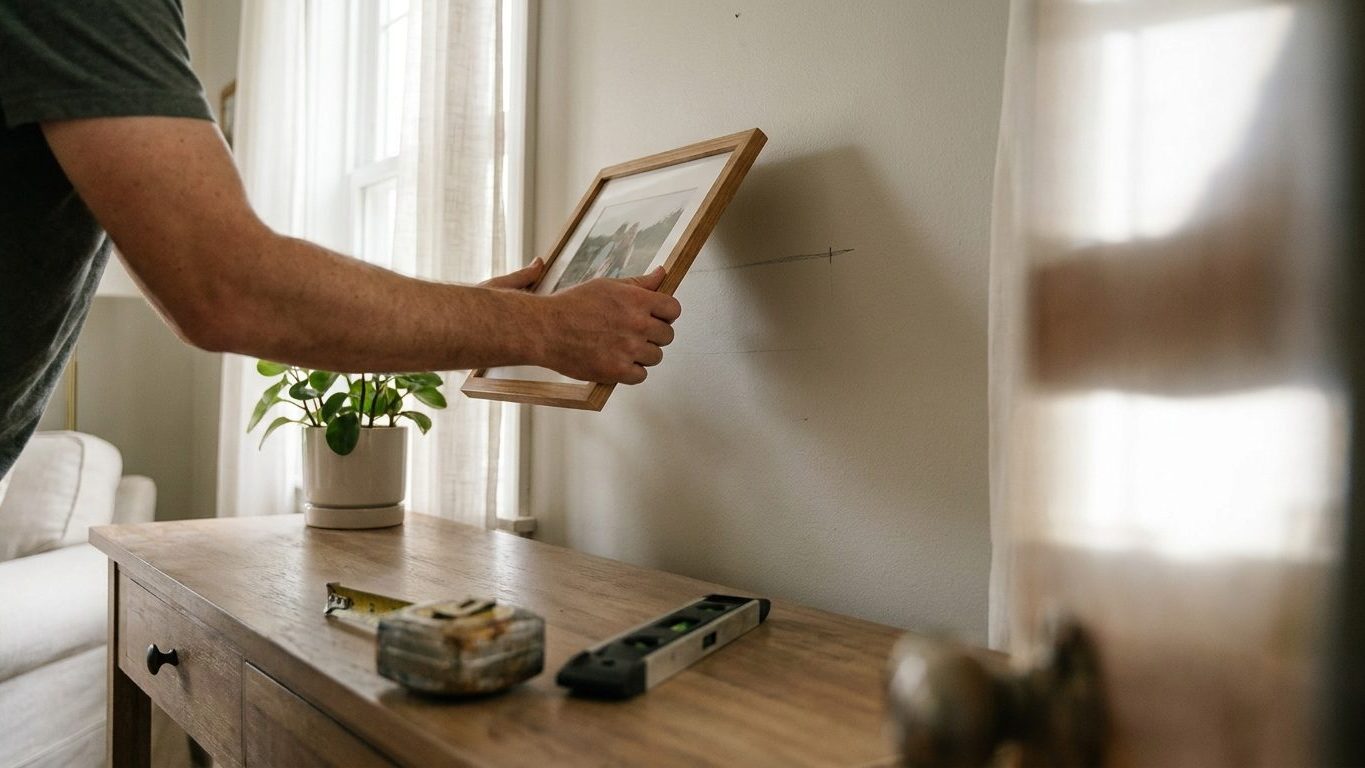

The frame is propped against the baseboard, hammer in one hand, and you’re stalling because one bad nail hole is permanent. The convention that solves this is hanging so the center of the piece lands at average standing eye level, somewhere in the range of 57 to 60 inches off the floor, then adjusting from there for the room in front of you. Measure up from the floor to that center point, mark it in pencil, and drive the nail before you talk yourself out of it.
Hanging one picture well is the same problem as furnishing a room in miniature, and the rules scale up: a single frame follows the height below, a group of frames follows the same line.
What is actually going on

The thing to understand here is eye level and context. The usual convention puts the center of a piece at roughly the eye level of an adult standing in the room, and that number holds up well on an open stretch of wall with nothing else competing for attention. It works because a picture hung at that height reads as something you look at, not up at or down at. Your eye lands on the middle of the piece without you tilting your head, which is the whole point of the convention in the first place.
That same number falls apart the moment furniture enters the picture. A sofa, a console table, a bed, a mantel. Any solid object sitting under the artwork changes what the eye is actually measuring against. Hang a frame at strict eye level above a low sofa and the piece floats, disconnected from the furniture below it, with an odd gap of bare wall in between. The convention was never built to account for a piece of furniture eating up the bottom third of the wall.
Room height changes the calculation too. In a stairwell or a room with a tall or vaulted ceiling, the person looking at the art is rarely standing flat-footed at one fixed distance. They’re climbing stairs, glancing up, viewing the piece from an angle the eye-level convention doesn’t anticipate. A single center height applied to a sloped stairwell wall will look correct at one step and wrong two steps later, because the geometry between viewer and wall keeps changing.
Light and context matter as much as height
The room’s lighting changes how a hung piece reads at any given height, and a warm bulb over a cool-toned print, or the reverse, can make a perfectly well-placed piece look off in a way that has nothing to do with the nail. If that mismatch is what’s actually bothering you about a piece that otherwise sits at a sensible height, the fix is in the bulb, not the wall. It’s worth understanding the difference between a warm and cool light temperature before you assume the placement itself is wrong.
None of this makes the eye-level convention wrong. It’s a starting point, not a rule stamped into the wall. The useful part is knowing which rooms and which walls need you to depart from it, and by how much, based on what else is sharing that stretch of wall with the picture.
Doing it
Start from the convention, then check it against whatever else is on that wall. The table below covers the three situations that most often call for an adjustment, and what goes wrong if you hang by the default number anyway.
| Situation | Usual starting point | What changes it | What happens if you skip the adjustment |
|---|---|---|---|
| Open wall, no furniture below | Center of the piece at standing eye level | Nothing, this is the case the convention was built for | N/A, this is the baseline |
| Above a sofa, console, or bed | A set gap above the furniture rather than a fixed floor height | The furniture, not the floor, is now the reference point the eye reads against | The piece floats, with an awkward band of empty wall separating it from the furniture underneath |
| Stairwell or sloped ceiling | A line that follows the slope of the stairs rather than one fixed height | The viewer’s position and distance from the wall keep changing as they climb | The piece looks level at one step and crooked, or too high, at the next |
| A grouped or gallery arrangement | The visual center of the whole group at eye level, not any single frame | The relationship between frames now matters more than any one frame’s own height | One frame lands at a sensible height while the rest of the group looks scattered around it |
When you’re hanging above furniture, judge the gap by eye rather than by a fixed inch count. Hold the piece up, step back to where you’d actually stand or sit in the room, and look at the relationship between the bottom of the frame and the top of the furniture before you mark anything. A gap that reads as connected from across the room is the target, not a specific number of inches, because the same gap looks different over a low bed than it does over a tall console.
Grouped arrangements are their own project, since the relationships between frames start to matter more than any single frame’s height off the floor. If you’re planning several pieces together rather than one, working out the spacing and alignment between frames before the first nail goes in will save you a wall full of extra holes. That’s covered in more detail in our guide to “/decor/gallery-wall/”>arranging a group of frames.
A quick way to test before you commit
- Cut a piece of paper to the size of the frame, or use painter’s tape to mark its outline directly on the wall.
- Stand where you’d actually view the piece from, not right in front of it, and check the height from that distance.
- Step out of the room and back in once. First impressions catch a height that’s off faster than staring at it up close.
What it looks like when it goes wrong
A picture hung too high sits above the natural sightline and reads as stranded, disconnected from the furniture and from the rest of the room. It’s a cosmetic problem, not a structural one, and it’s fixable without much drama: pull the nail, patch the hole, rehang lower. The same goes for a piece hung too low, which tends to look like an afterthought crowding the furniture underneath it rather than something the room was arranged around.
A frame that hangs level but visibly crooked relative to the floor or ceiling line is usually a hardware problem rather than a height problem. Check the wire and the hook before you assume the wall itself is out of square, since an off-center wire or a single hook holding a two-hook frame will pull a level frame crooked on its own. This one is a quick fix, not a rehang.
Grouped arrangements fail differently. One frame sitting at the “correct” eye-level height while the rest of the group scatters around it doesn’t read as one wrong frame, it reads as a wall with no plan behind it at all. The fix there is usually to rework the whole group’s spacing rather than nudge one frame, since the eye judges the group as a single shape, not as individual pieces each meeting their own height target.
The one failure that isn’t cosmetic
Separate all of the above from a genuine safety failure: a heavy piece, especially a mirror or a framed item with glass, hung on hardware not rated for its weight. A drywall anchor pulling loose under load, or a hook bending and letting the frame slide, isn’t a matter of taste. It’s a piece of glass and a mounted object that can fall, and it needs to be corrected immediately rather than left as an aesthetic quirk to live with. If a hung piece has ever felt loose, shifted on its own, or pulled its anchor partway out of the wall, take it down and rehang it on hardware sized for its actual weight before it goes back up, rather than assuming it will hold because it has so far.
What to settle first
Before any of the height decisions above matter, settle what the wall actually is. Drywall, plaster, brick, and tile all hold weight differently, and the hardware that works cleanly in one will barely grip another. A hollow-wall anchor rated for a light print in drywall is not the same fastener you’d use to hang the same piece on plaster or masonry, and guessing at this stage is where most falls and cracked frames start.
Know what’s behind the surface before you drill. Studs, pipes, and electrical wiring can all sit inside a wall cavity, and finding a stud with a stud finder or by tapping for a solid sound is a five-minute check against drilling into something you didn’t expect. This matters more with heavier pieces, where the fastener needs to reach a stud or use an anchor genuinely rated for the weight, not just whatever happened to be in the drawer.
Finally, ask whether the piece belongs on that wall at all. A large, heavy mirror or a substantial framed piece has real weight, and a wall that’s thin, damaged, or already patched in several places may not be the right spot regardless of how good the height looks on paper. This is also the point to check whether you’re dealing with a rented space, since some leases restrict what can go into the walls, and that’s a question for your lease or building management rather than a guess. For everything upstream of the height decision, plaster type, anchor choice, whether a given wall can take the load, the full breakdown is in our guide to “/decor/”>hanging, shelving, and fixing on any wall.
Common questions
Do I measure to the top of the frame or the center?
The convention is measured to the center of the piece, not the top or the bottom. If you’re working from a floor measurement, mark the center height first, then work out from there how far up the wire or hook needs to sit based on the frame’s own dimensions.
What if my ceilings are unusually low or high?
Standing eye level doesn’t move much from one room to the next, so the convention itself doesn’t really change with ceiling height. What changes is the amount of bare wall above and below the piece, which is a proportion question rather than a height question, and it’s fine to let a low-ceilinged room have less breathing room above a frame than a tall one.
Should every picture in the house be at the same height?
No, and trying to force that usually looks worse than varying it room to room. A hallway with nothing but open wall can follow the standard convention closely, while a piece over a headboard or a low bookcase needs to answer to that furniture instead. Consistency across a single wall or a single grouping matters far more than consistency across the whole house.
Can I hang a picture higher on purpose for a design effect?
You can, and plenty of rooms use a higher hang deliberately above a tall piece of furniture or in a room with unusually high ceilings, but that’s a taste decision, not a fix for a wall that’s genuinely wrong. If you’re doing it on purpose, look at the piece from where you’ll actually stand or sit before committing, rather than relying on a rule of thumb built for a different kind of room.