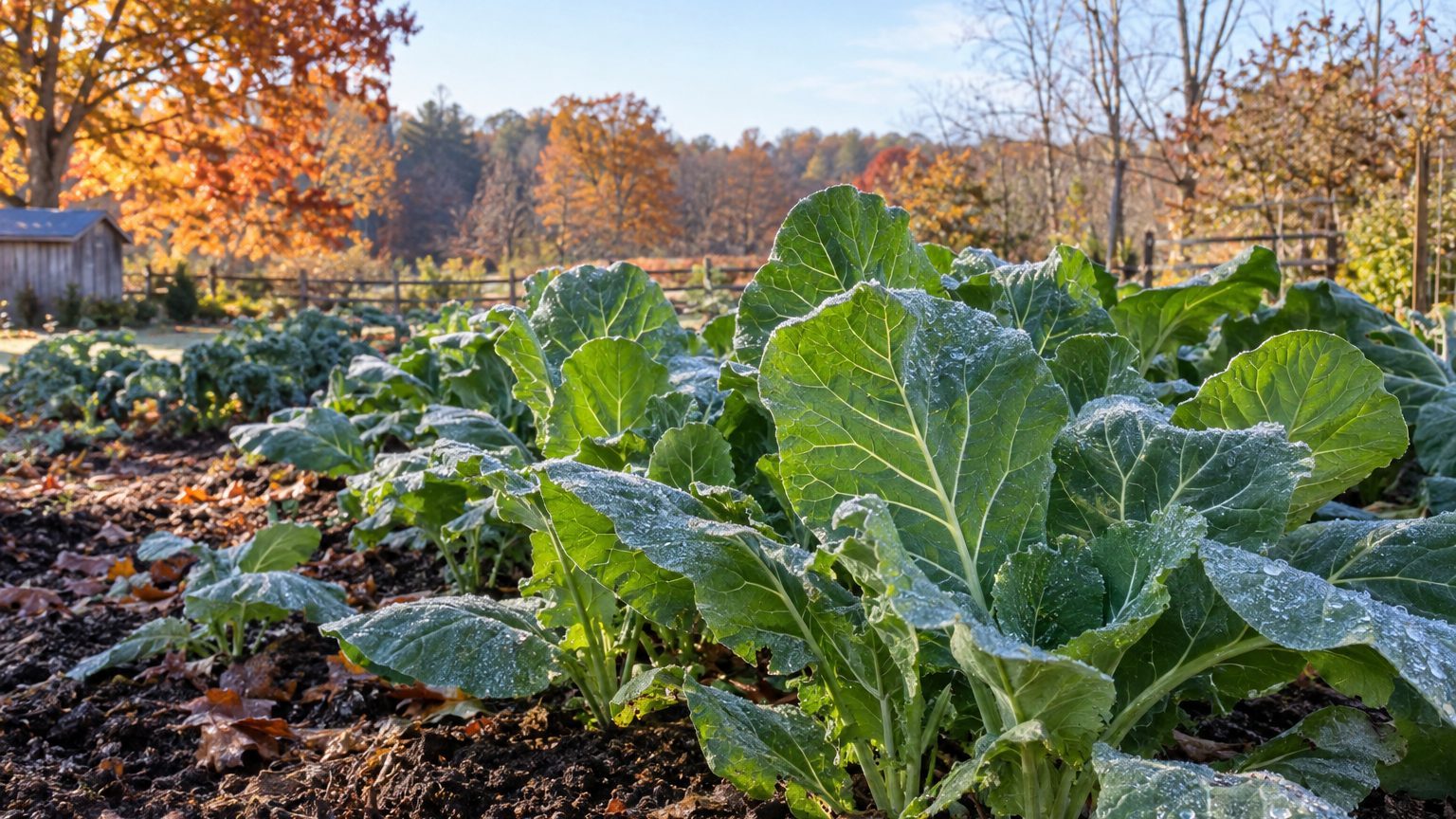

Georgia gardeners plant collards twice: once in late winter for a spring harvest, and again in mid-summer for the fall-into-winter crop that most of the state actually relies on. Both windows hang off the same two numbers, the state’s average last and first frost dates, and both come from a single weather station that doesn’t speak for every county.
The short answer for Georgia
Sow collard seed directly in the ground in late winter, and again in mid-summer, and you’ll cover both of Georgia’s collard seasons. The spring sowing rides on the state’s last spring frost, which falls somewhere between March 11 and March 29 according to NOAA’s 1991-2020 Climate Normals for station USW00013874. That’s not a guaranteed frost-free date, it’s the window where a 32°F freeze has a 30 to 70 percent chance of showing up, meaning either edge of it can still bite a young stand.
Because collards shrug off a light frost better than almost any other garden vegetable, most Georgia growers don’t wait for that window to close. Seed goes in from mid-February through March, sometimes a few weeks ahead of the median last frost, betting that a stray freeze will slow the seedlings rather than kill them outright. If you want a cushion instead of a bet, starting transplants indoors four to six weeks before your local last frost and setting them out once the soil has warmed is the safer route, something covered in more detail in Growing Collards in Georgia.
The bigger planting, for most Southern kitchens, is the one nobody skips: the fall crop. Work backward from the state’s first fall frost, which lands between November 13 and December 1 at that same Atlanta-area station. Collards need roughly two to three months from seed to a usable leaf harvest, so counting back from early-to-mid November puts the sowing window at mid-July through early August for most of Georgia. Plant later than that and the crop is racing an early frost; plant earlier and it spends its first weeks fighting the worst of summer’s heat.
Both dates come from one station near Atlanta, and that matters more than it sounds. A last-frost date isn’t a hard line, it’s a probability, and the same is true for the first fall frost. Treat both windows as a planning range, not a calendar appointment.
What will not work here

The most common failure in Georgia isn’t frost, it’s heat arriving before the plant is ready. Sow a slow-maturing collard variety in April, after the last-frost window has closed, and it’s often still filling out leaves in June, right when the state’s daytime highs settle into the 90s. Collards under sustained heat stress bolt, sending up a seed stalk and turning bitter fast. That’s a plant physiology problem, not a bad-luck problem, and no amount of watering fixes it once the stalk has started. Choosing a faster variety for a spring planting, and treating the spring crop as a bonus rather than the main event, sidesteps most of this, a decision covered variety by variety in The Best Collards and Greens for Georgia.
The opposite mistake shows up every November: gardeners pulling collards at the first hint of frost, assuming winter is about to finish the job. It usually isn’t. The coldest month at the reference Atlanta station averages a daily minimum of 35.6°F, which is a mean, not a record low, and it tells you winters here rarely go hard enough, or long enough, to kill an established collard stand outright. A plant that’s frosted once or twice often tastes better for it, since cold triggers the starch-to-sugar conversion that takes the bitter edge off. Pulling the crop in November, out of habit rather than necessity, throws away six to eight more weeks of picking that a mild Georgia winter would have allowed.
Watering on a fixed weekly schedule fails just as reliably, especially for the July-to-August sowing. Collard seed needs consistently damp soil through its full germination stretch, and a single missed watering during a Georgia summer dry spell can crust the surface and stall the stand before it ever gets going. And planting too tight compounds the state’s humidity problem: crowded rows trap moisture around the lower leaves, inviting the leaf spots and soft rot that thrive in Georgia’s muggy summer nights. None of these are frost problems. They’re heat, moisture, and spacing problems, and they’re the ones that actually take down a Georgia collard patch.
What changes across Georgia
Georgia is not one climate wearing a single date, it’s a state stretched across USDA Hardiness Zones 6a to 9b, a range built entirely on average annual extreme minimum temperatures. That’s one of the widest zone spreads of any state on the map, and it means a sowing calendar tuned to Atlanta is only a starting point for the mountains or the coast.
In the north Georgia mountains, sitting in the cooler end of that zone range, frost arrives measurably earlier in fall and lingers later in spring than the Atlanta averages suggest. A gardener there working the July-to-August fall sowing window should lean toward the earlier end of it, since a frost that shows up weeks ahead of the state average can cut a late-planted stand off before it’s sized up. Spring sowing, by the same logic, should wait a bit longer past mid-February before trusting the soil to hold.
Down toward the coastal plain and the far south of the state, in the milder end of that same 6a-9b spread, the opposite adjustment applies. Frost comes later in fall and quits earlier in spring, sometimes skipping altogether in a mild year. Gardeners there routinely stretch the fall planting later into August and keep picking well past the state’s typical first-frost window, sometimes running collards through the entire winter without a real break in harvest.
There’s no single number that covers a state this wide, and this page isn’t going to invent one. What it can do is point you to the USDA Plant Hardiness Zone Map to find where your county falls inside that 6a-9b spread, and let that placement tell you which direction, earlier or later, to nudge the dates above.
Where to check this for your own county
Everything above is a state-level average, built from one weather station near Atlanta. It’s a reasonable starting point, but a county recommendation beats a state one every time, because it accounts for local elevation, local frost pockets, and soil that this page has no way of knowing. That’s the job of Georgia’s Cooperative Extension Service, run through the University of Georgia at extension.uga.edu.
Once there, look for two specific things rather than browsing generally. First, the county-level planting calendar, which will narrow the broad windows given here down to dates that reflect your actual local frost history rather than an airport station’s. Second, the variety trial results for your region, since Extension offices routinely test collard varieties across the state’s different growing zones and report back on which ones held up to local heat, local pests, and local soil rather than performing well only in test plots.
A phone call or visit to your county office is worth more than another hour of general reading, since the agent there can usually tell you, in one conversation, whether your specific area tends to run its frosts earlier or later than the state averages this page relies on. That’s not a knock on state-level information, it’s just the nature of averages: they describe a whole territory well and a single backyard imperfectly.
Checking this against your own garden
Every date above is a starting estimate, and your own garden will correct it faster than any calendar can. Three things are worth watching before you trust a planting date over what’s actually happening in your soil.
Start with the soil itself. Grab a handful before you sow: it should crumble and hold loosely together, not clump into a cold, wet ball. Cold, sticky soil in late February is a sign your particular spot is running behind the state average, whatever the calendar says, and seed sown into it will simply sit and rot rather than germinate.
Once seedlings are up, watch for the first true leaves, the second set that emerges after the small rounded seed leaves. That’s the point where a stand has actually succeeded rather than just sprouted, and it’s your clearest signal that the sowing timing worked for your specific bed.
Later in the season, especially on a spring planting pushed into early summer, watch for a seed stalk starting to shoot up from the center of the plant. That’s the plant telling you it’s decided the season is ending, whether the calendar agrees or not, and it’s often the most honest read of how much heat your particular yard, with its own sun exposure and soil, actually carries compared to the county average.