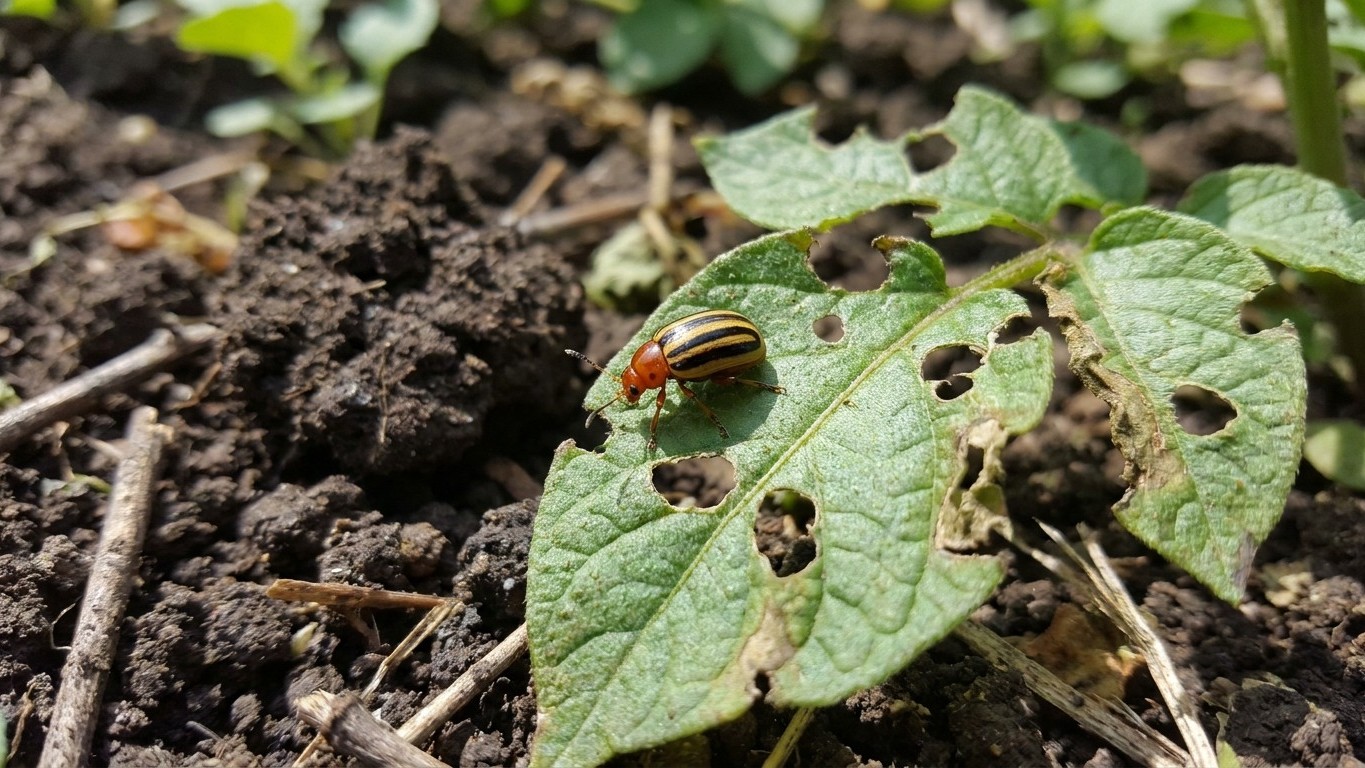

Of the pests the University of Vermont Extension documents in the state, three actually go after potatoes: Colorado potato beetle, flea beetles and white grubs. They work on different clocks. Flea beetles hit young leaves, the beetle strips foliage as plants fill out, and grubs stay out of sight until harvest. The rest of the list belongs to other crops.
Which pests attack potato in Vermont

The University of Vermont Extension documents these pests for the state: Asian jumping worms, boxelder bug, Colorado potato beetle, dark-winged fungus gnats, European chafer, flea beetles, green stink bug, leek moth, spongy moth, spotted wing drosophila, swede midge and white grubs. Read that as a roster of what turns up in Vermont, not a list of potato eaters. A pest being documented here does not mean it eats potato. Sorting it takes about a minute and saves a lot of wasted worry.
The three that do eat potato
Colorado potato beetle is the classic. Adults and larvae both chew potato foliage, and few other insects are so tied to the crop. Flea beetles are tiny jumpers that pepper leaves with small holes, mostly a problem for young plants. White grubs are the soil-dwelling larvae of beetles, and they gnaw roots and gouge tubers. European chafer is one of the white grubs, and its larvae live mostly in lawns, so a potato patch carved out of turf is exactly where they show up.
The ones to set aside
Leek moth goes after onions, leeks and their relatives. Swede midge targets the cabbage family. Spotted wing drosophila lays eggs in ripening soft fruit such as raspberries. Spongy moth caterpillars defoliate trees, oaks especially. Boxelder bug lives on boxelder and maple trees and mostly bothers people by crowding into houses.
Green stink bug is a wandering sap feeder found on many plants. It may land on a potato plant, but it is not what ruins a potato crop. Dark-winged fungus gnats breed in damp potting mix and seedling trays, not in a garden row planted with seed pieces. Asian jumping worms eat leaf litter and mulch, leaving soil that looks like coffee grounds. They change the ground, but they are not eating tubers.
When each one shows up, and what it does first
Everything below runs from your own planting date, and that date hangs on the last spring frost. For Burlington, NOAA NCEI Climate Normals put the last spring frost at April 30 to May 10, based on 32°F freeze probabilities in the 30 to 70 percent band at the Burlington station. Burlington sits on Lake Champlain, the mildest corner of the state. The Green Mountains and the Northeast Kingdom run substantially shorter, so everything below slides later there. The planting calendar that counts back from your last frost shows how to set your own date.
Flea beetles: first, in the weeks after shoots emerge
The first sign is a scatter of pinhead holes in young leaves, as if the plant were hit with fine shot. Brush a leaf and tiny beetles jump. Young plants take the worst of it, because there is little leaf area to spare.
Colorado potato beetle: as plants leaf out and bulk up
Adults walk in from wherever they overwintered, usually near last year’s potato ground. What you see first is ragged leaf edges, then clusters of orange eggs and humpbacked, dark-spotted larvae on the undersides. Check the undersides of leaves as soon as shoots are up, not after the tops look chewed. By the time defoliation is obvious, the larvae have been feeding for a while.
White grubs: nothing above ground, everything at harvest
Above ground, the only hint may be a plant that sags in a dry spell. The real evidence is in the soil, and the grubs feed late in the season, so the answer arrives when you dig: irregular gouges and holes in the tubers, sometimes a fat, C-shaped, cream-colored larva in the hole. An earlier season class, early rather than late, means tubers spend less time in the ground with feeding grubs. The potato varieties that suit Vermont are sorted by that class.
Telling the damage apart from everything else
Half the damage that gets blamed on insects is water stress, nutrient shortage, disease or a shovel. Dig one affected plant and look at the roots, the tubers and the soil before you decide a bug did it. Then match what you see against the table below.
| What you see | Possible causes | What separates them |
|---|---|---|
| Small round holes in young leaves | Flea beetles, hail, early leaf disease | Tiny beetles hop when you brush the plant. Hail hits every plant at once after a storm. Disease spots usually have a colored ring or yellow halo. |
| Ragged, chewed leaf edges | Colorado potato beetle, deer or rabbit browsing | Look underneath for orange egg clusters and dark larvae. Browsing leaves torn stems and hits plants unevenly. |
| Yellowing lower leaves | Nutrient shortage, too much or too little water, normal aging late in the season | No insects present, and the whole bed fades in a similar pattern. A soil test through your extension office settles the nutrient question. |
| Afternoon wilting | Dry soil, root feeders such as white grubs | Dig down and check soil moisture first. Wet soil and a wilting plant point to the roots. |
| Curled, mottled or stunted plants | Virus, herbicide drift | Insects do not explain a whole patch that stays small and mottled. Take a sample to your extension office. |
| Holes or gouges in tubers | White grubs, fork or hoe damage, other soil pests, common scab | Tool cuts have clean edges. Scab is a rough, corky surface patch rather than a hole. Irregular gouges with a larva nearby suggest a soil feeder. |
None of this tells you what is in your garden. It tells you what to look for. A photo and a sample at your county extension office will get you an actual identification.
What actually works here, and what is a waste of time
On a short northern season, timing beats treatment. Cover the row the day you plant, with the edges buried or weighted so beetles cannot walk under. Colorado potato beetles and flea beetles arrive after emergence, and a barrier that is already in place stops the first wave that a late spray only chases. Rotation helps for the same reason: put potatoes well away from last year’s patch, because overwintered beetles start their search there.
Scouting works when it happens early. Walking the rows and checking leaf undersides catches egg clusters while they can still be crushed by hand, and hand-picking is a real tool in a garden-sized planting. Avoid planting into freshly turned sod, where white grubs are likeliest to be sitting. And buy certified seed: uncertified seed carries virus, and no amount of insect control fixes a virus already in the tuber. The overview of growing potatoes in Vermont covers seed and site choices in more detail.
What wastes time? Spraying on a calendar without knowing what is on the plants. Spraying leaves for grubs, which live in the soil. Planting late to dodge beetles, since the frost-free window is already short in the Green Mountains and the Northeast Kingdom and a late start costs yield. Trusting unproven home mixtures over a barrier. And treating yellow leaves as an insect problem when they may be a water or nutrient problem.
This site does not recommend pesticides. The University of Vermont Extension is the place to ask what is registered in Vermont and what fits your situation.
Where to check this for your own county
The University of Vermont Extension is the authority for this page, and its county-level office is where a general list becomes a specific answer. A statewide list says what has been documented somewhere in Vermont. It does not say what is in your garden, and pest presence varies within the state. A Champlain Valley yard and a Northeast Kingdom hillside are different places for insects and for frost.
The same caution applies to the frost dates above. The April 30 to May 10 window belongs to Burlington, the reference city here. Higher and colder ground runs substantially shorter, so count your own planting date from what your local office and your own yard tell you. The pest calendar moves with it.
Bring something useful when you contact the office: a clear photo of the damage, your planting date, when you first noticed it, and where in the row it started. A live insect in a sealed jar beats a description. Your next step is to write down your planting date today, then flip over a few leaves at the first sign of shoots and photograph anything that looks off.
Common questions
Do Asian jumping worms eat potatoes?
They eat leaf litter and mulch, not tubers. Their effect is on the soil, which turns loose and granular. If your potato problem is holes in tubers, look elsewhere first.
Can leek moth or swede midge hurt my potatoes?
No. Leek moth feeds on onion-family plants and swede midge on cabbage-family plants. They are on the University of Vermont Extension list because they matter in Vermont gardens, just not in the potato row.
When will I know if I have white grubs?
Usually at harvest, when tubers show irregular gouges. Above ground the only clue may be a plant that wilts in dry weather. Digging one plant and checking the roots and soil is the quickest test.
Does the April 30 to May 10 frost window apply to my garden?
Only if you garden near Burlington. That is the reference city, and it sits on Lake Champlain, the mildest corner of the state. The Green Mountains and the Northeast Kingdom run substantially shorter, so ask your county extension office.