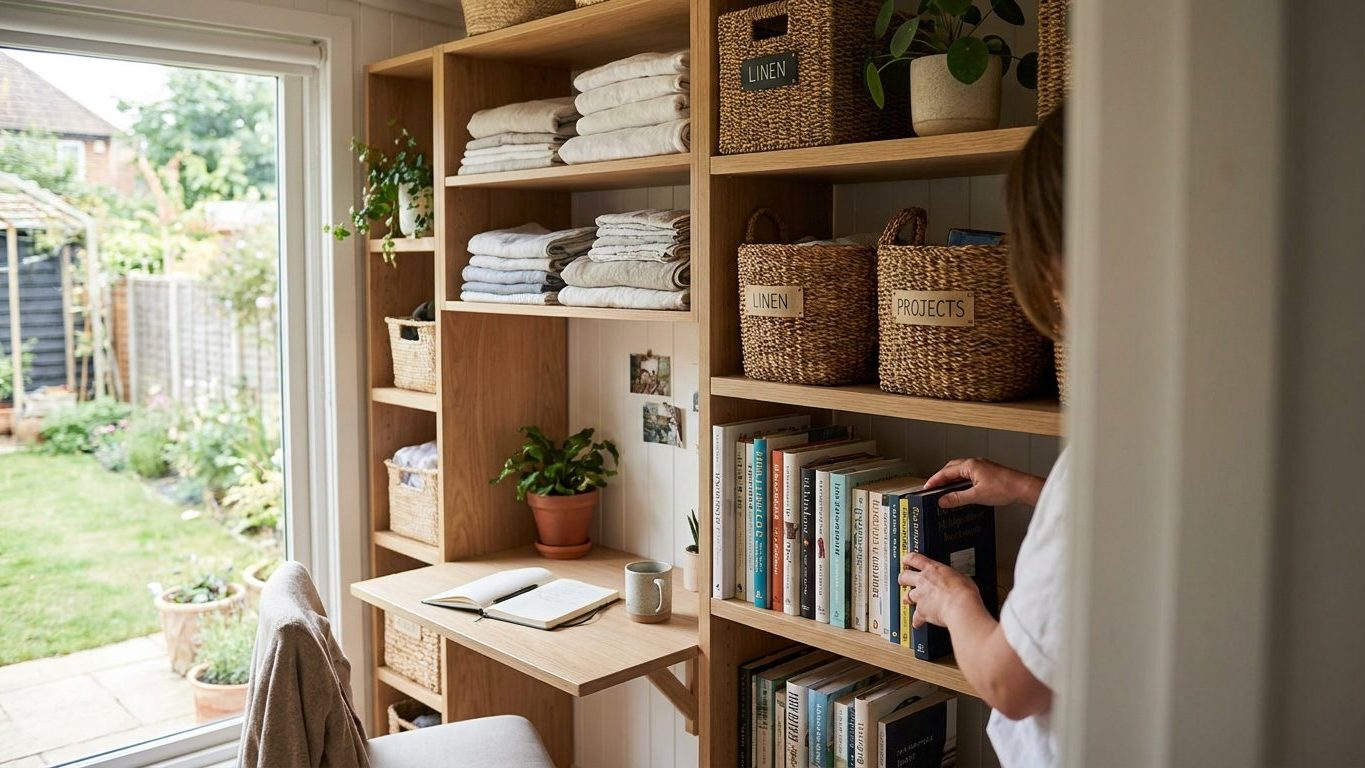

That boxy spare room where the bed blocks the closet door and you have to shuffle sideways past the dresser just to reach the window: that’s not a small room problem, it’s a traffic problem. The room works when you clear a straight path through it and let the eye travel to the farthest wall unobstructed. Start by walking the room the way you actually use it, several times a day, and note every spot where you have to turn your body or step around something.
What is actually going on

A room reads as small when two things fail at once: you cannot move through it without detours, and your eye stops on something close instead of carrying to the far wall. Square footage matters less than most people assume. A 100-square-foot room with a clear diagonal path and a low, open shelf under the window will feel roomier than a 140-square-foot room with a tall dresser blocking the doorway and a rug that stops six inches short of every wall.
Circulation is the physical path your body takes getting from the door to the bed, the closet, the desk. Every time that path bends around a piece of furniture, the brain registers friction, and friction reads as cramped even when the actual distance is short. This is why a room with furniture pushed flush to three walls and one clear route down the middle almost always feels bigger than the same room with furniture floating in the center, even if the floating arrangement looks nicer in a photo.
Sightlines are what the eye does when it enters the room. If the first thing it hits is a tall piece close to the door, it stops there and the room’s actual depth never registers. If it can travel past low furniture to a window, a mirror, or an empty stretch of wall, the room reads as deeper than it is, regardless of the true measurement.
Color, pattern, and lighting choices get most of the attention in small-room advice, and they do affect mood, but they are not why a room feels tight. A pale wall with a blocked path still feels small. A dark wall with a clear path and good sightlines usually reads fine. Where advice tells you a certain paint sheen or a certain rug size is “correct,” treat it as convention rather than rule. The usual habit is to keep a rug’s edges a short distance from the wall so the floor shows as a border, but that is a look people have settled on, not a measurement the room requires.
Once you separate the two mechanisms, circulation and sightlines, the fixes stop being decorating tricks and start being a short list of physical checks: where the furniture actually sits, how tall each piece is relative to the sightline, and whether the path from door to window ever forces a detour.
Doing it
- Map the path first, before moving anything. Stand in the doorway and trace the route you take most often, to the bed, the closet, the desk. Mark every point where you currently step around something. Skip this and you end up rearranging furniture by eye, which usually just relocates the same detour to a different wall.
- Pull furniture off the middle of the room and onto the walls it can reach. A bed, a dresser, or a desk pushed against a wall frees a continuous path down the open side. Leaving pieces floating in the center, even attractively, is the single biggest cause of a blocked circulation path in a small bedroom or home office.
- Put the tallest piece where the sightline from the door doesn’t hit it first. A tall bookcase or wardrobe belongs on the wall beside the door, not directly opposite it, so the eye’s first long look travels past low furniture instead of stopping on the tallest object in the room. Skip this and the room photographs fine but feels shorter the moment you walk in.
- Check clearance around anything with a door or a drawer. A closet door, a dresser drawer, and a desk chair all need room to open fully. If a drawer only opens halfway before it hits the bed frame, that’s a daily friction point, not a minor inconvenience, and it will keep reading as cramped no matter what else you fix.
- Use the vertical wall instead of the floor for storage. Floor-standing furniture eats into the circulation path twice, once for its footprint and once for the clearance needed to use it. Wall-mounted shelving or a hung mirror does the same storage or display job without narrowing the path. This is where putting up a shelf on brackets earns its keep in a small room, since a shelf at the right height clears the walking path entirely.
- Reassess the whole layout once, not piece by piece. Moving one item at a time and judging each move in isolation is how people end up with a room that’s individually reasonable and collectively still blocked. Step back and look at the full path after every two or three changes.
For a deeper pass on which piece goes where and why, arranging furniture around how the room is used covers the layout logic in more detail than fits here. The advice that does very little, despite how often it’s repeated, is painting a room white to “make it feel bigger.” Color affects light and mood, but it does not touch circulation or sightlines, which are the two things actually making the room feel small.
A note on mirrors and light
A mirror placed to reflect a window or a light source does extend the apparent sightline, which is a real effect, not a myth. It only works, though, if it’s placed along the path the eye already travels when entering the room. A mirror on a wall the eye never reaches first does nothing for the sense of space, whatever its size.
What it looks like when it goes wrong
The doorway swing is blocked
This is the most common failure: a bed or dresser placed so the door can’t open fully, or opens into furniture. It’s correctable in most cases, just by shifting the piece a few inches or reversing which way it faces, but it has to be caught before you’ve hung anything on the wall behind it that assumed the furniture wouldn’t move again.
A path that forces a turn narrower than a shoulder width
If you have to angle your body to get through a gap, that gap is too narrow, full stop, no matter what the floor plan says on paper. This is correctable by removing or relocating one piece. It rarely needs a full redo, but it does mean accepting that one piece of furniture doesn’t fit in that room the way you pictured it.
Furniture blocking an outlet, vent, or window latch
This crosses from cosmetic into safety and function. A dresser in front of the only window latch on an upper floor, or a bed pushed against a heating vent, isn’t a look you can live with while you save up to fix it. Move it now. This one is not optional the way a sightline issue is.
Wall-mounted storage that comes loose under load
A shelf or mirror that shifts, tips, or pulls its anchors partway out of the wall is a safety failure, not a style problem, and it needs to come down and be reinstalled properly, not touched up. If you’re unsure whether the wall behind it can take the load in the first place, that’s the exact question hanging, shelving and fixing: the wall decides is written to answer, and it’s worth reading before anything heavier than a picture frame goes back up.
A rug or runner that stops the eye instead of extending it
A rug that’s too small for the furniture grouping it sits under makes the whole area look like an island in the middle of the floor, which shortens the sightline rather than extending it. This is purely cosmetic and easily corrected with a differently sized rug. It’s a matter of convention, the usual habit being to size a rug so the front legs of the main furniture rest on it, not a rule the room enforces.
What to settle first
Before any shelf goes up or any furniture gets bolted to a wall for stability, find out what that wall actually is. A wall in an older house may be plaster over lath, which holds weight very differently than drywall over studs, and the fixing method that works in one fails in the other. If you don’t already know your wall type, a stud finder and a small test hole in an inconspicuous spot will tell you more in five minutes than guessing will.
Check what’s inside the wall before drilling anything deeper than a picture hook. Electrical wiring, plumbing, and in some homes structural bracing can sit exactly where you’d otherwise plan to anchor a heavy shelf or a wall-mounted desk. A stud finder with wire-detection is worth using on any wall you plan to load, and if you hit something unexpected, stop and get it identified before continuing.
Confirm whether the wall is load-bearing before you plan anything that involves removing part of it, widening a doorway, or building storage that ties into the wall structurally. This is not something to guess at from the direction of the joists overhead. A local building department or a licensed contractor can confirm it, and given how much a wrong guess costs to undo, that call is worth making before any demolition starts, not after.
Finally, settle the load question for anything you’re hanging: what the shelf or fixture will actually carry once it’s loaded with books, folded clothes, or a television, not what it weighs empty. Fixings rated for a light decorative shelf will fail under real storage weight, and that failure shows up as the wall pulling loose, not as a slow warning sign. Match the anchor to the actual load before you commit to the layout, not after it’s already up and holding something.
Common questions
Does painting a small room white actually make it look bigger?
Not by itself. Light color affects brightness and mood, but it doesn’t change the circulation path or the sightline, which are the two things that make a room feel cramped. A dark wall with a clear walking path and low furniture near the entrance will usually feel roomier than a white room with the bed blocking the door.
Is it worth buying smaller furniture for a small room?
Sometimes, but the height of the piece often matters more than its footprint. A tall dresser with a small footprint can block a sightline just as badly as a wide low one, so check the piece against where the eye travels when you walk in, not just against the floor space it takes up.
What’s the minimum I should leave for a walking path?
There’s no single figure that applies to every room or every local code, so don’t rely on a fixed number. Walk the path yourself with your shoulders straight and confirm you’re not turning sideways to get through, and check with your local building department if you’re altering a hallway or exit path specifically.
Can I fix a small room without moving any furniture?
Only partly. Lighting, a mirror placed along the existing sightline, and wall-mounted shelving instead of floor-standing pieces will all help, but if the furniture itself is blocking the main path or sitting in front of the doorway swing, no amount of styling around it will fix that. The furniture position has to change first.