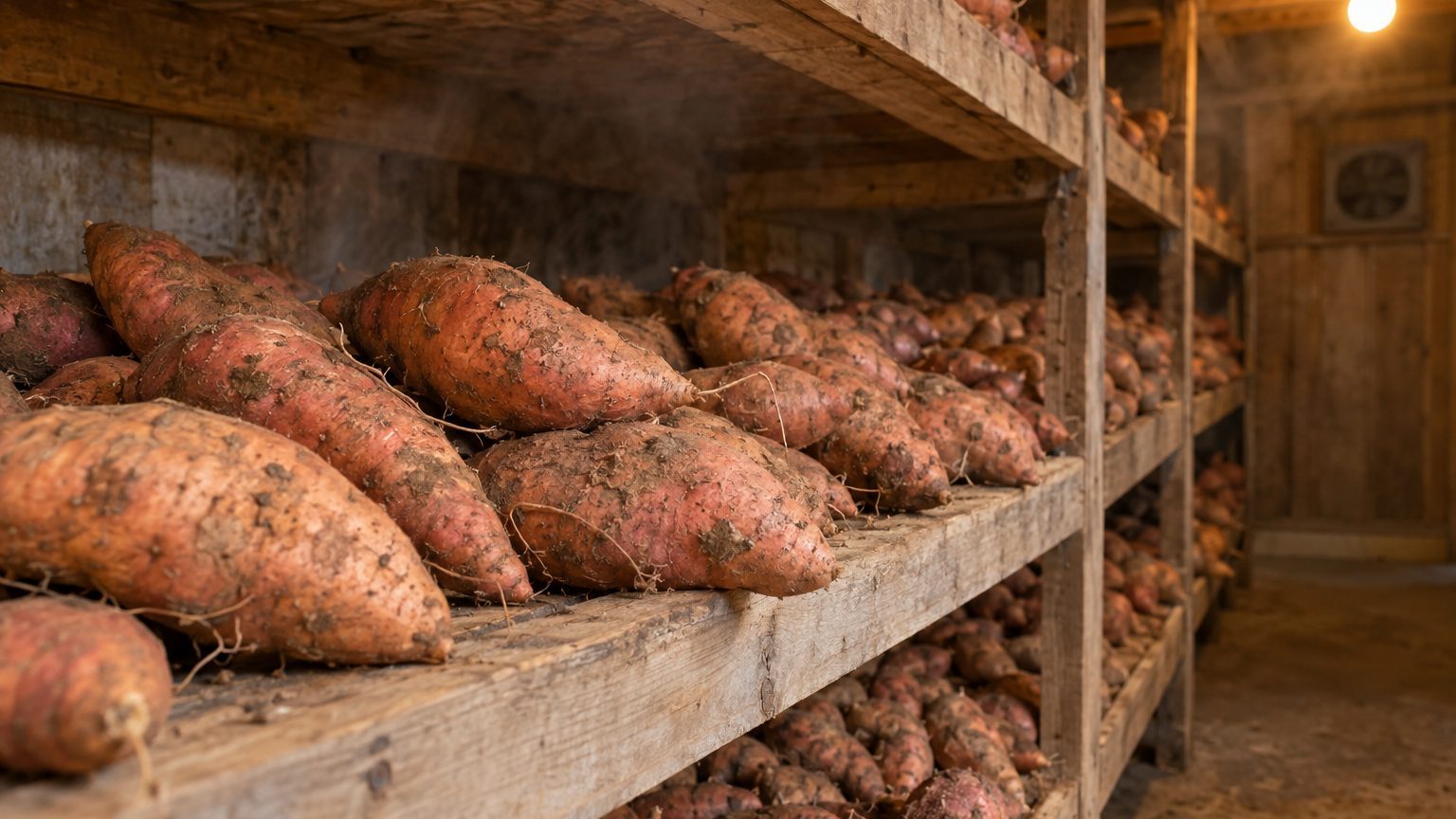

Curing sweet potatoes means holding freshly dug roots in a warm, humid spot for about a week before they go anywhere cool. That stretch heals the skin and gets starch turning into sugar. Skip it and you get a bland root that stores badly. Do it right and the sweetness you expect from the store shows up in your own kitchen. Growing the crop is covered in Growing Sweet Potatoes: Slips, Heat, and a Careful Cure. This page starts the day the digging fork goes in.
What is actually going on
A sweet potato eaten straight from the ground is a disappointment: dense, chalky, faintly bland. Curing is the entire reason. The thing to understand here is enzymes.
Starch, sugar and the oven
A freshly dug root is mostly starch. Enzymes called amylases chop that starch into sugars, mainly maltose, and they work faster when the root is warm. Part of the conversion happens during curing. More happens over the following weeks in storage. The last push comes in the oven, where heat drives the same enzymes hard until it finally shuts them down. A baked sweet potato tastes sweeter than a raw one for exactly that reason, and a cured, stored root baked the same way tastes sweeter still.
The second job is the skin, and it matters as much. Digging leaves scrapes and micro-tears you can barely see. In warm, humid air the root responds by laying down a fresh corky layer under the damage, like a scab that grows from the inside. Without that layer, moisture escapes through the wounds and rot organisms walk in. An uncured root tends to shrivel or spoil in storage, sometimes both.
Both processes need conditions a kitchen rarely has. Extension guidance commonly points to roughly 80 to 85°F with humidity in the high 80s percent, for about a week. A house in autumn usually sits closer to 70°F and runs dry, especially once the heat comes on. That gap is why curing takes a little improvising, and why it fails so quietly when nobody bothers.
A root that is not what the label says
Sweet potato is not a potato, and it is not a yam either. It belongs to the morning glory family, so it is not a nightshade and has no rotation relationship with potatoes or tomatoes. True yams are a separate tropical plant, and the “yam” tag on orange-fleshed roots at the supermarket is a marketing leftover. The practical catch: potato curing advice runs cool, and following it here would wreck the crop.
Types differ too. Moist, orange-fleshed roots convert a lot of starch and end up soft and sweet, while drier, paler types stay firmer and less sugary. Which specific varieties do well near you is a question for your state extension service, since they run the local trials. For the general sorting, see Orange, White and Purple: Which Sweet Potato to Grow.
In the garden
Curing is a short checklist, and each item has a specific way of going wrong. Both halves are in the table below.
| Step | What you want | What happens when it goes wrong |
|---|---|---|
| Digging and handling | Dry day, gentle hands, soil brushed off, no washing | Cuts and bruises become entry points for rot, and a wet root carries moisture straight into the cure |
| Warmth | Roughly 80 to 85°F the whole time | Cooler air slows healing to a crawl or stops it. Hot pockets well above that range can start breaking roots down |
| Humidity | High, in the high 80s percent | Too dry and roots shrivel while the skin never seals. Wet with no airflow and condensation drips onto roots and breeds mold |
| Airflow | Loosely covered crates or boxes, never sealed | Stale, dripping air invites mold and rot |
| Time | About a week, with some extension sources allowing a few days longer | Cut short, the skin stays porous and roots decline in storage |
| Afterward | Move to a dark, dry-ish spot in the mid-50s to about 60°F | Cold injury. Never a refrigerator, never a cold cellar |
That last row deserves plain words. Cold damage below the storage range is real and irreversible, and it is the most common way a good harvest gets ruined at home. The root may look fine for days, then turn hard at the center, taste off and break down. Refrigerating roots does not save them from anything. The full picture is in Storing Sweet Potatoes: Never in the Cold.
Most homes need a setup, and a few work reasonably well. An oven with only the light bulb on holds a gentle warmth in a closed space, especially with a pan of water on a lower rack. Tape a note to the door so nobody preheats it with roots inside. A small closet or spare bathroom with a thermostat-controlled heater and a humidifier can work, though I would never leave a heater running unattended in a cramped space. A plastic tote with a few holes and a damp towel draped loosely over the top, kept in a warm utility room, is another option. In any of these, set a cheap thermometer and hygrometer among the roots instead of trusting your hand.
When the week is up, inspect every root. The skin should look dry and firm, with scrapes sealed over. A soft patch, a weeping spot or a sour smell ends the question for that root, so discard it and check its neighbors. A sound appearance is not a guarantee of anything, which is why nobody can honestly promise how long a cured root will keep.
What it depends on where you are
Some of this is national. The mechanism is the same in every state, the target range for warmth and humidity is the same, and so is the rule about cold. Those parts you can carry anywhere.
The rest is local, and this page does not know your garden. Season length decides when the roots come out and how warm the weather still is on digging day. In a long, warm fall the garage or porch may do half the curing for free. In a short season, the house has to do it all, and the difference between a mild October and a cold snap can decide the whole plan. Summer heat matters because it shapes how the crop sizes up, and summer rainfall matters because a wet late season leaves roots harvested from soggy ground, which are more prone to splitting and rot.
Frost timing is the other local variable. A frost that kills the vines starts a clock, since roots sitting in cold soil can pick up chilling damage before you ever dig them. How much margin you have depends on your area, so watch your own forecast instead of a calendar from somewhere else.
Start with the state pages on this site, which cover how growing conditions differ across the country. Then call or check the website of your state’s cooperative extension service. They know which types have been trialled where you live, what your typical digging window looks like, and whether your climate favors moist orange roots or something drier. Their curing advice will usually match what is here on the mechanics but will be tuned to your weather. If the two ever disagree on a number, go with the local office.
The mistake that costs the most
Moving roots straight from the ground to a cool place. It feels responsible, because you dug them, brushed them off and put them somewhere sensible, like a basement, an unheated garage or the crisper drawer. But cool is the opposite of what a fresh root needs.
The damage comes in two parts. Without warmth and humidity, the skin never seals, so every scrape stays open. Meanwhile, if the space is cold enough, the root is also taking on chilling injury, the irreversible kind. Nothing shows on day one. Weeks later you find roots that are hard in the middle, oddly flavored or collapsing from the inside, and by then the whole batch has usually gone the same way. A crop that took a full summer to grow is gone in a few days of bad placement.
The fix is to reverse the order. Cure first, warm and humid, for about a week. Then move the roots to a dark, dry-ish spot in the mid-50s to about 60°F, such as an interior closet or a spare room that stays steady. Never a refrigerator, never a cold cellar. If you are unsure whether a spot is cold enough to hurt them, put a thermometer there for a couple of days and read it at night, when it matters.
Reading it also helps with a related trap: cold garages that feel fine at noon and drop hard after dark. If the roots must sit somewhere temporarily, an insulated cooler indoors is better than a bare porch.
Common questions
Can I eat sweet potatoes right after digging?
Yes, once cooked. They are safe to eat fresh, they just taste starchier and less sweet. Any root you plan to store should be cured first, and any with cuts or bruises should be eaten soon.
Do store-bought sweet potatoes need curing?
No. Commercial roots are cured before they reach the shelf. What they need at home is a spot that is not cold, so keep them out of the refrigerator.
Can I cure them in the sun?
A short spell on the ground at digging is common, but hours of hot sun can scald the skin, and a cool night afterward can chill the roots. A controlled, covered warm space is safer than leaving them out in the field.
How do I know the cure worked?
The skin looks dry and firm, scrapes have sealed, and no root feels soft or wet. A soft patch or weeping spot means discard it. A sound look proves nothing, so keep checking through the storage season.