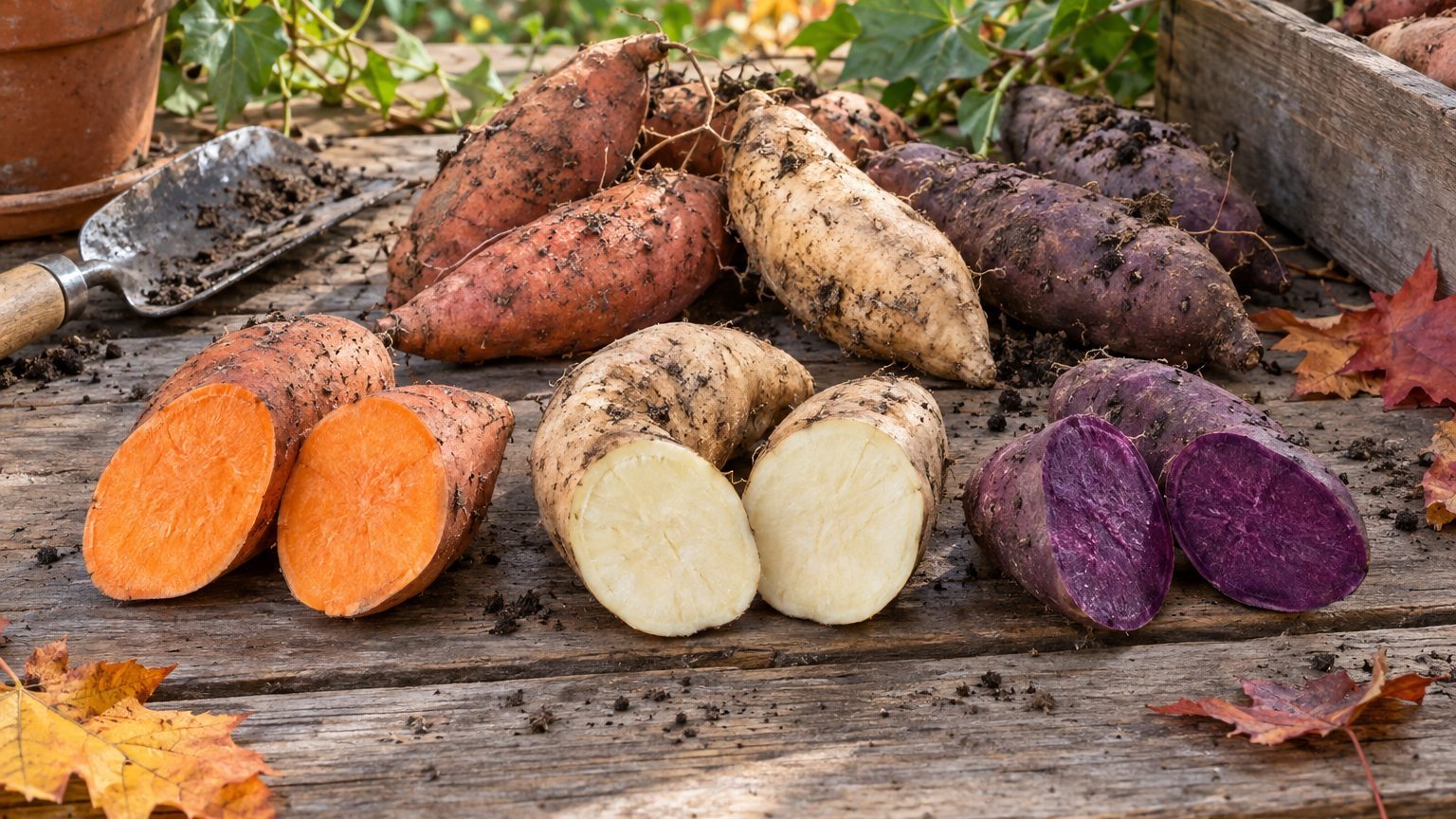

Start with an orange-fleshed type. It is the soft, moist, sweet sweet potato most American cooks expect, and it is the easiest one to judge in the kitchen. White and purple types are drier and firmer, which suits some dishes and disappoints in others. Whichever color you pick, your growing season decides whether it finishes.
What is actually going on
The thing to understand here is starch and moisture. Orange-fleshed types are moist and soft when cooked. Pale and purple ones are drier and firmer. Flesh color tells you more about texture than about flavor, and that is the opposite of how most seed catalogs and grocery displays invite you to read it.
Color is pigment, texture is chemistry
The orange comes from carotenoid pigments, the same family that colors carrots. The purple comes from anthocyanins, the pigments in blueberries and red cabbage. Neither pigment makes a root wet or dry. Moisture and starch content do that, and they travel loosely with color rather than being caused by it. Moist types hold more water and turn their starch into sugars readily as they heat, which is why they collapse into a soft, syrupy interior. Drier types keep more of their starch intact, so they stay crumbly, dense and less sweet on the tongue.
Once you see it that way, cooking decisions follow. A moist orange root makes a good mash, pie filling or soft roasted half. A firm white or purple root holds its shape in cubes, fries and stews, and it can turn chalky if you expect it to behave like its orange cousin. Curing shifts things too, since starch keeps converting to sugar in the weeks after harvest. The Curing Sweet Potatoes: Where the Sweetness Comes From guide covers that step, and it matters for every type.
Skin color is a separate question
Skins run from pale tan to copper to deep red to purple, and skin does not reliably predict what is inside. A purple-skinned root can have pale flesh. A tan one can be deep orange. If you are growing for a specific texture, go by a description of the flesh rather than a photo of the skin.
One correction belongs here. A sweet potato is not a yam, and it is not a potato. It is a vine in the morning glory family, with no relation to the nightshades, so it does not rotate with potatoes or tomatoes. True yams are a different plant, rarely grown in American gardens. The “yam” on a supermarket can usually means a moist orange sweet potato. If you shop for slips, the plant is the same whatever the label says.
Varieties are where this page stops. Named cultivars differ by region, and your state extension service publishes trial results for the ones that perform where you live. Use that list, not a name you saw once.
In the garden
Here is how the three broad types compare on the points that matter to a gardener. The last column is the one to read twice, because each type has its own way of disappointing you.
| Type | Texture | How it cooks | Time and short seasons | When it goes wrong |
|---|---|---|---|---|
| Orange-fleshed | Moist, soft, sweet | Mashes, bakes soft, suits pies and casseroles | Many are sold as shorter-season, but check trial results, not the tag | Cut too soon or skipped curing, it tastes bland and starchy. Skin cracks after heavy rain late in the season. |
| White or cream-fleshed | Dry, firm, mild | Holds shape when cubed, fried or roasted | Varies widely, so ask your extension service | Treated like an orange type in a mash, it turns crumbly and dull. Mild flavor gets mistaken for a failed crop. |
| Purple-fleshed | Dry, dense, sometimes chalky | Steams and roasts well, keeps color when cooked gently | Often wants a long, warm season, so verify locally | A short season gives small, thin roots. Overcooking turns them gray and mealy. |
The pattern is that the moist orange types forgive you more in the kitchen, and the drier types reward you only when the cooking matches. That is a reason to grow one row of each rather than an all-or-nothing bet, at least in the first year.
Storage deserves one plain warning, because it is where good crops are ruined. Never put sweet potatoes in a refrigerator or a cold cellar. Cold injury below their storage range is irreversible, and it shows up later as hard centers, off flavors and quick rot. Cure first, then keep them somewhere that stays comfortably above what a fridge or cold cellar offers. Before you eat any stored root, look it over. A soft patch or a weeping spot ends the question: that root goes to the compost, and a sound-looking neighbor is not a guarantee. Nobody can promise a keeping time for a home crop, so inspect what you have on a regular schedule.
The Growing Sweet Potatoes: Slips, Heat, and a Careful Cure guide walks through the full season if you want the big picture behind this comparison.
What it depends on where you are
Some of this is true from Maine to Arizona. Flesh color says little about sweetness. Moist and dry types cook differently. Every sweet potato is frost-tender, wants warm soil, and needs curing. Those points come from the plant, not the place.
The rest is local, and this page cannot know your version of it. Season length decides whether a slow type can finish before the weather turns. Summer heat affects vine growth and root set, and a summer that runs cool can leave you with a lot of foliage and little underneath. Summer rainfall matters as well: a wet stretch late in the season raises the odds of cracking and rot in heavy soil, and a dry one means you are watering more than you planned. Two gardeners in the same state can land on different answers because of soil and microclimate alone.
So treat this page as the frame and your own conditions as the fill. Start with the state pages on this site, which cover local timing and conditions in more detail than one national article can. Then check your state’s cooperative extension service. Extension offices run or collect variety trials, and they know which types have done well in your soils and which ones sulked. A phone call or a look at their website usually beats guessing from a catalog description.
Timing is the other half of the decision. A type that suits a long, hot season may be wrong for a shorter one, and slips set out too early into cold soil stall no matter which type you chose. The Planting Sweet Potatoes: Wait for Warm Nights guide explains how to read your own conditions rather than trusting a calendar date.
The mistake that costs the most
Choosing by color instead of by what your season can finish. It is easy to do: the purple looks striking in the catalog, the white sounds mild and interesting, the description promises everything. You order slips, plant them, tend them all summer, and dig in fall to find small or stringy roots because the type you picked wanted more warm weather than you had.
The cost is a full season. A sweet potato bed takes space for months, and there is no second try until next year. Worse, the failure is easy to misdiagnose. Gardeners blame the soil, the fertilizer or the slips, then repeat the same type the next year. The problem was the match between type and season, and it never got tested.
Do this instead. Before ordering anything, find your state extension service and ask which sweet potato types and varieties have been trialled in your area. Pick your first type from that list, whatever its color. If you are curious about a purple or white type that is not on it, grow a small patch of it alongside the proven one, so a failure costs you a few plants, not the whole bed. Use the same care with every type at harvest: dig gently, since these skins bruise, cure the roots, and inspect them. Keep them out of any cold place, and discard any root with a soft patch or a weeping spot.
One good season of a locally proven type teaches you more about your garden than any description does. After that, experimenting with color is a pleasure instead of a gamble.
Common questions
Is an orange sweet potato a yam?
No. The moist orange roots sold as “yams” in many US stores are sweet potatoes, and the label is a holdover from marketing. True yams belong to a different plant family and are seldom grown in home gardens here.
Do purple sweet potatoes taste different from orange ones?
The texture differs more than the flavor. Purple-fleshed types tend to be drier and denser, with a milder sweetness than the soft orange kind. Cooking method changes the result a lot, so do not judge a type from one boiled sample.
Can I swap one type for another in a recipe?
Usually yes, but expect a different result. A firm white or purple root will not mash as smoothly or bake as soft as a moist orange one. For soups, stews and cubed roasting the swap works well, and for pies and casseroles stay with the moist orange types.
Can I keep my harvest in the fridge or a cold cellar?
No. Cold injury is real and cannot be undone, and it is one of the most common ways a good harvest is lost. Cure the roots first, store them somewhere that stays warmer than a refrigerator or cold cellar, and check them often. Any root with a soft patch or a weeping spot should be thrown out, even if the rest of the pile looks fine.