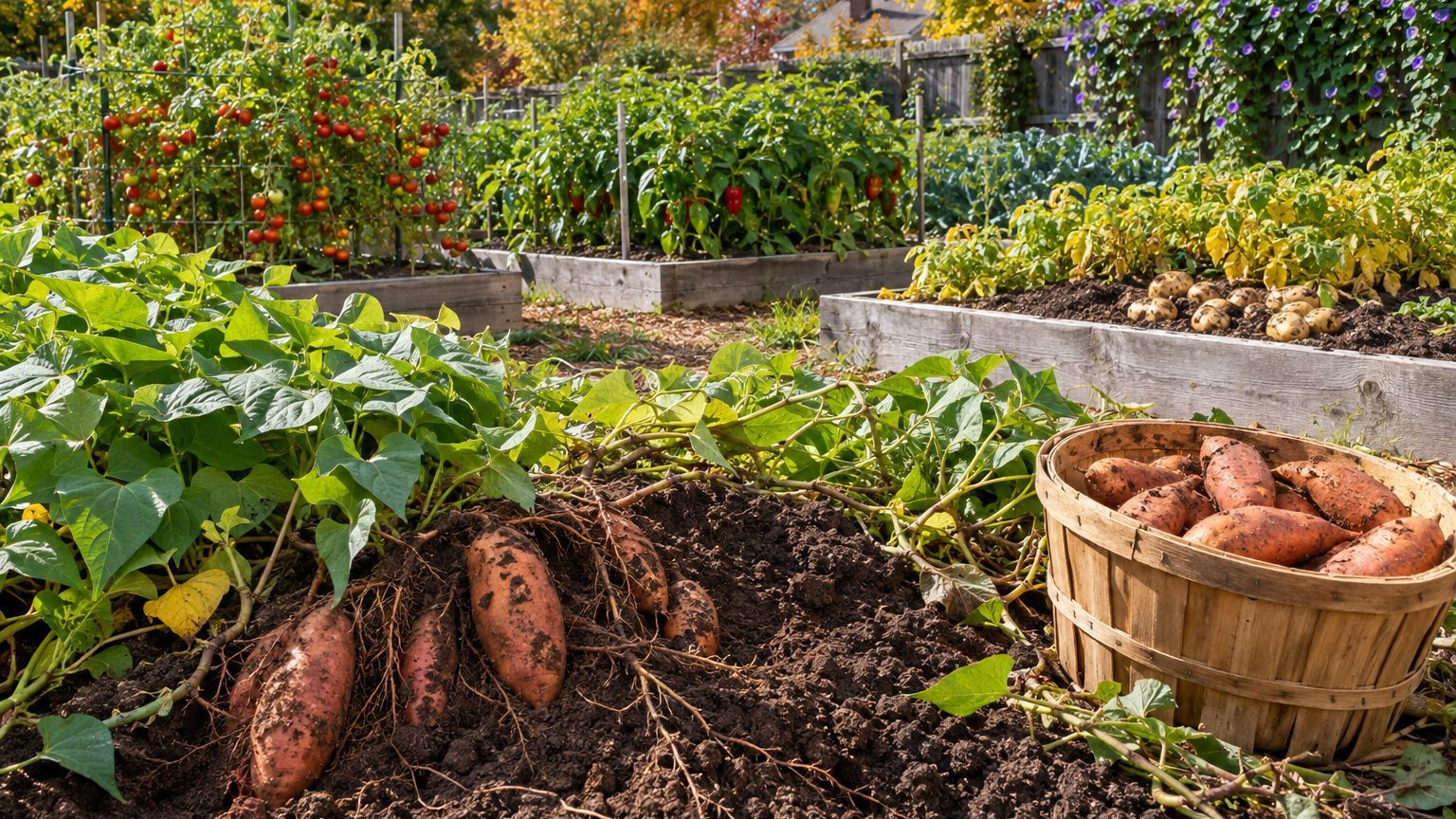

Sweet potatoes rotate with almost everything except their own kind. The plant belongs to the morning glory family, so the nightshade rules that govern potatoes, tomatoes and peppers do not apply to it. What does apply is a shorter list of soil-borne pests and rots that build up when the same ground grows the crop year after year. Build the rotation around those, and the rest of the garden can follow in whatever order suits it.
What is actually going on
The commonest rotation mistake with this crop comes straight from its name. “Potato” sits right there in the word, and the grocery store adds to the confusion by stacking orange-fleshed roots under a “yam” label. Neither name is right. Sweet potato (Ipomoea batatas) is a relative of the morning glory vine on a fence post and the bindweed in a neglected corner. Potatoes, tomatoes, peppers and eggplant are nightshades, a different family. True yams are another plant again, tropical, and rarely sold in an ordinary US produce aisle.
Why family drives rotation
Rotation works because pests and diseases are picky eaters. The blights, wilts and beetles that pile up in a nightshade bed are adapted to nightshades. A sweet potato is not on their menu. A bed that grew tomatoes last summer carries no family-based penalty for sweet potatoes, and the reverse holds too. Nobody needs to leave a three-year gap between a pepper patch and a sweet potato row.
That is the good news. The catch is that “no shared family” does not mean “any bed is fine.” Some pests ignore family lines. Root-knot nematodes feed on an enormous range of plants, nightshades and sweet potatoes among them. Wireworms and white grubs, the larvae that live in grass sod, chew on whatever root is available. So the question shifts from “what family was here?” to “what is living in this soil, and what did the last crop feed?”
The relatives that matter
Sweet potato’s own family does cause trouble. Wild morning glories and bindweed are close cousins, and in regions where the sweet potato weevil is established, those weeds can shelter it between crops. Clearing them from the bed edges is part of rotation, whether or not it feels like it.
The sweet potato’s own diseases, meanwhile, ride in on planting stock. A supermarket root is a poor starting point for reasons covered in What a Slip Is, and Why You Do Not Plant the Root, and clean slips are the first defense before any rotation plan begins. The wider picture of heat, planting and curing lives in Growing Sweet Potatoes: Slips, Heat, and a Careful Cure.
In the garden
The rotation table
Here is how the common bed histories play out, including what happens when the choice goes wrong.
| Bed history | Verdict | What goes wrong |
|---|---|---|
| Sweet potatoes again in the same bed | Avoid | Soil rot, scurf and other root diseases build up, along with nematodes and weevils where they occur. Roots come out pitted, cracked or misshapen, and harvests shrink each year. Because the vines above ground can look fine, the cause often goes unnoticed. |
| After potatoes, tomatoes, peppers or eggplant | Fine on family grounds | Nothing, unless root-knot nematodes or wireworms are in the soil. Then the roots turn up galled, stunted or tunneled, and the “shared problem” is the soil, not the family. |
| First year after sod or lawn | Risky | Wireworm and grub larvae feed on the forming roots. The tunnels are also an easy entry point for rot. Grow something else in newly turned sod first. |
| After a legume cover crop, fresh manure or a heavy feeder | Use caution | Too much nitrogen builds lush vines and thin roots. The crop does well on modest fertility. |
| Followed by corn, beans, onions, brassicas, squash or greens | Fine | Only leftovers cause trouble. Roots missed at harvest can resprout as volunteers in the next crop and carry disease with them. |
Filling the gap years
The number extension services most often give for a break between sweet potato crops in the same spot is around three to four years, and longer where disease has already shown up. A garden with four beds handles that naturally: sweet potatoes in one, then three other beds of anything else before it comes back around.
Gardeners with only one or two beds have a harder problem. Growing a grass-type cover crop in the off years is a reasonable break, since grasses do not host the sweet potato’s own diseases. Container growing avoids soil-borne buildup altogether if the potting mix is fresh each year and the pots are cleaned. A raised bed filled with garden soil, on the other hand, is still soil and follows the same rules.
What it depends on where you are
The national part
Some of this holds everywhere in the country. Sweet potato is a morning glory relative, so nightshade rotation rules do not apply. Its own diseases and soil pests build up in a bed that keeps growing it, so a multi-year gap helps. Volunteers and leftover roots need to come out. All of that comes from the plant’s biology, not from a map.
The local part
The rest changes from one county to the next, and this page does not know yours. Season length decides whether the bed is tied up all summer or empties early enough for a fall crop behind it. Summer heat affects which pests are active and how fast they multiply. Summer rainfall shifts the disease mix, because wet and dry soils favor different rots. The sweet potato weevil is a concern mainly in warm, humid parts of the country, and some areas restrict moving roots and slips because of it. Where you live decides whether it is on your list at all.
Even the sweet potato types worth growing vary. Compact bush-habit types suit small beds, long-vining types eat space, and short-season types matter more in cooler places. Which ones have actually been trialed and performed well near you is a question for your state’s cooperative extension service, and searching for your state name plus “extension sweet potato” usually gets you to it. Their local pest alerts also tell you if wireworms, nematodes or weevils are an issue in your area, which is exactly the information that sets the length of your rotation.
The state pages on this site carry the regional detail this page cannot, and they pair well with the extension service. Use the national logic here, then let the local sources tell you how strictly to apply it.
The mistake that costs the most
Planting sweet potatoes back into the same bed because the crop seems easy. That is the one error that quietly drains a harvest year after year.
Why it goes unnoticed
The logic is understandable. Someone learns that sweet potatoes are not nightshades and are not fussy about rotation with tomatoes. Someone else finds them a low-maintenance crop that grows happily in poor soil. Both points are true, and both lead people to conclude that the bed does not matter. It does, because the crop’s own problems accumulate. The damage is easy to blame on weather. Vines look healthy for the whole summer, then the roots come up scabby, pitted or underweight, and the gardener assumes it was a bad year and plants the same bed again. Each repeat makes the next harvest worse.
What to do instead
Keep a simple written map of where the crop grew, even a sketch on the back of a seed packet. Give the bed a break of at least the three to four years commonly advised, longer if roots came out with lesions or soft patches. Start each year from clean slips. At season’s end, lift every root you can find, and read Sweet Potato Vines: Leave Them or Lift Them before deciding what to do with the vines, since debris left in the bed carries disease forward. Any root that shows a soft patch or a weeping spot should be discarded, not saved and not composted into the garden.
Common questions
Can sweet potatoes follow tomatoes or potatoes?
Yes, on family grounds. Sweet potatoes are not nightshades, so the shared diseases do not apply. The one caution is soil pests like root-knot nematodes and wireworms, which attack both crops regardless of family.
How long before sweet potatoes can return to the same bed?
A break of about three to four years is the range extension services commonly recommend, longer if disease appeared. Your state’s cooperative extension service can tell you what is typical locally.
What should I plant after sweet potatoes?
Nearly anything outside the morning glory family: corn, beans, onions, brassicas, squash or leafy greens. Dig out leftover roots first, because a stray root that resprouts becomes a volunteer that carries disease into the next crop.
Does rotation change how I handle the harvest?
It does, because the same inspection that guides rotation guides storage. Look over every root, and if you find a soft patch or a weeping spot, the question is settled and that root goes. Cured roots belong in a warm, dry, ventilated place, never in a refrigerator or a cold cellar. Cold injury is irreversible, and it ruins more home crops after a good harvest than almost anything else.