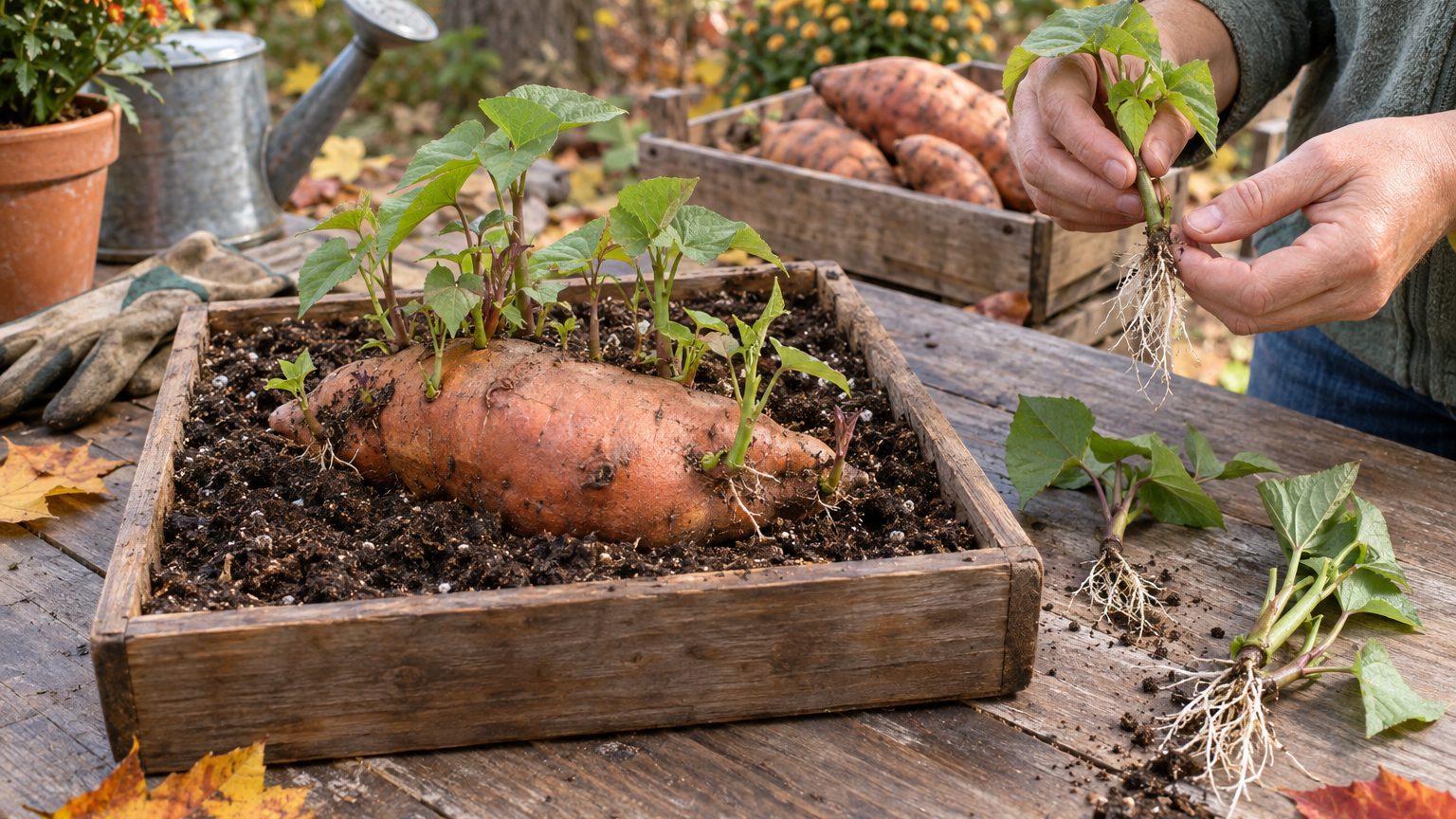

A slip is a leafy, rooted shoot that grows out of a stored sweet potato, and the slip, not the root, is what goes into the garden. The root you eat is the parent plant’s pantry. Bury it whole and you will most likely get a tangle of thin, stringy roots. Bed it in warm, damp material, let it throw shoots, and plant those instead.
What is actually going on
Gardeners talk about “planting sweet potatoes” the way they talk about planting potatoes, and that phrase is where the trouble starts. Sweet potatoes are grown by vegetative propagation, which means you clone the plant from a piece of itself rather than starting it from seed. The piece is the shoot. The stored root only exists to produce it.
Shoot, not root
Set a healthy sweet potato in warm, moist conditions and buds on its skin wake up and push out sprouts. Each sprout grows leaves above and, given a little time, its own roots below. That rooted sprout is the slip. Once it is in the ground, the buried nodes along its stem (the points where leaves attach) form new roots, and some of those swell into the sweet potatoes you will eventually dig. The old root contributes nothing to that harvest. It only got the shoot started.
That explains why the whole root does poorly in the ground. It sends up a crowd of shoots that compete for the same reserves. It sits in cool soil, where it is prone to rotting. And the roots that would have swelled never form in the right place, because the buds that make good storage roots sit on the buried stem, not on the old tuber.
Not a potato, not a yam
The confusion runs deeper than technique. A sweet potato is a relative of morning glories, not a nightshade. A potato tuber is a swollen underground stem, while a sweet potato is a swollen root, so the two crops play by different rules. They do not rotate with each other, they do not share the same pests in any dependable way, and advice written for one will mislead you on the other. The “yam” on the supermarket label is not a yam either. True yams are an unrelated group of tropical plants, and the name stuck to certain sweet potatoes through old marketing habits.
Why a grocery-store root is a gamble
Any sweet potato can sprout, so it is tempting to start one from a bag of roots. Some do sprout well. But roots sold for eating may have been treated to discourage sprouting, and they carry whatever diseases or pests rode along from the field. Slips from certified, disease-free stock start clean. If you do start your own from a root, the walkthrough is in Growing Your Own Slips From a Stored Root. Whatever root you choose, keep it warm. A refrigerator or cold cellar causes cold injury that cannot be undone, and an injured root sprouts poorly or rots.
In the garden
Once you have slips, whether you grew them or bought them, the job is to move them into the ground without letting them dry out or chill. Most failures at this stage come from small things that look harmless. The table below pairs each step with what happens when it goes wrong.
| Step | What right looks like | What happens when it goes wrong |
|---|---|---|
| Judging the slip | Stocky stem, healthy leaves, some roots or root buds showing, and a length you can bury at several nodes. | A pale, spindly, or blackened stem struggles to root. Slips with a slimy or discolored base can carry disease into your bed. |
| Handling on arrival | Unpack promptly, keep the bases moist, and plant soon. If you must wait briefly, stand them in shallow water in a shaded, sheltered spot. | Slips left in a sealed box or in sun wilt, cook, or rot. Wilted ones often recover, but each day of delay costs vigor. |
| Timing and soil | Plant after frost danger has passed and the soil has warmed. Sweet potatoes are a warm-season crop. | Cold soil stalls growth and invites rot. A slip that survives may sit and sulk for weeks while weeds move in. |
| Depth | Bury the lower stem so that several nodes are underground, with the top leaves in the air. | Too shallow means few roots form and the slip dries out. Buried to the leaves, it can smother and rot. |
| Watering in | Settle the soil around each slip and keep it evenly moist while it roots. | Dry soil sets the slip back. Waterlogged soil rots the buried stem before roots take hold. |
Two of these rows deserve a comment. First, wilting on arrival alarms new growers, but a limp slip with a sound stem is normal after shipping, and it usually perks up within a few days of planting and watering. A slip with a soft, dark stem is a different story and is not worth planting.
Second, depth is where the plant’s biology shows. Because the roots come from nodes, burying more of the stem gives it more chances to form them. Lay the slip in the soil at a slight angle or plant it deeply, whichever suits your bed, as long as leaves remain above ground.
After planting, moisture matters most in the first stretch, then changes. That pattern is covered in Watering Sweet Potatoes: Steady, Then Dry. For the full path from slip to harvest and cure, start at Growing Sweet Potatoes: Slips, Heat, and a Careful Cure.
What it depends on where you are
Some of this holds everywhere. A slip is a rooted shoot. The root stays out of the ground. Nodes go under the soil, leaves stay above, and cold does damage. Those are properties of the plant, and they do not change at a state line.
The calendar, though, is local, and this page does not know yours. Three things move the answer. The first is season length: sweet potatoes need a long warm stretch between planting and the first fall cold, and a gardener with a short season has less margin for late slips than one with a long season. The second is summer heat. Warm soil pushes slips to root quickly, while a cool, late spring holds them back even after frost has passed. The third is summer rainfall. A wet climate raises rot pressure and drainage becomes the main concern, while a dry one leans on your watering.
Those three factors together decide when you should start slips indoors, when to set them out, and whether a raised bed or a mound helps or is unnecessary. Guessing from another region’s advice is how people end up with slips ready in a cold garden or roots that never bulked up.
The best local source is your state’s cooperative extension service. Search for your state name plus “extension” and look for their sweet potato or vegetable guidance. Extension staff also know which types have been trialled where you live, which matters more than any national list, and they can tell you whether your state restricts moving sweet potato plants or roots across borders because of pests. That last point can affect where you are allowed to buy slips.
On this site, the state pages carry the regional detail this page leaves out. Use them for local timing and conditions, and treat the parent guide, Growing Sweet Potatoes: Slips, Heat, and a Careful Cure, as the common thread that connects them.
The mistake that costs the most
Planting the root. It is the most common error, and it costs the most, because it burns an entire season for a crop that cannot be replanted until next year.
It usually happens by accident of kindness. A sweet potato sprouts in the pantry, the shoots look alive and eager, and burying the whole thing feels like giving it a chance. What follows is predictable: a burst of vines, a rotting parent root, and a harvest of pencil-thin roots or nothing worth digging. The gardener then blames the soil or the weather, and the real cause never gets named.
What to do instead is a short chain. Take a firm, healthy root, one that shows no soft spots or weeping. Set it in a warm place, on or partly in a moist medium, and let the sprouts grow. When they are long enough to handle, twist or cut them off the root, leaving the parent behind. Root them briefly if they have no roots yet, then plant only the shoots, with the nodes buried. The parent root is done, so compost it if it is sound or discard it if it is not.
If you have already buried a whole root, you can still recover. Dig it up, keep it warm and damp, and harvest the sprouts as slips. A root that is soft, sour-smelling, or leaking fluid is finished. Throw it out, and do not use it as a slip source.
Keep any root you intend to sprout away from cold. Refrigerators and cold cellars cause chilling injury, and that damage is permanent. A root that sat there may look fine and still fail to sprout or rot from the inside.
Common questions
Can I plant a whole sweet potato and get a crop?
You might get vines and a few small roots, but you should not count on a usable harvest. The roots that swell come from buried nodes on a slip, not from the old root. Start the root indoors, harvest the sprouts, and plant those.
Is a slip the same as a seed potato?
No. A seed potato is a piece of stem tuber that you plant directly, and potatoes are nightshades. A slip is a rooted shoot from a swollen root of an unrelated plant. The two crops do not rotate with each other, and their planting methods differ.
Can I use a sweet potato from the grocery store to make slips?
Sometimes, but the results vary. Some roots are treated to discourage sprouting, and they may carry disease. Certified slips or roots from a trusted source give you a cleaner start. If you use a grocery root, pick a firm one and discard it at the first sign of softness or weeping.
How do I know which types suit my area?
Ask your state’s cooperative extension service, which knows what has been trialled in your climate. Local growers and nurseries that sell slips can also tell you what does well nearby. Think in types, such as moist or dry-fleshed and bush or vining, and let local experience narrow the list.