
Yes, sweet potatoes can be grown in New Brunswick, but the timing is tight and the margin for error is thin. Slips go out after the average last frost of May 23 at Moncton, and only once the soil has really warmed. Roots come out before the average first fall frost of October 2. Between those dates, expect to lean on black plastic, raised ridges and an early-maturing type.
When the soil is warm enough in New Brunswick

The average last spring frost at Moncton falls on May 23, according to Environment and Climate Change Canada’s 1981-2010 Climate Normals (station Moncton, climate ID 8103100). That is a mean, not a guarantee. In one year out of two the last frost lands later, so read the date as the middle of a window and never as a safe day to plant.
The frost date is also a proxy. Sweet potatoes do not care when the last frost happens. They care about warm soil, and soil lags behind the air. It warms after the frost risk ends, not at the same moment. A slip set into cold ground sits there, stalls, and often rots at the base before it ever puts out a new leaf.
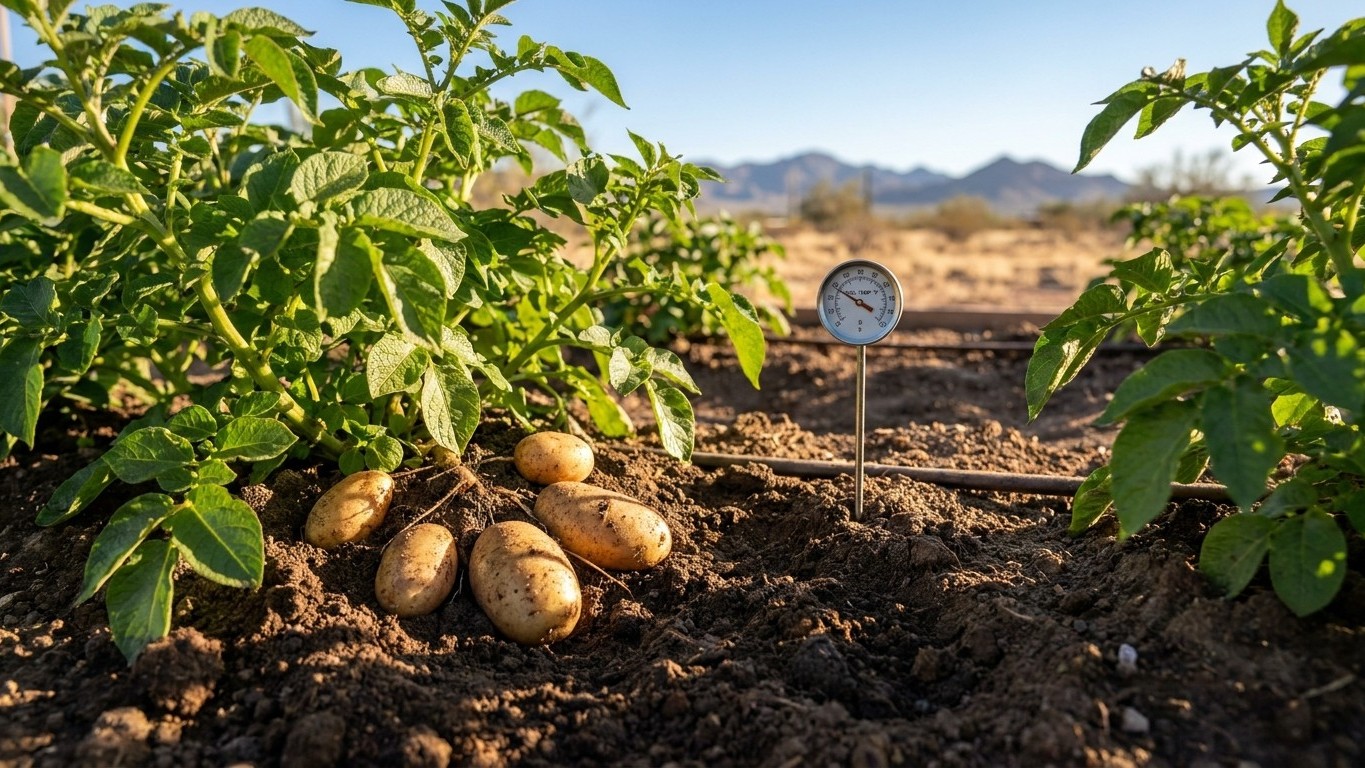
Air temperature is a poor guide to what is happening at root depth. Heavy, wet ground holds cold far longer than a sandy or loamy bed that drains freely. A pleasant, sunny afternoon in late May can sit on top of soil that is still chilly a few inches down. A soil thermometer settles the argument in about a minute. Take the reading in the morning, when the soil is at its coolest, and ask your slip supplier or provincial agriculture office what minimum they want to see.
Black plastic laid over the bed several days before planting is the standard trick in cool regions. It captures sun and pushes soil temperature up faster than bare ground. If you have never grown the crop, the full method for producing and hardening slips is in Growing Sweet Potatoes: Slips, Heat, and a Careful Cure.
Two caveats on the number itself. Moncton is one station, and a province is not one climate. Northern and upland districts of New Brunswick run weeks behind it, so a gardener up the Restigouche or on higher ground should add a margin. Canadian normals cover 1981-2010, while the US figures cover 1991-2020, so the two sets are not a like-for-like comparison.
One more point, because the grocery store muddies it. A sweet potato is not a potato, and it is not a yam either, whatever the label on the orange ones says. It belongs to the morning glory family, not the nightshades. Your rotation rules for potatoes, tomatoes and peppers do not apply to it, and the diseases that plague those crops are a different set.
How long the season lasts here
The average first fall frost at Moncton arrives on October 2, from the same station and the same 1981-2010 normals. Count from May 23 to October 2 and you get 132 days, a little under 19 weeks. Both ends are means, so the real window in any given year can be noticeably shorter or longer.
That number is generous for a northern garden and stingy for a crop from the tropics. The 132 days are also not all usable. Soil needs time to warm after May 23, so the working window starts later than the frost date, and you want roots out of the ground ahead of a hard frost rather than on the day it arrives. Frost-blackened vines are a signal to harvest promptly, not to wait and see.
What does a window of this length allow? One planting. Sweet potatoes are not sown as seed. They are set out as slips, rooted cuttings started indoors or bought in, and a second round of slips in July would be racing the fall frost with no cushion. I would not bet a bed on it. The whole season is one bet, placed once, so it pays to get the starting material right.
That is also where the root check earns its keep. A slip should show a healthy start of white roots or be ready to make them, with a firm stem and no dark, sunken lesions at the base. Skip the sad, limp ones. In a longer-season state, a failed planting can be replaced, but here a replacement set in late June is already behind. Harden slips off before transplanting, and set them out on a mild, overcast day if you can.
Heat and water in New Brunswick

Moncton A, the airport station, averages 1.0 day a year reaching 32 °C (the exact equivalent of 90 °F). It averages 4.6 days a year above 30 °C. Those are counts of hot days at one reference station outside the city, and airport stations read differently from neighbourhoods around them. They tell you extreme heat is rare, not that the season cannot deliver.
Take care with what that figure does and does not say. A count of scorching days is not a measure of the growing season. What decides whether a heat-loving plant succeeds is the length of the frost-free period and the summer means, and neither is captured by a single day above 32 °C. The sensible reading is this: the crop is not routine here the way it is in a hot state, so it becomes a project. That project involves plastic to warm the soil, ridges to drain and heat it, and an early type. Warm nights matter as much as warm afternoons, and these figures do not measure nights at all.
A cool, damp summer brings its own trouble, and this is what to watch for. Foliage stays wet and mildew moves in. Roots bulk up slowly. Soil-borne rots get a foothold in ground that never quite dries. Spacing the plants so air moves through the vines, and planting on ridges, is the practical answer to all three.
Rain is a reasonable ally. Moncton A normally receives about 10.5 inches (267 mm) across June, July and August, out of 1201 mm (47.3 inches) over the whole year. June runs to about 95 mm (3.73 inches) and July to about 92 mm (3.63 inches). The driest summer month is August, at 81 mm (3.18 inches). These are 1981-2010 normals for that station, so they describe what the region can usually expect, not a forecast.
Rainfall never reads alone, though. The same inch behaves differently on sand than on clay. A sandy bed lets it through within the day, so even a wet summer can still mean watering every second day. A clay bed holds it for a week, which suits a drought and hurts a crop that resents wet feet.
Sweet potatoes handle steady, moderate moisture well, and they crack when a long dry spell ends in a sudden soaking. Even watering through summer and easing off as harvest approaches reduces that risk. A cheap rain gauge on your own plot tells you more than any station 40 miles away. A slope, a shelter belt or a city block can shift the picture.
Which sweet potatoes suit New Brunswick
Choose by type, and start with the calendar. Moncton offers about 132 days between mean frost dates, less once you wait for warm soil, so the earliest-maturing types are the natural fit. Bush or compact-vined types also suit small beds and cool climates, since they tuck into a ridge without smothering their neighbours. Humidity is the other pressure. With summer rainfall in the range above and a damp maritime feel, disease resistance and certified disease-free slips should be first on the shopping list.
| What the numbers say | What to favour |
|---|---|
| A window of 132 days between mean frost dates | Earliest-maturing types |
| 1.0 day a year above 32 °C at Moncton A | Plastic mulch and ridges to build soil warmth |
| Summer rain of 267 mm, with a damp climate | Disease-resistant types and clean, certified slips |
The only recommendation that means anything is one from a variety trial run near you. A name pulled from a national catalogue might do well in Louisiana and sulk in Sackville. So ask which varieties have been trialled in New Brunswick, starting with the provincial department of agriculture and, as a working entry point, Agriculture and Agri-Food Canada.
Your hardiness zone will not settle the question either. Moncton sits in Canadian hardiness zone 5a, per Natural Resources Canada’s Plant Hardiness Site (1991-2020 normals). That is a Canadian zone, built on seven climate variables, and it does not convert to a USDA zone. Sweet potatoes are grown as an annual in any case, so the frost-free stretch matters more than winter minimums. If you are curious how the same crop plays out at other edges of the map, Growing Sweet Potatoes in Prince Edward Island covers a neighbouring maritime climate, and Growing Sweet Potatoes in Yukon shows the far northern extreme.
A last word on the harvest, because a good crop can be lost after digging. Freshly dug roots need a warm, humid cure before storage, so plan your final dig around settled weather rather than a forecast night of frost. Then store them somewhere ordinary and dry, never in a refrigerator and never in a cold cellar. Cold injury below the proper storage range is real and permanent, and it is the most common way a good home crop is ruined. Inspect every root. A soft patch or a weeping spot ends the question, and a root that merely looks sound proves little. Do not promise yourself a storage time, and eat the doubtful ones first, or discard them.
Common questions
Can you really grow sweet potatoes in New Brunswick?
Yes, with a plan. The average frost-free stretch at Moncton runs about 132 days between mean frost dates, and heat spikes are rare. Plastic, ridges and an early-maturing type make up for what the climate does not hand over.
When should I plant slips?
After the soil has warmed, which comes after the average last frost of May 23 at Moncton. In one year out of two the last frost falls later than that date, and districts north of Moncton run weeks behind. Use a soil thermometer rather than the calendar.
Are sweet potatoes the same as yams or potatoes?
No. They are not yams, despite the supermarket label, and not potatoes. They are in the morning glory family, not the nightshades, so potato rotation rules do not apply.
Can I keep the roots in the fridge or a cold cellar?
No. Cold injury below the storage range is irreversible. Cure the roots warm, store them somewhere ordinary, and inspect regularly. Any soft or weeping root should be discarded.