
Sweet potatoes can grow in Newfoundland and Labrador, but only as a deliberate project. At St. John’s airport the last spring frost falls on average May 30, the first fall frost on average October 17, and the thermometer did not reach 32 °C once in the 1981-2010 record. Plan on slips, plastic and an early type, all planted well after the frost date. The general method for slips, heat and curing still applies.
When the soil is warm enough in Newfoundland and Labrador

The date most gardeners look up first is the last spring frost, and for St. John’s it is May 30. That is the average from Environment and Climate Change Canada’s 1981-2010 normals at the ST JOHN’S A station, the airport. An average is a midpoint. In one year out of two the last frost lands later, so read May 30 as the middle of a window, not a safe date. The figure also belongs to one station. Northern and upland districts run weeks behind it.
The frost date is a proxy, not the trigger
A frost date measures air. Sweet potatoes, which come from the tropics, respond to soil. Ground warms more slowly than air, so it reaches planting condition after the frost risk ends, not on the same day. A slip set into cold, wet ground sits there and stalls, and a stalled slip in a short season is a summer partly lost.
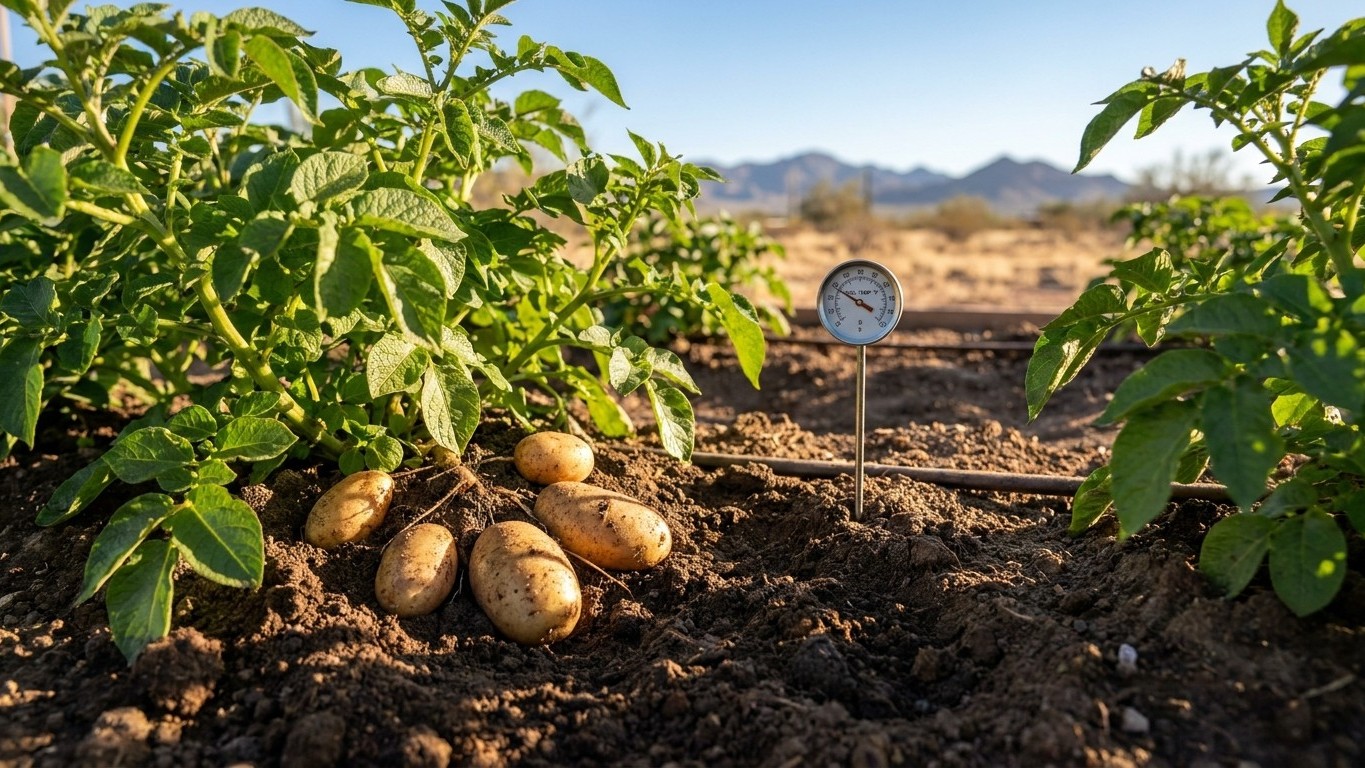
The practical check is a soil thermometer at planting depth, read in the morning for several days running. Plant when the readings hold, not on the first sunny afternoon. Black plastic laid over the bed ahead of planting speeds the warming. Your provincial agriculture office can tell you the soil reading to wait for in your district.
Do not run this crop like potatoes
Newfoundland gardeners grow potatoes well, and that habit misleads here. A sweet potato is not a potato. It is not a yam either, whatever the supermarket label says. It belongs to the morning glory family, so it is not a nightshade and does not share a rotation with potatoes. It is also planted differently. Potatoes go in as seed pieces in cool spring soil, while sweet potatoes go in as rooted vine cuttings called slips, late and into warm ground.
The provincial office is the place to ask which ones have actually been trialled locally.
How long the season lasts here
Count from May 30 to October 17 and you get 140 days between the two average frost dates at St. John’s A. Both are means from the same 1981-2010 Canadian normals. The fall date is a midpoint too, so in about half of years frost arrives earlier than October 17 and the window closes sooner.
That 140 days is also not the crop’s window. Slips cannot go out on May 30. They go out once the soil has warmed, which trims weeks from the front. The usable season is noticeably shorter than the frost-to-frost count.
One planting, not two
A long window lets a gardener plant twice and stagger the harvest. A window this short means the first planting is the only one. Here, sweet potato is not one of those crops.
The short window also settles the transplant question. Every week counts, so the root check before planting is worth the time. Look at each slip before it goes in the ground. A slip already showing roots picks up growth quickly, while a bare cutting may spend a week or two rooting in the bed, and that is a large slice of a summer this short. Slips that arrive without roots can be rooted in water or damp medium indoors first.
What hardiness zone 6a does and does not say
St. John’s sits in Canadian hardiness zone 6a, according to Natural Resources Canada’s plant hardiness site (1991-2020 normals). That is the Canadian system, built on seven climate variables. It does not convert to a USDA zone, and NRCan itself says there are no simple conversions. For a sweet potato, the number matters little anyway. Zones describe winter survival, and this is a tender plant grown as an annual. Frost dates and summer heat are the figures that decide the crop.
Heat and water in Newfoundland and Labrador

Sweet potatoes want accumulated warmth and warm nights, not just a few hot afternoons. At St. John’s A, the count of days reaching 32 °C over 1981-2010 is zero. The daily record is complete, and the thirty-year maximum stayed below that mark. The 30 °C count is only 0.16 days a year, roughly one day every six years. Heat of this order simply does not occur at that station.
That is a statement about one airport, not the whole province. Sheltered inland gardens may run warmer, though those figures are not in the data used here. Where a state has many hot days, as on the Alabama page, the crop is routine. Where the count is near zero, it becomes a project. The gardener has to bring the heat, which means plastic, ridges and the earliest types.
What a cool, damp summer brings instead
Rainfall at the same station is about 290 mm (11.4 inches) across June, July and August, and 1534 mm (60.4 inches) over the year. July is the driest summer month at 92 mm (3.61 inches). June runs about 98 mm (3.84 inches) and August about 100 mm (3.94 inches). With low heat, little water evaporates, so beds stay wet. The likely problems are mildew on the foliage, slow ripening and rot in waterlogged ground. The splitting that comes from a drought followed by a soaking is the lesser worry.
Soil changes the picture. A sandy bed lets an inch of rain through within a day, while a clay bed can hold it for a week. Roots swell steadily in soil that stays evenly moist but never soggy. These normals describe what the station can usually expect, not your plot. A rain gauge in your own garden settles it.
Cool-summer tactics come down to a short list:
- Black plastic mulch over the bed before planting
- Raised ridges or beds for drainage and faster warming
- Row cover or a low tunnel in the first weeks
- The sunniest, most sheltered spot on the property
- The earliest-maturing type you can source
For a cool-summer comparison inside the US, the Washington page is a useful read, though its normals cover a different period and are not directly comparable.
Which sweet potatoes suit Newfoundland and Labrador
A variety that performs well in a long, hot season can sulk through a 140-day window and a summer with almost no heat. A wrong guess costs a whole growing season.
Types are safer to reason from, and the station figures point in three directions:
| What the St. John’s A figures say | Type to favor | Reason |
|---|---|---|
| 140 days between average frosts, fewer once the soil warms | Earliest-maturing types | Every week of the short season counts |
| No days at 32 °C, 0.16 days a year above 30 °C | Compact vines that fit under plastic or a tunnel | The gardener supplies the warmth |
| About 290 mm of summer rain, 1534 mm a year | Disease-resistant types, spaced for airflow | Wet foliage and soil invite mildew and rot |
Ask where the trials were run
The only recommendation that means anything is one from local trials. Contact the provincial agriculture office through the Government of Newfoundland and Labrador agriculture pages. Ask which types have been tried in your district, where slips can be sourced, and whether any plant-import rules apply.
Choosing an early type also protects the back end. Harvest before a hard frost, then cure the roots somewhere warm. Never store Sweet Potatoes in a refrigerator or a cold cellar. Cold injury below their storage range is irreversible, and it is the most common way a good home crop is ruined. Before anything goes into storage, inspect each root. A soft patch or a weeping spot ends the question, however sound the rest looks.
Common questions
Can I grow sweet potatoes outdoors in Newfoundland without a greenhouse?
It is possible in principle, but marginal. With no days at 32 °C at St. John’s A and a short window, plastic, ridges, an early type and a sheltered spot do the work a hot summer would do elsewhere. Start with a few plants as a trial, not a whole bed.
Is a sweet potato the same as a yam or a potato?
No to both. It is a relative of morning glory, not a nightshade, so it does not rotate with potatoes. True yams are a separate, unrelated crop. The “yam” label in many supermarkets is simply wrong.
Should I buy slips or sprout a grocery-store root?
Slips from a supplier are the more dependable route, and the provincial agriculture office can say what sources and import rules apply. A short season leaves no room for a slow start. A slip that arrives already rooted, or one you root indoors first, wastes less of it.
Where can I keep the harvested roots?
Not in a refrigerator or a cold cellar, where cold injury cannot be reversed. Cure the roots warm first, then check them often. A soft patch or a weeping spot on any root means it should not be eaten, and one bad root can spread to the rest.