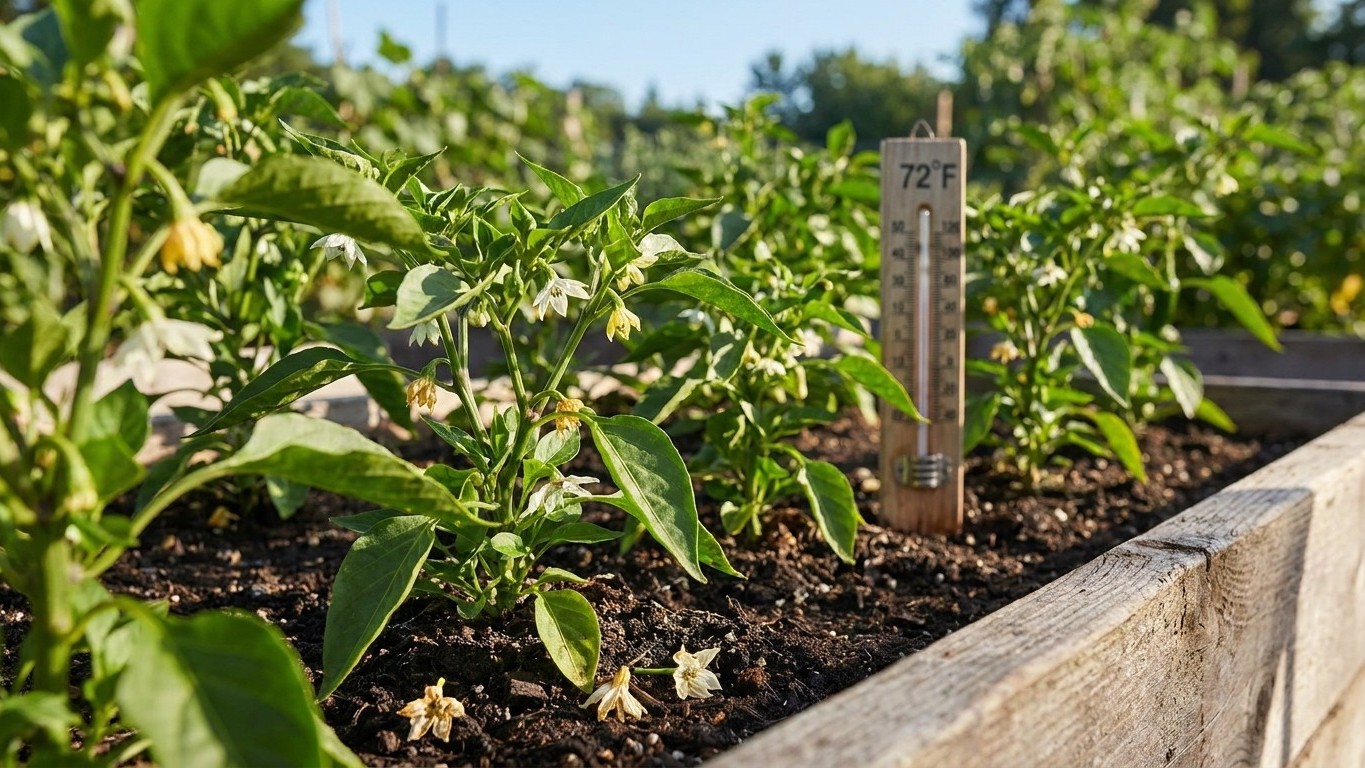

In most of Pennsylvania, pepper seed goes into trays indoors somewhere between early and mid-March, with transplanting outdoors held until after the last frost and once soil has warmed to 60 F, usually late April to mid-May depending on where you garden. That’s the arithmetic behind the calendar. The rest of this piece explains why that window shifts by county and what can still go wrong even when the timing looks right.
The short answer
Philadelphia, used here as the reference station for the state, averages 24.0 days a year at or above 90 F, according to NOAA NCEI Climate Normals for 1991-2020. That number matters more than most gardeners realize. Peppers stop setting fruit when daytime highs climb past 90 F, so every one of those 24 days is a day when blossoms can drop instead of turning into peppers. In a normal Pennsylvania summer, that’s not a constant threat, it’s a recurring one, usually clustered into a handful of hot stretches in July and August rather than spread evenly across the season.
That’s the hot end of the problem. The cool end is just as real, and it works in the opposite direction: pepper fruit set also fails when nights drop below 55 F. Cool nights are common in Pennsylvania in early spring and again in early fall, which is exactly when a lot of gardeners are tempted to rush transplants outside or push the harvest a few extra weeks. This site tracks days at or above 90 F for the state, but it does not carry summer night minima, meaning there’s no published figure here for how many nights in your area actually drop below 55 F in June, July, or August.
That gap matters because Pennsylvania is not one climate. A valley in the Alleghenies can see 55 F nights well into June, while a spot in the Philadelphia suburbs may not see one after Memorial Day. Elevation, proximity to ridgelines, and even how close you are to a river or a paved area can shift nighttime lows by several degrees from what a regional average suggests. None of that can be reliably guessed from latitude alone or from how cold your winters run, so the only dependable move is to watch your own nighttime lows through a home thermometer or a nearby weather station during the growing season, rather than assume the state average applies to your yard.
Put together, the short answer is that Pennsylvania pepper growers are managing a narrower fruit-set window than the frost-free season implies. The days above 90 F give you a real, sourced number to plan around. The nights below 55 F are just as important to fruit set, but they’re a number you’ll have to track yourself, plot by plot, season by season.
When to start seed here
Working out a start date is mostly working backward from your transplant date, and the transplant date itself depends on two separate conditions that don’t always line up. Here’s the sequence, in the order you’d actually walk through it:
- Find your last spring frost window. For the Philadelphia area, NOAA NCEI’s 1991-2020 freeze probability data puts the last spring frost between March 29 and April 6. Philadelphia is the mildest corner of the state, so the northern tier and the Alleghenies typically run two to four weeks later, pushing the last frost closer to mid-to-late April in those regions.
- Confirm soil temperature, not just the calendar. Even after the frost date passes, peppers need soil at 60 F before transplanting does any good. Air can warm up well ahead of soil, especially in a cool, wet spring, so a soil thermometer pushed a few inches into the bed is worth more than trusting the date alone.
- Set your transplant date at whichever of those two comes later. If your last frost falls in early April but soil doesn’t hit 60 F until early May, early May is your real transplant date. In much of Pennsylvania outside the Philadelphia corridor, that soil threshold, not the frost date, ends up being the deciding factor.
- Count back 8 to 10 weeks from that transplant date for your indoor sowing date. This range comes from Utah State University Extension’s guidance on starting peppers indoors. If you’re transplanting in early May, count back 8 to 10 weeks and you land on early to mid-March for sowing seed indoors.
- Adjust for your specific county. A gardener near Erie or in the higher elevations of the Alleghenies working with a mid-May transplant date would push seed-starting into mid-to-late March instead, keeping the same 8-to-10-week gap but shifting the whole sequence later.
The logic holds regardless of where in the state you garden, because it’s built on your own frost date and your own soil, not a fixed date on a seed packet. That’s also why two gardeners forty miles apart in Pennsylvania can have a two-week difference in when they should be starting seed.
What goes wrong here
Even with the timing worked out, Pennsylvania’s climate creates a specific set of failures that show up on peppers more than on most other vegetables in the garden.
- Blossom drop from a hot spell. Once daytime highs push past 90 F, which happens on average 24.0 days a year around Philadelphia, blossoms can fall off the plant before they ever set fruit. There’s no fix once it happens, but afternoon shade cloth during the hottest stretches and consistent watering going into a heat wave reduce the stress that triggers the drop.
- Blossom drop from a cool night. The opposite problem hits when nights fall below 55 F, most often in late spring right after transplanting or again in early fall. Because summer night minima aren’t tracked on a regional basis here, the only reliable defense is watching your own overnight lows and delaying transplant, or covering plants on unusually cool nights, rather than assuming the season is warm enough just because the calendar says June.
- Sunscald on exposed fruit. Pennsylvania summers bring enough strong, direct sun that peppers left without leaf cover can develop pale, blistered patches on the side facing the sun. Keeping the plant’s own foliage intact, rather than aggressively pruning leaves, gives fruit natural shade and cuts down on scald.
- Blossom-end rot from uneven watering. This shows up as a dark, sunken spot on the bottom of the fruit and usually traces back to a calcium uptake problem caused by inconsistent soil moisture rather than a soil calcium shortage itself. Deep, regular watering on a set schedule, especially through the same hot stretches that cause blossom drop, keeps this from taking hold.
Common questions
Can I start pepper seed earlier than 8 weeks to get a head start?
Starting much earlier than the 8-to-10-week window from Utah State University Extension usually backfires. Plants held indoors too long before conditions outside are ready become leggy and root-bound in their trays, and they often transplant worse than seedlings started on schedule, not better.
Does soil temperature really matter more than the frost date?
In much of Pennsylvania outside the Philadelphia area, yes. A frost-free date doesn’t mean the soil has caught up, and peppers transplanted into soil below 60 F tend to stall rather than grow, even if the air temperature feels warm enough.
How do I know if my nights are staying below 55 F?
Since this isn’t tracked on a regional basis here, the only dependable method is a simple outdoor thermometer, checked in the evening and again before sunrise, over the first few weeks after transplant and again as fall approaches.
Is 24 days above 90 F a lot for pepper growing?
It’s enough to matter, but it’s not evenly distributed. Most of those days cluster in July and August, so plants set fruit fine in the cooler stretches around them, with losses concentrated in whatever heat waves actually arrive that season.