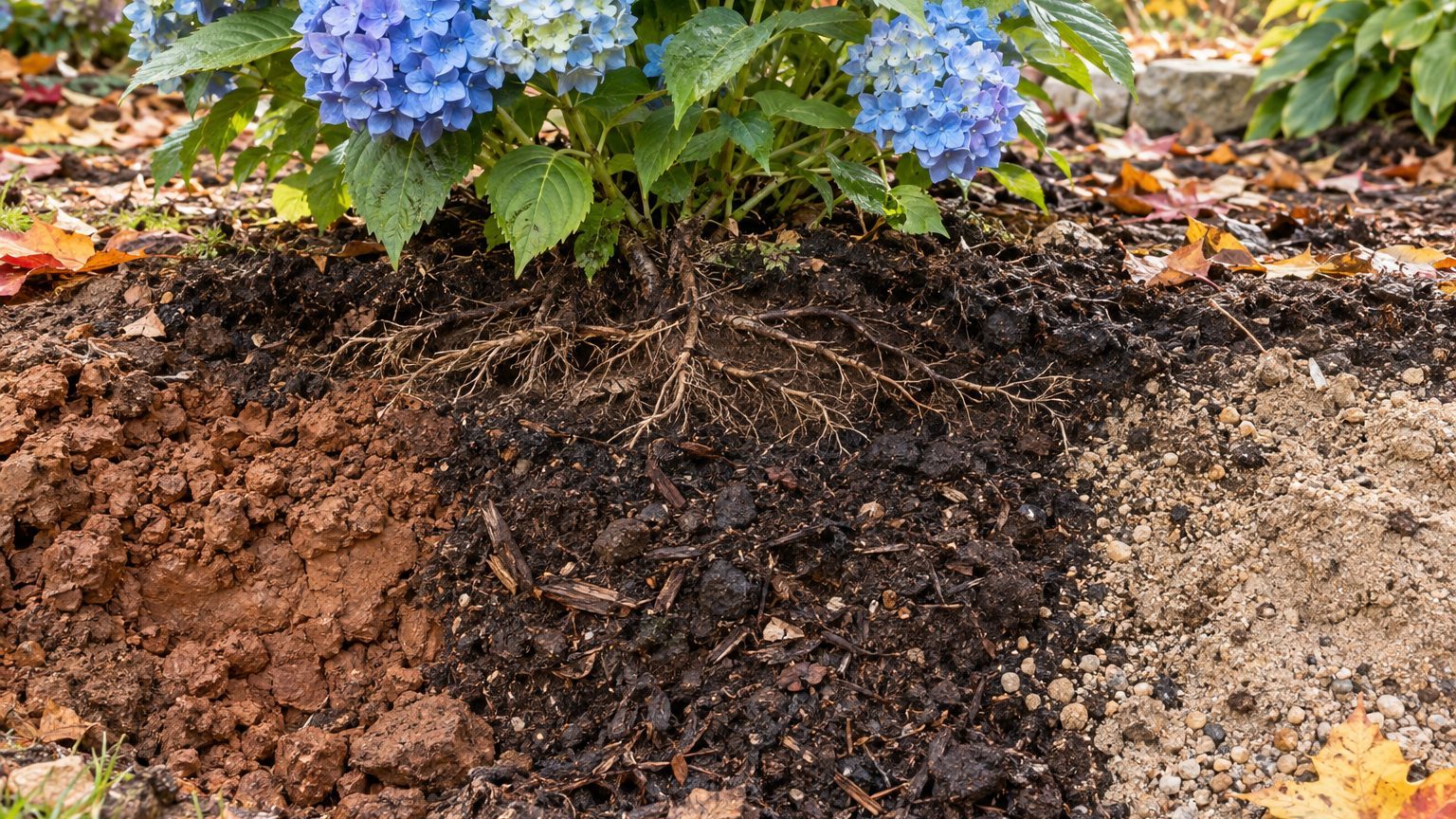

Most hydrangeas grow in clay, loam or sand, as long as water drains and the ground is rich in organic matter. Soil pH only steers flower color on bigleaf (mop-head and lacecap) and mountain types. On panicle, smooth, oakleaf and climbing hydrangeas, acidifying or liming does nothing to the blooms. So the job is mostly drainage and organic matter, with pH adjustment as an optional extra for two types.
Why this matters
Bigleaf and panicle hydrangeas are both shallow-rooted, which explains most soil problems. Their roots sit in the top layer, so that layer has to hold moisture without staying soggy. NC State Extension lists clay, loam or sand as acceptable, and says “occasionally wet” is fine. Ground that stays saturated is not. Compost or leaf mold in that top layer evens out both extremes: it helps sand hold water and opens up clay so water can leave.
Color is the other piece. In bigleaf and mountain hydrangeas, blooms are blue below about pH 5.5, pink above about pH 6.5, and purple in between. The mechanism is aluminum. Acidic soil releases it so the plant can take it up, and neutral or alkaline soil locks it away. Skip the soil work and a plant you bought in blue can drift to pink within a season or two. If the plant sulks at midday, the cause is often heat rather than soil. The guide on why a hydrangea wilts in the afternoon and recovers by morning helps sort out which it is. The main hydrangea guide covers the rest of the crop.
When to do it
Follow the plant’s own stages, not the calendar. The best window for building soil is before roots go in: at transplanting, when you can work the whole planting area. A hydrangea that is already established can’t be dug around without damaging those shallow roots, so it gets top-dressing only.
For color changes on bigleaf and mountain types, start when new growth is pushing out, since that is when the plant is actively drawing up water and whatever is dissolved in it. Bigleaf buds form the previous summer, so a change made now shows up in this year’s flowers only partly and fully in the next round. Watch the blooms as they open. If last year’s blue is coming in purple or pink, the soil is drifting up in pH or the fertilizer is binding aluminum.
Signs that drainage needs attention appear at any stage: water pooling around the crown after rain, yellowing leaves, wilting that does not recover overnight. During the first year of care, watch these closely, because a young plant has fewer roots to cope with wet feet. Pruning dates and hardiness verdicts depend on your zone and hydrangea type, so check your state’s page in this guide for those.
How to do it

Test before you amend
Test the soil where the plant will sit. A home kit is enough for a rough reading, and a lab test through your county extension office is more precise. Guessing wastes effort, because acidifying already-acid soil or liming already-alkaline soil accomplishes nothing. Then check drainage: dig a hole about the size of the root ball, fill it with water, and see whether it empties as the rest of the yard drains. If it sits there long after that, fix drainage before touching pH.
Build the soil, not a pit
Dig the planting area wide and no deeper than the root ball. Blend compost, leaf mold or fine shredded bark into the native soil you removed, until the backfill looks like dark, crumbly garden soil with some body to it. It should not look like bagged potting mix. This page publishes no set ratio, and you don’t need one: a backfill that reads as “native soil, improved” is right. In heavy clay, spread the amendment across a broad area, or plant a little high, so roots can leave the hole. For a plant already in the ground, spread compost over the surface and cover it with mulch. Both bigleaf and panicle hydrangeas benefit from mulch. Keep it off the stems, and let earthworms do the mixing.
Move color only where it applies
Only bigleaf and mountain hydrangeas respond. For blue, aluminum sulfate acidifies the soil and releases aluminum. Dissolve it in water and apply to moist soil at the rate on the product label, since this page does not publish a dose. For pink, lime makes soil more alkaline. Rather than trying to push soil pH up or down forever, decide which color you want and stay consistent.
Watch your fertilizer as well. High-phosphorus formulas lock aluminum up in the soil, which pushes blue flowers toward pink. A feeding decision shows up as a color problem. Retest after a full growing season. If soil that started neutral to alkaline keeps drifting back, a large container may be the more practical way to hold blue.
What goes wrong

The most common error is treating the wrong plant. Acidifying a panicle, smooth, oakleaf or climbing hydrangea is wasted effort: those go white, cream, pink or green as the season ages, whatever the soil. If you did it and nothing changed, the type was never going to respond.
Next come the kitchen remedies. Coffee grounds and citrus peel are widely believed to turn hydrangeas blue, and NC State’s plant profile repeats the idea. In practice the pH shift they cause is very small. What the plant needs is available aluminum, which real acidity releases. A sprinkle of grounds rarely moves soil enough to change the flowers, so people conclude their soil is stubborn when they simply used a weak tool. Grounds are fine as compost material, just not a color method.
The mistake that looks like extra care: filling a generous hole with rich, fluffy amended soil in heavy clay. It feels generous. But water drains into the improved pocket, then stays there, because the surrounding clay will not take it. The result is a bathtub, and roots in it turn yellow and wilt without recovering overnight. Feeding heavily with a high-phosphorus fertilizer is the same kind of trap, since it also shifts blue flowers to pink. A similar case is more aluminum sulfate than the label calls for. Shallow roots burn easily, and leaf edges browning after an application points to that.
Doing it differently
Containers give you the most control. A small volume of potting mix is easy to acidify or lime, so holding blue or pink is more realistic there than in the ground. Drainage holes matter more than the mix itself, and the pot needs more frequent watering. In a raised bed, drainage is mostly solved by the bed itself, which makes it a good answer for heavy clay. Fill it with a loamy blend with plenty of organic matter.
The variation that matters most is type. Here is how the soil question changes:
| Type | Color responds to pH? | Flowers on |
|---|---|---|
| Bigleaf (H. macrophylla) | Yes | Last year’s wood |
| Mountain (H. serrata) | Yes | Last year’s wood |
| Panicle (H. paniculata) | No | Current season’s growth |
| Smooth (H. arborescens) | No | New wood |
| Oakleaf (H. quercifolia) | No | Old wood |
| Climbing (H. petiolaris) | No | Old wood |
For the four types with no color response, skip pH work and concentrate on drainage and organic matter. Panicle is the one that takes full sun well, so it may also dry out faster and reward extra mulch.
Common questions
Do hydrangeas need acidic soil?
No. NC State lists acid, neutral and alkaline soils as workable. Acidity only matters if you want blue flowers on a bigleaf or mountain hydrangea.
Can I turn my panicle hydrangea blue?
No. Panicle hydrangeas do not change color with pH. They age from white toward cream, pink or green whatever the soil is like.
Do coffee grounds make hydrangeas blue?
Rarely. The pH change from grounds is very small, and blue depends on available aluminum. Aluminum sulfate is the reliable tool, applied to the label rate.
How do I fix clay soil for hydrangeas?
Blend compost or leaf mold into a wide planting area, not a small pit. Then mulch. Bigleaf and panicle roots stay shallow, so surface improvements reach them.